Artwork
Tea Party
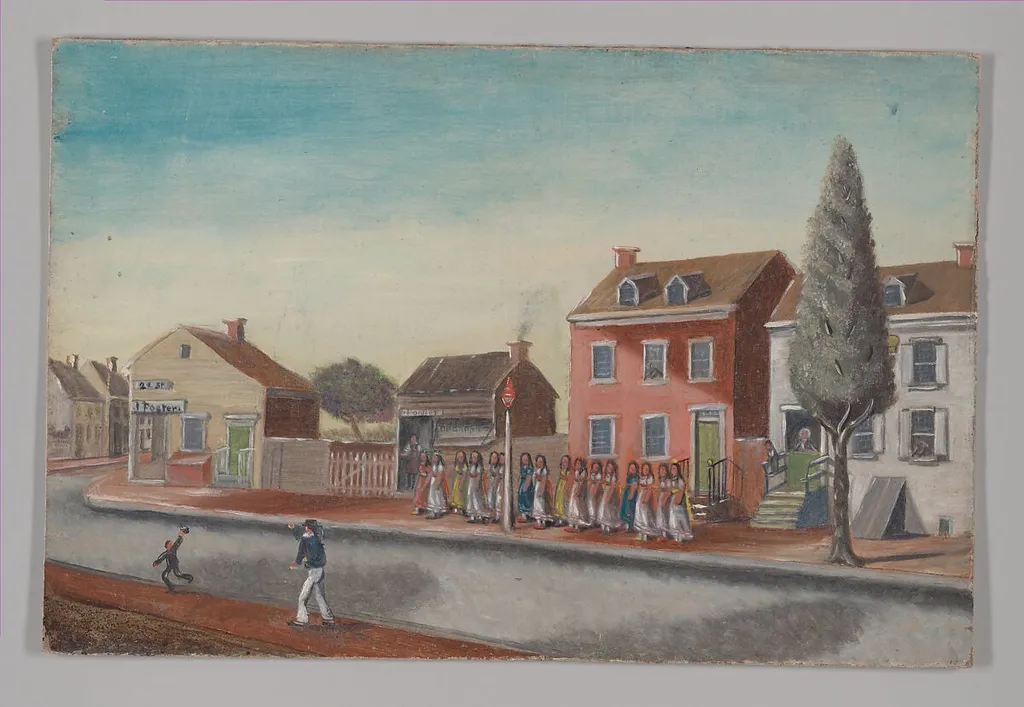
Tea Party is an oil painting by the American Folk Art artist William P. Chappel. It dates from 1874 and is held in the collection of the Metropolitan Museum of Art. Painted in 1874, William P.
About this work
Subject & Meaning
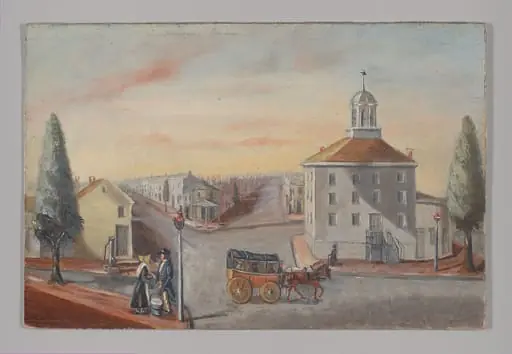
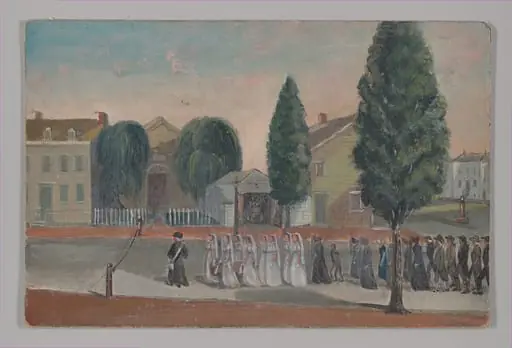
The composition includes a man, a woman, a tree, the house façade, and the surrounding street, all rendered in oil on slate paper.
Tea Party (1870) by William P. Chappel is a genre scene portraying a domestic encounter outside a house on a city street. The composition includes a man, a woman, a tree, the house façade, and the surrounding street, all rendered in oil on slate paper. The presence of these elements situates the work within a typical 19th‑century American streetscape, where the house and tree suggest a blend of private and public space, while the figures imply a moment of social interaction.
As part of The American Wing’s collection at the Metropolitan Museum of Art, the painting reflects contemporary interests in everyday urban life and domestic leisure.
Technique & Style
Created in 1870, William P. Chappel's Tea Party is executed in oil paint applied to a slate paper support. The work measures 15.6 cm in height and 23.7 cm in width. Classified as a genre scene, the painting depicts a domestic exterior featuring a house, street, and trees populated by a man and a woman.
The piece is currently held within The American Wing collection at the Metropolitan Museum of Art. While the specific handling and current physical condition are not detailed in the available records, the medium of oil on slate paper suggests a distinct surface quality compared to traditional canvas or panel works of the period.
History & Provenance
William P. Chappel painted Tea Party in 1870, as documented by both the Metropolitan Museum of Art and supporting scholarship. The work was executed in oil on slate paper, a technique consistent with Chappel’s genre scenes of this period. There is no evidence of a specific commission; rather, the painting appears to have been created independently by the artist.
Since its creation, Tea Party has been part of the collection of the Metropolitan Museum of Art, where it remains housed as of the latest records.
William P. Chappel's 1870 oil painting Tea Party is held in the collection of the Metropolitan Museum of Art. The work is classified within the museum's American Wing. While the provided sources confirm the painting's presence in the Met's collection and its creation date, they do not disclose a specific inventory or accession number.
Regarding exhibition history, the available documentation lists the artwork's physical location and attributes but contains no record of specific past exhibitions or display schedules. The painting depicts a genre scene featuring a house, street, and figures, with dimensions recorded as 15.6 by 23.7 units.
Overview
Painted in 1874, William P. Chappel's Tea Party depicts a quiet domestic scene featuring three women in long skirts and bonnets seated around a small table in a sunlit parlor. The figures are engaged in the act of drinking tea, captured with a sense of stillness and intimacy. Chappel executed this work on slate paper rather than traditional canvas, a choice that provided a smooth, non-absorbent surface conducive to his precise technique.
This support allows for the rendering of minute, crisp details, such as the delicate lace patterns on the tablecloth and the reflective highlights on the teapot. As a genre scene from the late 19th century, the painting reflects the era's interest in documenting everyday middle-class life and domestic rituals. The composition focuses on the interaction between the figures and the textures of their immediate environment, emphasizing the quiet elegance of the setting.
Chappel, an American artist active during this period, utilized this specific medium to achieve a level of finish and clarity that distinguishes the work within his oeuvre and the broader context of American genre painting of the time.
Context
Created in the 1870s, "Tea Party" reflects a broader artistic trend in America towards genre scenes that documented contemporary life. The depiction of a domestic interior and social gathering aligns with an interest in portraying the evolving social fabric and everyday experiences of urban residents, particularly in cities like New York. Such works often served as visual records of the era's customs and environments.
Artist & collection