Artwork
"Snap-the-Whip"
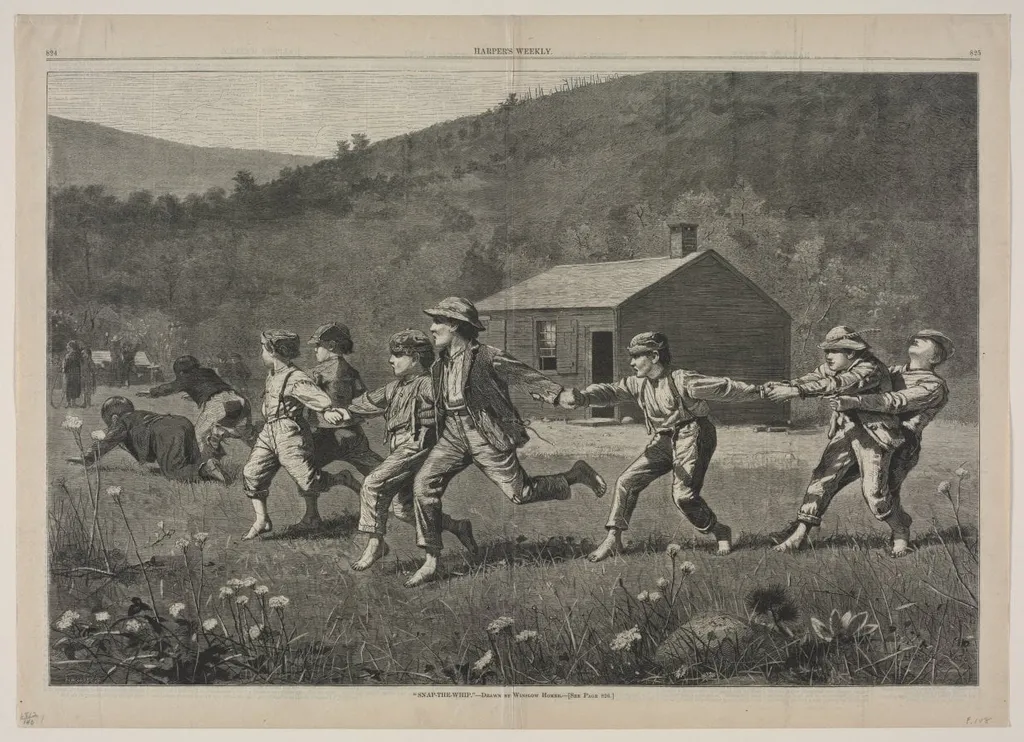
"Snap-the-Whip" is a print by the Impressionist artist Winslow Homer. It dates from 1873 and is held in the collection of the Cleveland Museum of Art.
- Accession no.
- 1942.1309
- Credit line
- Purchase from the J. H. Wade Fund
About this work
Overview
It captures a moment of unstructured childhood play in a rural setting, rendered with brisk, confident lines that convey motion and spontaneity.
Winslow Homer’s 1873 work 'Snap-the-Whip' is a black-and-white illustration originally created for publication in a periodical. It captures a moment of unstructured childhood play in a rural setting, rendered with brisk, confident lines that convey motion and spontaneity. Unlike his later oil paintings, this piece reflects his early work as a commercial illustrator, prioritizing clarity and narrative immediacy over textured finish.
Subject & Meaning
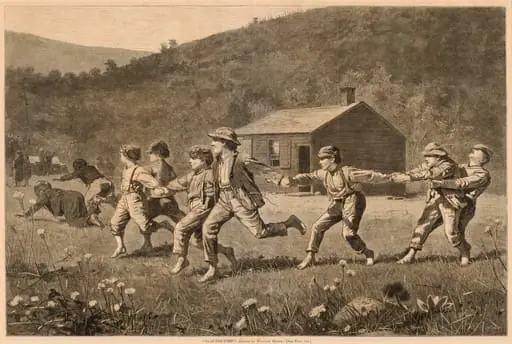
The scene depicts a group of boys playing 'snap-the-whip,' a game where children form a line and swing one another in a circular motion, often causing the end participant to be flung forward. One boy lifts his leg mid-stride, suggesting the moment of release. The presence of adults in the background implies a watchful, passive community. The image conveys innocence and physical freedom, grounded in the everyday rhythms of 19th-century American rural life.
Technique & Style
Homer employed pen and ink with wash to achieve tonal variation and dynamic movement. The loose, energetic lines define the boys' postures without fine detail, emphasizing gesture over individuality. The background is minimally suggested, a cottage, scattered figures, allowing focus on the kinetic group.
This approach aligns with journalistic illustration of the era, where clarity and speed were essential for reproduction in print.
History & Provenance
Created in 1873, the illustration was made for a magazine, likely Harper’s Weekly, where Homer frequently contributed. It was not originally intended as a fine art object but as a narrative image for mass circulation. The work later entered the collection of the Cleveland Museum of Art, where it is preserved as part of Homer’s broader graphic oeuvre, reflecting his transition from illustrator to fine artist.
Context
In the post-Civil War era, American art increasingly turned to scenes of ordinary life as a means of national self-definition. Homer’s illustrations, including this one, aligned with the Realist movement’s interest in unidealized, authentic moments. Rural childhood games like 'snap-the-whip' were seen as emblematic of democratic simplicity, contrasting with European academic traditions and offering a distinctly American subject.
Legacy
Though less known than Homer’s marine paintings, 'Snap-the-Whip' exemplifies his early ability to capture human movement and social atmosphere with economy and empathy. It remains a significant example of how illustration informed his later figurative work and contributed to the legitimization of everyday American life as worthy artistic subject matter in the 19th century.
Artist & collection
Artist
Winslow Homer (February 24, 1836 – September 29, 1910) was an American landscape painter and illustrator, best known for his marine subjects.