Artwork
Snap the Whip
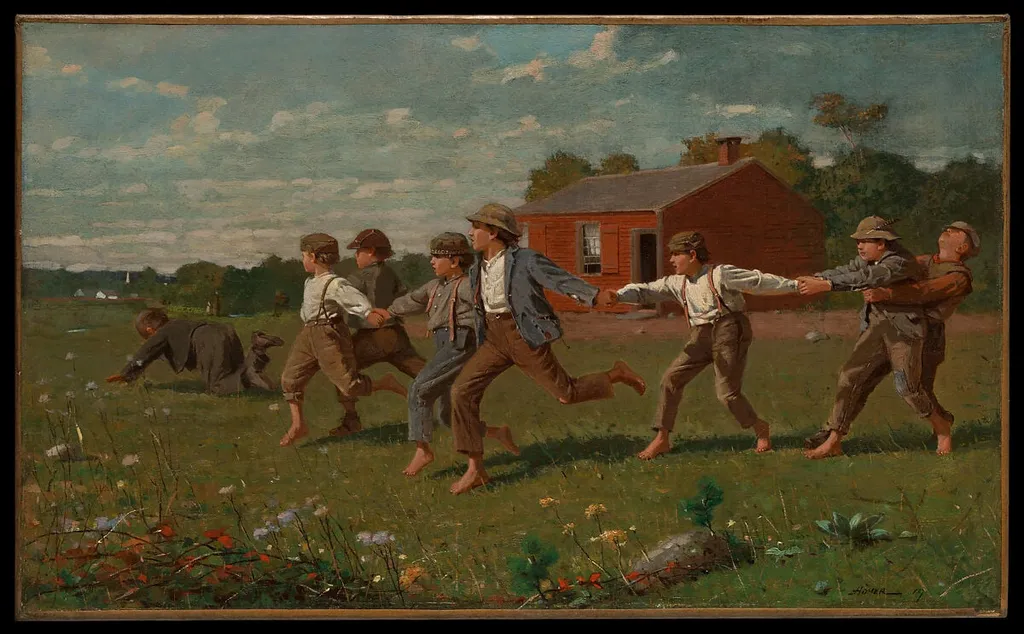
Snap the Whip is an oil painting by the American Impressionist artist Winslow Homer. It dates from 1872 and is held in the collection of the Metropolitan Museum of Art.
About this work
Subject & Meaning
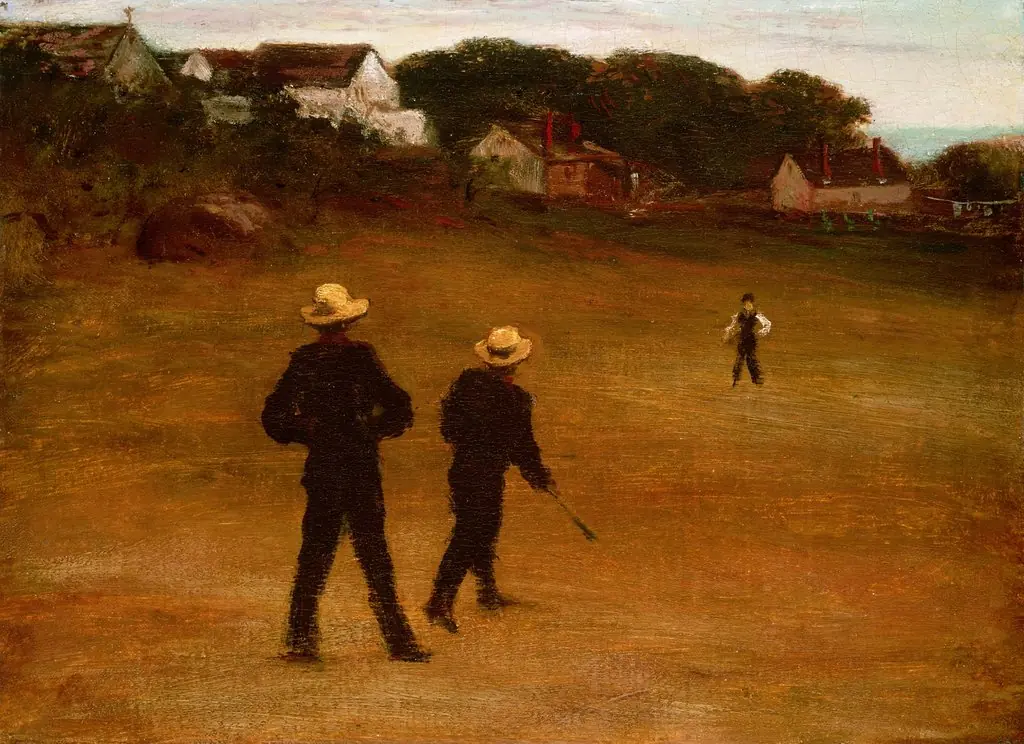
In the background, a simple house anchors the rural environment, suggesting a schoolhouse or village context typical of post-Civil War America.
Winslow Homer's 1872 oil painting, Snap the Whip, depicts a group of boys engaged in a traditional children's game in an outdoor setting. The scene captures the energetic motion of the players as they link hands and attempt to maintain their formation while running, with one boy breaking away from the line. In the background, a simple house anchors the rural environment, suggesting a schoolhouse or village context typical of post-Civil War America.
The work functions as a genre scene that celebrates youthful vitality and the communal spirit of outdoor play. While the title refers to the specific mechanics of the game, the imagery evokes broader themes of childhood innocence, freedom, and the transient nature of youth within a changing American landscape.
Technique & Style
Snap the Whip is executed in oil paint on canvas, a standard support for Winslow Homer's genre scenes of this period. The work measures 30.5 by 50.8 centimeters, a relatively modest horizontal format suited to its panoramic rural subject. Classified by the Metropolitan Museum of Art within The American Wing, the painting belongs to the genre-scene tradition, depicting boys at play alongside a house in a landscape setting.
The horizontal canvas orientation accommodates the linear, rhythmic arrangement of figures suggested by the title, while the oil medium allows for the layered handling characteristic of Homer's mature outdoor scenes.
History & Provenance
Winslow Homer painted Snap the Whip in 1872. The work is an oil on canvas measuring 30.5 × 50.8 cm and is classified within The American Wing as a genre scene depicting boys at play near a house. It entered the collection of the Metropolitan Museum of Art, where it remains.
No record of a specific commission, accession number, or prior exhibition history is provided in the available sources.
Context
Winslow Homer's 1872 oil on canvas 'Snap the Whip' belongs to The American Wing's genre painting collection at the Metropolitan Museum of Art. The work portrays a group of boys engaged in a rural game beside a modest house, a scene that reflects post-Civil War nostalgia for agrarian simplicity. Art historians view the painting as emblematic of Homer's transition from illustration to fine-art realism and as a visual record of 19th-century American life.
Its realistic detail and composition have been cited in scholarship as indicative of the era's emerging national identity, situating the piece within broader discussions of American genre painting.
Overview
Winslow Homer’s Snap the Whip, an oil on canvas from 1872, presents a lively genre scene of children at play. The painting captures a group of boys engaged in a spirited game in a sunlit field, with a schoolhouse visible in the background. This work is characteristic of Homer’s focus on depicting everyday life, a practice that solidified his reputation as a prominent figure in 19th-century American art. It offers a window into the innocent pastimes of childhood.
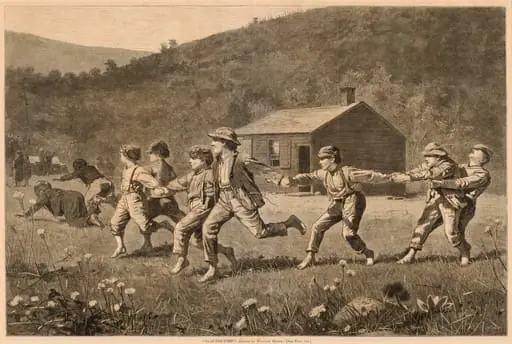
Artist & collection
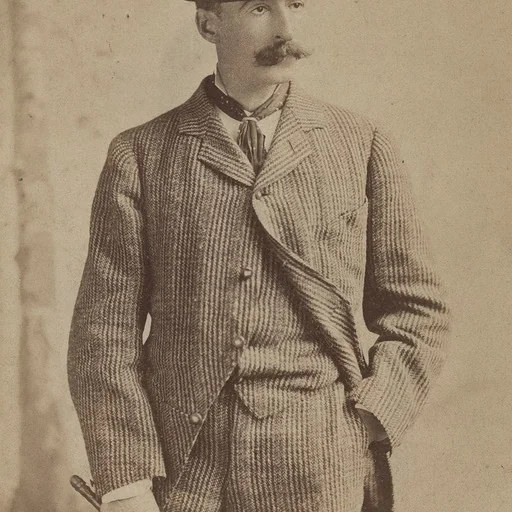
Artist
Winslow Homer (February 24, 1836 – September 29, 1910) was an American landscape painter and illustrator, best known for his marine subjects.