Artwork
Cardinal Albrecht of Brandenburg - The Small Plate
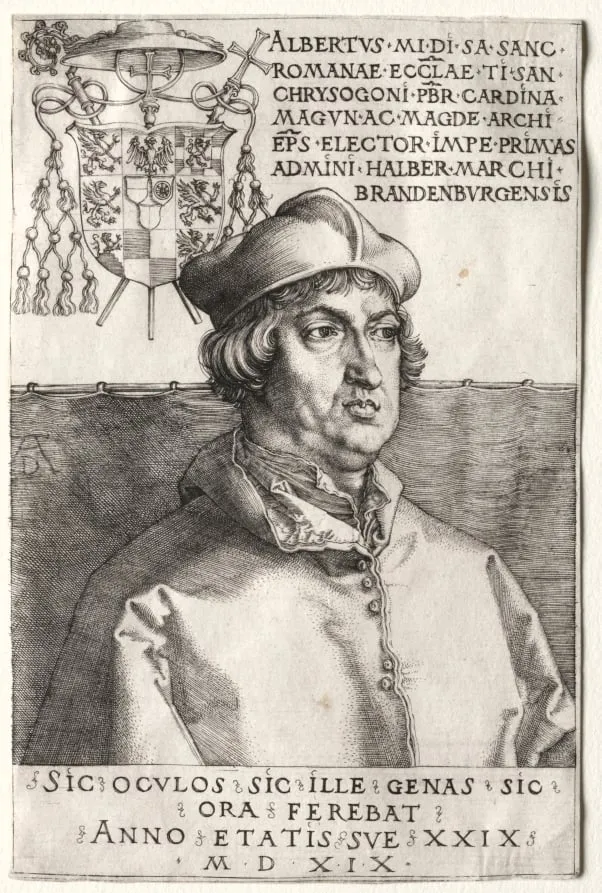
Cardinal Albrecht of Brandenburg - The Small Plate is a print by the Renaissance artist Albrecht Dürer. It dates from 1519 and is held in the collection of the Cleveland Museum of Art.
- Accession no.
- 1939.560
- Credit line
- Gift of Edward B. Greene
About this work
Overview
It is held in the collection of the Cleveland Museum of Art, where it stands as one of several portraits Dürer produced of influential patrons.
Created in 1519 by Albrecht Dürer, this small engraved portrait captures Cardinal Albrecht of Brandenburg, a prominent ecclesiastical figure in early 16th-century Germany. Executed in engraving, a medium Dürer refined over his career, the work reflects his precision in rendering texture and form. It is held in the collection of the Cleveland Museum of Art, where it stands as one of several portraits Dürer produced of influential patrons.
Subject & Meaning
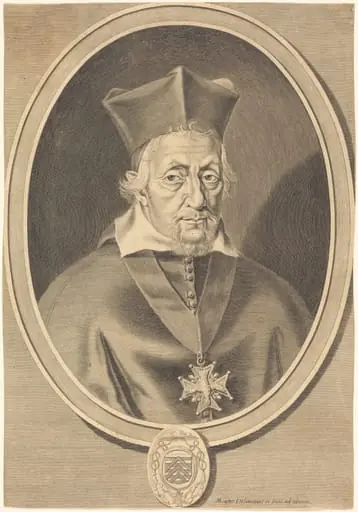
The portrait presents Cardinal Albrecht, Archbishop of Mainz and a key political player in the Holy Roman Empire, in formal ecclesiastical attire. His turned gaze and restrained expression convey authority without ostentation. The inclusion of his family coat of arms in the upper left affirms lineage and status, while the simple background focuses attention on the sitter’s presence. The image functions as both personal likeness and institutional emblem.
Technique & Style
Dürer employed fine, controlled lines in engraving to define the cardinal’s fur-lined robe, hat, and facial features. Subtle gradations of tone, achieved through hatching and cross-hatching, model the contours of the face and fabric, suggesting volume without heavy chiaroscuro. The texture of the hat’s velvet and the metallic sheen of the tassel are rendered with meticulous attention, showcasing Dürer’s mastery of the medium’s capacity for detail.
History & Provenance
The engraving was made during Dürer’s mature period, following his travels to the Netherlands and his growing reputation among northern European elites. Cardinal Albrecht, a major patron of the arts and collector of Dürer’s works, likely commissioned the portrait. The plate remained in private collections before entering the Cleveland Museum of Art’s holdings, where it has been studied for its technical and historical significance.
Context
In 1519, Germany was on the cusp of religious upheaval, and church officials like Albrecht held immense power. Dürer’s portraits of such figures served not only as personal records but also as tools of political and ecclesiastical identity. The engraving reflects the intersection of art, religion, and aristocracy in the early Reformation era, where visual representation reinforced social hierarchy.
Legacy
This small plate exemplifies Dürer’s influence on the development of portrait engraving in Northern Europe. Its clarity and restraint set a standard for depicting ecclesiastical authority in print. Though less celebrated than his larger works, this portrait remains a key example of how Dürer translated human presence into the disciplined language of the engraved line, shaping generations of printmakers.
Artist & collection
Artist
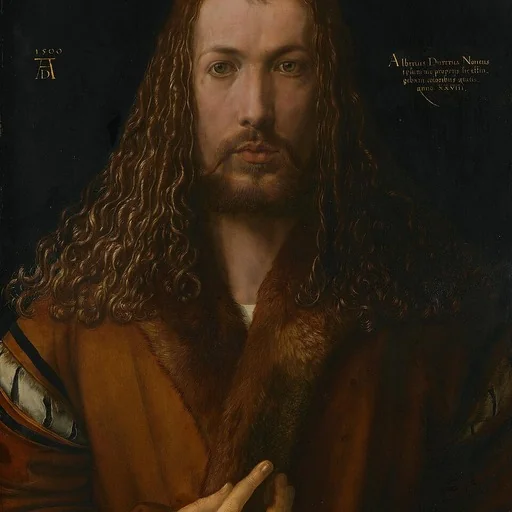
Albrecht Dürer spent his life in Nuremberg, a busy German city where artists traded prints like currency.

![Madonna and Child [obverse], by Albrecht Dürer](https://artifactworldgallery.com/img/albrecht-durer--madonna-and-child-obverse--d7b8ebf05d22ebe5-w320.webp)
![Lot and His Daughters [reverse], by Albrecht Dürer](https://artifactworldgallery.com/img/albrecht-durer--lot-and-his-daughters-reverse--b4ebf9b282faa17a-w320.webp)