Artwork
Cardinal Albrecht of Brandenburg ("Small Cardinal")
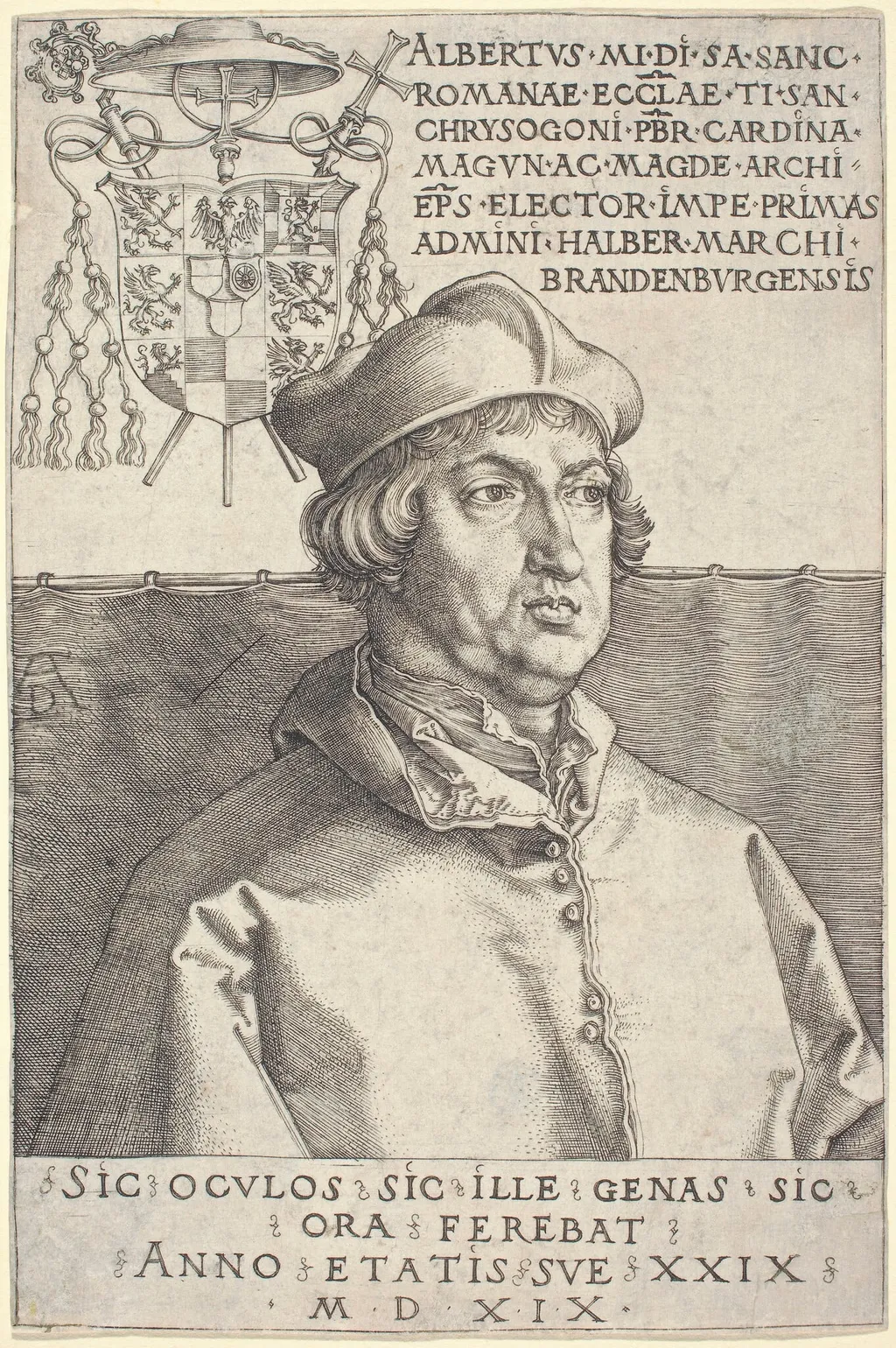
Cardinal Albrecht of Brandenburg ("Small Cardinal") is an ink print by the Northern Renaissance artist Albrecht Dürer. It dates from 1519 and is held in the collection of the National Gallery of Art.
- Inscription
- Inscribed:in plate, top left: ALBERTVS. MI[SERICORDIA]. D[E]I. SA[CRO]. SANC[TAE]. / ROMANAE. ECCL[ESI]AE. TI[TVLI]. SAN[CTI]. / CHRYSOGONI. P[RES]B[ITE]R. CARDINA[LIS]. / MAGNVN[TINENSIS]. AC. MAGDE[BVRGENSIS]. ARCHI= / EP[ISCOPV]S. ELECTOR. IMPE[RII]. PRIMAS. / ADMINI[STRATOR]. HALBER[STADENSIS]. MARCHI[O]. / BRANDENBVRGENSIS [Albert, by God's mercy Cardinal Priest of the Holy Roman Church titular presbyter cardinal of St Chrysogonus, Archbishop of Mainz and Magdeburg, Primate Elector of the Empire, Administer of Halberstadt, Margrave of Brandenburg]; in plate, bottom: SIC OCVLOS SIC ILLE GENAS SIC / ORA FEREBAT / ANNO ETATIS SVE. XXIX / M. D. X. I. X. [So appeared his eyes, his cheeks, his features at the age of 29 MDXIX]; verso, upper right, in graphite by a later hand: 44 [?] [obscured by old hinge]; verso, upper left, in graphite by a later hand: m500 [?] [crossed out]; verso, lower left, in graphite by a later hand: B102; verso, lower left, in graphite by a later hand: C.15207; verso, lower center, in graphite by a later hand: très rare; verso, lower left, in graphite by a later hand: 102; verso, lower left, in graphite by a later hand: 38; verso, lower left, in graphite by a later hand: r9 [?] [underlined] / Lua [?]; verso, lower center, in graphite by a later hand: 18-; verso, lower center, in graphite by a later hand: 102; verso, lower left, in graphite by a later hand: très belle Epreuve; verso, lower left, in graphite by a later hand: Canse [?] [partially erased]
About this work
The text around him lists titles like "Cardinal" and "Archbishop," showing he held high church power.
This is a black-and-white portrait of a serious-looking man in a hat and fur collar. His face is detailed, with a strong jaw and deep-set eyes. Behind him, a coat of arms with lions and a cross sits on a stand.
The text around him lists titles like "Cardinal" and "Archbishop," showing he held high church power. The bottom text says the portrait was made at age 29 in 1519.
Next, look up engraving to see how artists like Dürer carved these precise lines.
Overview
Created in 1519, this engraving by Albrecht Dürer depicts Cardinal Albrecht of Brandenburg, a prominent church figure of the early 16th century. Rendered in fine black lines on laid paper, the portrait captures the cardinal in formal ecclesiastical attire. The work is part of the National Gallery of Art’s collection in Washington, D.C., and reflects Dürer’s mastery in translating portraiture into the medium of print.
Subject & Meaning
The cardinal is portrayed with solemnity, his strong jaw and focused gaze conveying authority. His attire, rich fur collar and distinctive hat, signals his high rank within the Church. Surrounding the image, inscriptions list his ecclesiastical titles, emphasizing his institutional power.
The coat of arms behind him, featuring lions and a cross, reinforces his noble and spiritual lineage, anchoring his identity in both secular and religious hierarchies.
Technique & Style
Dürer employed precise engraving techniques, using a burin to incise fine lines into a copper plate, which were then inked and pressed onto paper. The texture of the fur, the sheen of fabric, and the subtle modeling of the face demonstrate his command of tonal gradation. The composition is tightly framed, focusing attention on the cardinal’s face and the heraldic emblem, with no extraneous detail to distract from the subject’s presence.
History & Provenance
The engraving was produced in 1519, during Dürer’s mature period, shortly after his second trip to the Netherlands. It was likely commissioned to commemorate the cardinal’s status or to serve as a diplomatic gift. The print entered the National Gallery of Art’s collection in the 20th century, having passed through several private European collections since its creation, though its early ownership remains partially undocumented.
Context
In 1519, the Catholic Church was under growing scrutiny, and figures like Albrecht, known for his role in selling indulgences, were central to the tensions preceding the Reformation. Dürer, though sympathetic to reformist ideas, maintained professional ties with Catholic patrons. This portrait reflects the complex intersection of art, power, and religion in early 16th-century Germany, where visual representation served both personal and institutional agendas.
Legacy
The engraving stands as one of Dürer’s most restrained and psychologically acute portraits. It influenced later generations of printmakers who sought to convey authority through precise line and minimal background. Its enduring presence in major collections underscores its role as a key example of how Renaissance artists used print to disseminate images of power beyond the elite circles of painting and sculpture.
Own this work as a print
Artist & collection
Artist
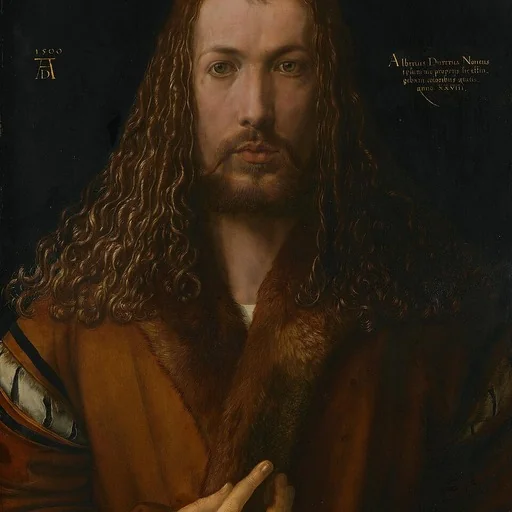
Albrecht Dürer spent his life in Nuremberg, a busy German city where artists traded prints like currency.

![Madonna and Child [obverse], by Albrecht Dürer](https://artifactworldgallery.com/img/albrecht-durer--madonna-and-child-obverse--d7b8ebf05d22ebe5-w320.webp)
![Lot and His Daughters [reverse], by Albrecht Dürer](https://artifactworldgallery.com/img/albrecht-durer--lot-and-his-daughters-reverse--b4ebf9b282faa17a-w320.webp)