Artwork
Capricci di varie battaglie (Frontispiece)
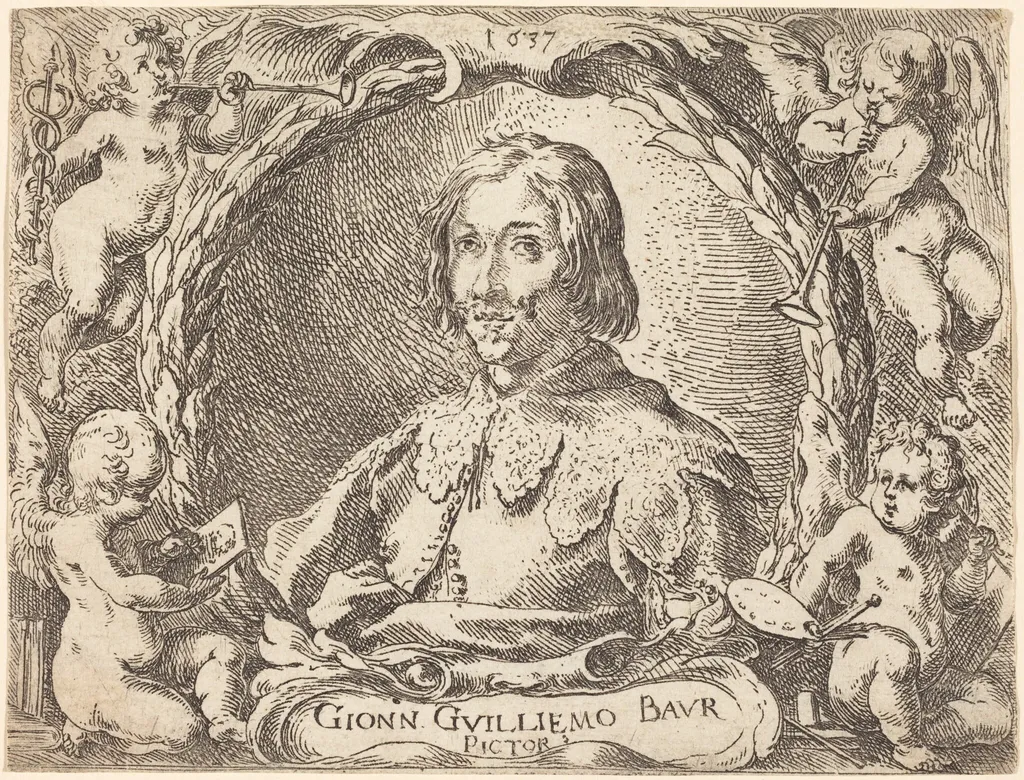
Capricci di varie battaglie (Frontispiece) is an ink print by the Baroque artist Johann Wilhelm Baur. It dates from 1635 and is held in the collection of the National Gallery of Art.
- Inscription
- Inscribed:across bottom in plate: GIONN. GVILLIEMO BAVR / PICTOR
About this work
His face is the main focus, but the background has small, sketchy figures and swirling lines that look like they’re part of a bigger scene.
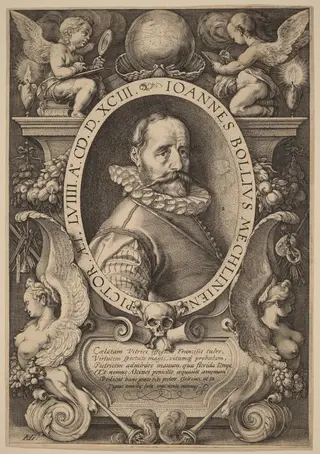
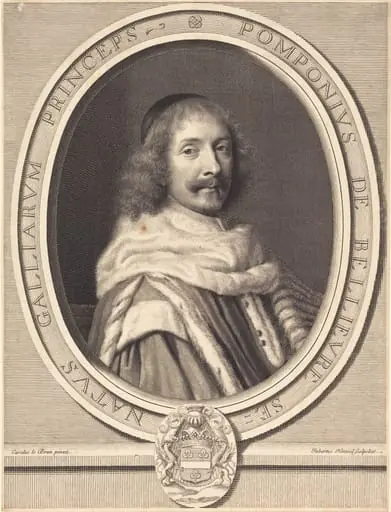
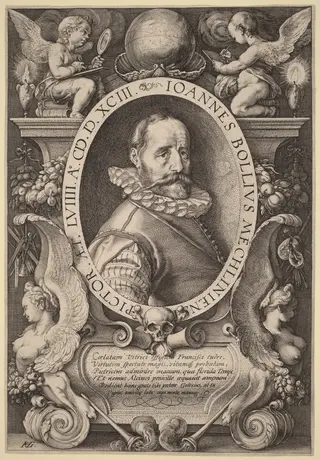
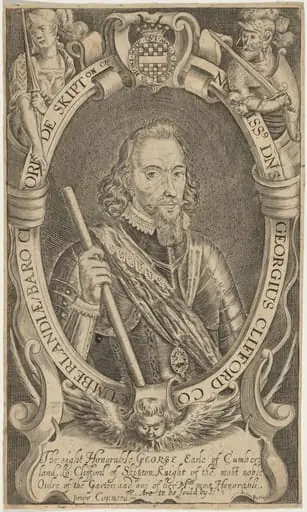
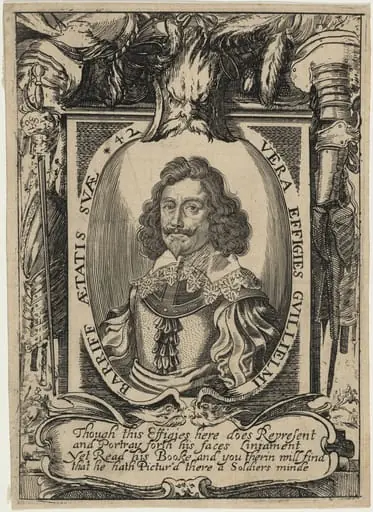
This image shows a black-and-white etching of a serious-looking man with a beard and curly hair, framed by a wreath of leaves and vines. His face is the main focus, but the background has small, sketchy figures and swirling lines that look like they’re part of a bigger scene. The edges of the paper have a textured look, like it was made by hand.
The name at the bottom reads "Gionn. Gvilliemo Baur Pictor", which is a fancy way of saying the artist’s name. The year 1635 is written in the corner, and the whole image has a rough, detailed style that makes it feel old.
If you like this kind of detailed, dramatic art, look up etching next.
Overview
Created in 1635, this etching by Johann Wilhelm Baur serves as the frontispiece to a series of battle scenes. Executed in black ink on laid paper, it combines a central portrait with an ornamental border of foliage. The work reflects Baur’s skill in fine-line engraving and his interest in integrating portraiture with allegorical or decorative elements, typical of early Baroque printmaking in Central Europe.
Subject & Meaning
The central figure is a bearded man, rendered with solemn expression and curly hair, likely a symbolic representation rather than a specific individual. Surrounded by a wreath of vines and leaves, he may embody the spirit of war or the artist’s own identity as a creator of martial imagery. The faint, sketchy figures in the background suggest chaotic battlefields, subtly linking the portrait to the broader theme of conflict without literal depiction.
Technique & Style
Baur employed etching to achieve fine, controlled lines with a hand-drawn quality. The texture of the paper and the irregular edges reinforce the handmade nature of the print. The background is rendered with loose, swirling strokes that contrast with the precise rendering of the face, creating visual tension. This blend of detail and suggestion exemplifies Baroque printmakers’ interest in atmospheric depth and expressive line work.
History & Provenance
The print was produced as part of a larger series titled Capricci di varie battaglie, likely intended for publication or private collection. Baur, active in Italy and Germany, often worked for patrons interested in classical and military themes. The signature 'Gionn.
Gvilliemo Baur Pictor' and the date 1635 align with his known period of activity, placing the work within his mature phase of print production.
Context
In the mid-17th century, etchings like this were widely circulated among collectors and artists as both artistic specimens and preparatory studies. Baur’s work reflects the European trend of blending portraiture with allegory, influenced by Italian Mannerism and Northern engraving traditions. His engagement with Ovid’s Metamorphoses suggests a broader interest in mythological and historical narratives, even when applied to military subjects.
Legacy
Though not widely reproduced today, Baur’s prints contributed to the development of narrative etching in Central Europe. His ability to merge intimate portraiture with expansive, implied scenes influenced later generations of printmakers. This frontispiece remains a quiet example of how personal and thematic elements were woven into printed works during the Baroque era, before the rise of mass reproduction.
Own this work as a print
Artist & collection
Artist
Johann Wilhelm Baur, Joan Guiliam Bouwer, or Bauer (Strasbourg, 31 May 1607 - Vienna, 1 January 1640) was a German engraver, etcher and miniature painter. He is famous for a series of illustrations of Ovid's Metamorphoses.