Artwork
The Crucifixion
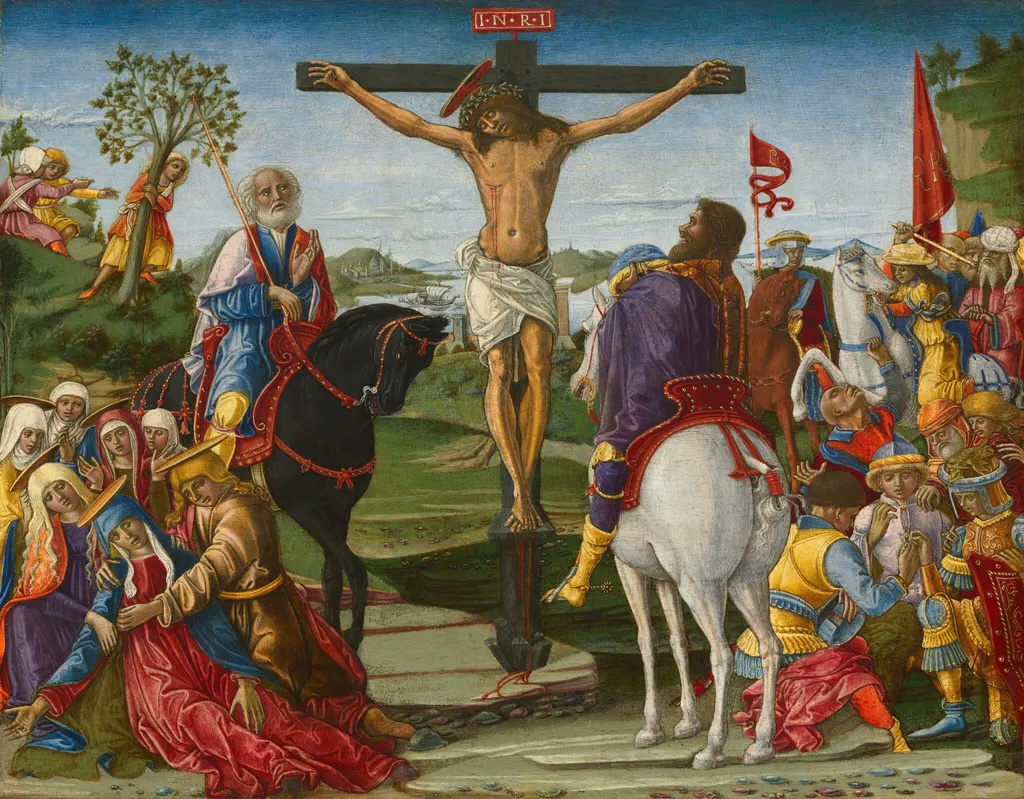
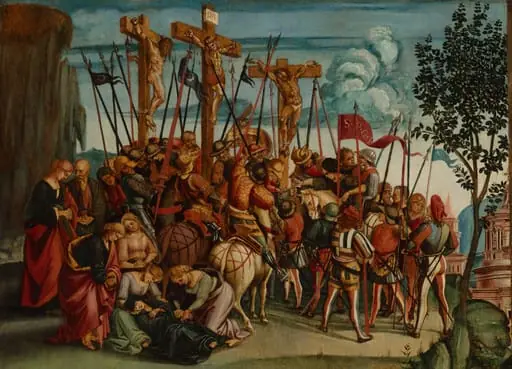
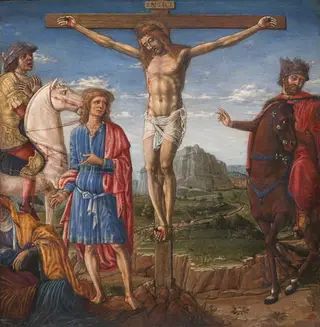
The Crucifixion is a tempera painting by the Early Renaissance artist Benvenuto di Giovanni. It dates from 1491 and is held in the collection of the National Gallery of Art.
About this work
Subject & Meaning
The scene follows traditional representations of the event, showing Christ nailed to the cross at the center, flanked by mourning figures and soldiers.
The painting depicts the Crucifixion of Jesus Christ, a central subject in Christian iconography, rendered with a crowded composition of figures. The scene follows traditional representations of the event, showing Christ nailed to the cross at the center, flanked by mourning figures and soldiers. The surrounding elements, including the Virgin Mary and John the Evangelist, reinforce the devotional and narrative focus typical of late medieval Italian religious art.
The work’s crowded arrangement and small scale suggest it may have been designed for private devotion rather than a large altarpiece, aligning with the format described in the provenance notes from the early 19th century.
Technique & Style
The Crucifixion is executed in tempera on a wooden panel, a common medium for late-fifteenth-century Sienese panel painting. The composition is characterized by sharply delineated figures and a crowded, narrative-driven arrangement, with Christ on the cross positioned centrally against a gold ground typical of the period. The figures, including the Virgin, Saint John, and a group of mourners, are rendered with precise, almost linear contours and attenuated proportions, reflecting Benvenuto di Giovanni’s engagement with the refined stylistic conventions of Mantegna.
The handling emphasizes clarity and linearity over atmospheric modeling, with jewel-like color accents and meticulous attention to detail in costume and gesture, particularly in the crowded foreground scene.
History & Provenance
The Crucifixion by Benvenuto di Giovanni is dated to about 1491. Its early provenance traces to Luigi de Angelis, custodian of the Siena Library, who possessed the panel by 1824. The work later entered the Cook collection via Sir John Charles Robinson’s 1875 acquisition for Sir Francis Cook at Doughty House, Richmond.
It descended through three generations of the Cook family, Sir Frederick Lucas Cook, Sir Herbert Frederick Cook, and Sir Francis Ferdinand Maurice Cook, before being sold in April 1946 to Francis A. Drey in London. Wildenstein & Co. of New York subsequently handled the painting, which was purchased in June 1949 for the Samuel H. Kress Collection and gifted to the National Gallery of Art, Washington, D.C., in 1952.
The Crucifixion by Benvenuto di Giovanni is currently held by the National Gallery of Art in Washington, D.C., as part of the Samuel H. Kress Collection. The work was acquired by the gallery in 1952 as a gift from the Kress Foundation after being purchased in June 1949. Prior to entering the Kress collection, the painting was sold in April 1946 to Francis A. Drey in London and had been in the Cook family collection for generations.
Sir Francis Cook, 1st Baronet, acquired it in 1875 through Sir John Charles Robinson, and it remained at Doughty House in Richmond, Surrey, passing through four generations of the Cook baronets. Earlier provenance traces the work to Luigi de Angelis, custodian of the Siena Library, who listed it in his possession by 1824.
Context
Benvenuto di Giovanni’s 1491 tempera panel The Crucifixion, originally documented in the Siena Library custodian Luigi de Angelis’s collection and later owned by the Cook family before entering the Samuel H. Kress Collection, exemplifies late‑Quattrocento devotional painting in Tuscany. Scholars highlight its compositional complexity and its connection to the artist’s earlier Ascension altarpiece, noting the crowded figural arrangement as characteristic of the period’s narrative intensity. The work’s provenance through Robinson, the Kress Foundation, and its 1952 donation to the National Gallery of Art underscores its significance within the corpus of Italian Renaissance religious art.
Overview
Benvenuto di Giovanni's painting, The Crucifixion, created around 1491, is an early Renaissance work rendered in tempera on panel. This piece exemplifies the Sienese artist's engagement with religious narratives, a common theme throughout his career. It presents a focused depiction of Jesus Christ on the cross, characteristic of the period's devotional art.
Own this work as a print
Artist & collection

Artist
Benvenuto di Giovanni, also known as Benvenuto di Giovanni di Meo del Guasta (13 September 1436 – c.