Artwork
Death and the Miser
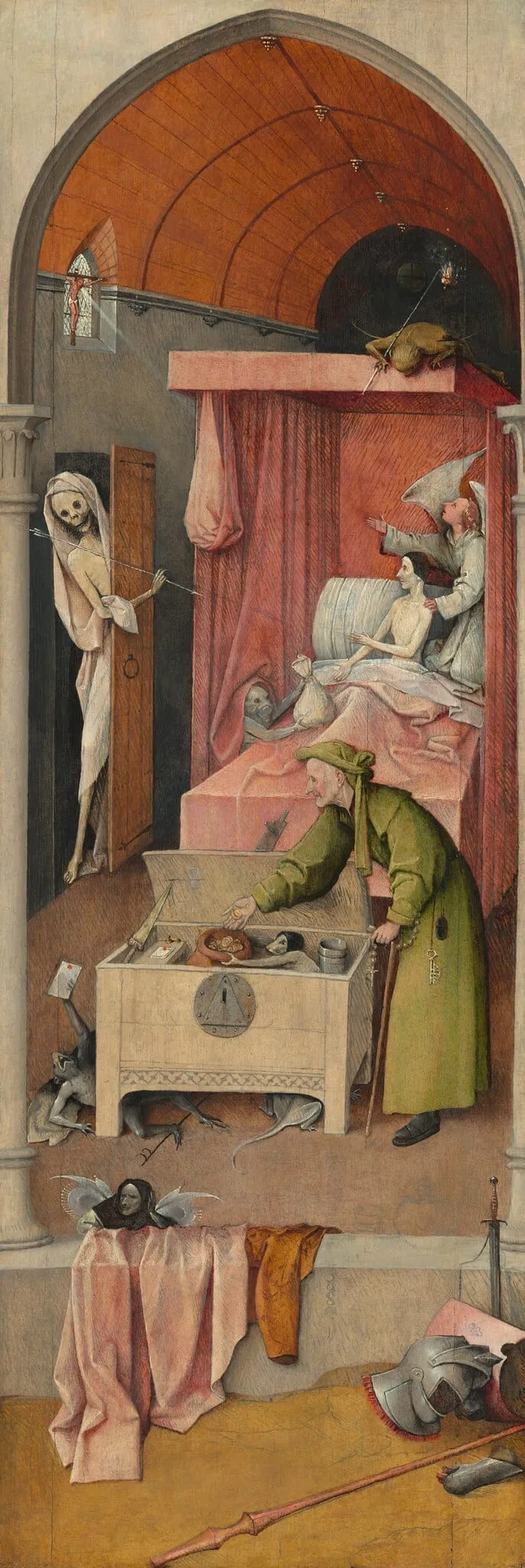
Death and the Miser is an oil painting by the Northern Renaissance artist Hieronymus Bosch. It dates from 1488 and is held in the collection of the National Gallery of Art.
About this work
A skeleton peers around a wooden door gripping an arrow while a dying man in a red-canopied bed reaches toward a bag of gold held out by a fish-faced demon. An angel tugs the miser's shoulder and points to a crucifix, but his eyes stay on the coins. Hieronymus Bosch painted this narrow panel around 1485, compressing the moral drama into a cramped bedroom.
Subject & Meaning
Discarded armor and weapons on the floor symbolize the futility of earthly power against death.
The painting is a memento mori allegory, warning against the sin of avarice. It shows the dying miser at two moments: in the foreground, he hoards gold with a demon's help while clutching a rosary, exposing his hypocrisy; in the background, Death with an arrow emerges from a doorway as an angel points him toward a crucifix and a beam of light. A demon offers him another bag of gold.
The scene draws on the Ars moriendi tradition but leaves the outcome uncertain, the miser's gaze and hand still reach for worldly wealth, suggesting the decision between salvation and damnation lies with him. Discarded armor and weapons on the floor symbolize the futility of earthly power against death.
Technique & Style
Executed in oil on panel, the painting measures 93 × 31 cm (36 5/8 × 12 3/16 in) and was originally the left wing of a triptych. The support is oak, and the ground and paint layers are thinly applied, making the underdrawing visible to the naked eye in many areas. Infrared reflectography has revealed an extensive underdrawing that differs significantly from the finished composition, for instance, originally a string of rosary beads and three metal cups were drawn on the wall.
The formal structure is characterized by a narrow, vaulted interior viewed through a pointed arch flanked by column capitals, a compositional scheme derived from the workshop of Robert Campin and later used by Rogier van der Weyden. The palette relies on reddish-brown and gray tones, set off by the green robe of the miser in the foreground. The thin handling and visible pentimenti speak to Bosch’s working process and the painting's condition.
History & Provenance
The painting's earliest known record dates to 1826, when it was in a private collection near Arundel, Sussex, England. It passed through several London dealers in the 1920s–1930s, including Asscher and Welker, who offered it to the Louvre in 1931. By 1932 it belonged to Baron Joseph van der Elst; he sold it in 1951 through dealers to the Samuel H. Kress Foundation, which donated it to the National Gallery of Art, Washington, in 1952.
Scholarly dating ranges from 1480 to 1516, with a consensus around 1485–1490 or 1500–1510. It was originally the left wing of a triptych, possibly the 'Wanderer Triptych,' whose other panels are lost. No specific commission is documented.
The painting is held in the National Gallery of Art (NGA) in Washington, D.C., as part of the Samuel H. Kress Collection. Its provenance traces to a private collection in England, possibly near Arundel, Sussex, around 1826, followed by a sequence of London dealers in the 1920s–1930s. By 1932 it belonged to Baron Joseph van der Elst; in 1951 it was sold through dealers to the Samuel H. Kress Foundation, New York, and gifted to the NGA by exchange in 1952. The work was included in the exhibition "Jheronimus Bosch - Visions of genius."
Context
Critical reception of the painting is marked by scholarly debate over its precise symbolism. Some, like Charles de Tolnay, interpret the weapons in the foreground as satire on the nobility, while Anne Morganstern reads the usurer's pawned armor as evidence of usury. The work's unresolved ending, the miser's gaze fixed on Death rather than angel or demon, is seen as a departure from the didactic certainty of Ars moriendi illustrations, underscoring Bosch's nuanced moral ambiguity.
Within Bosch's wider oeuvre, the panel is often grouped with The Ship of Fools and Allegory of Gluttony as surviving parts of the dismantled “Wanderer-Triptych”. Its compositional framing, derived from Robert Campin's workshop, links Bosch to earlier Early Netherlandish traditions. The painting is classified as Early Netherlandish and was featured in the major retrospective “Jheronimus Bosch – Visions of genius”.
Legacy
Since entering the National Gallery of Art in 1952 via the Samuel H. Kress Collection, Death and the Miser has become one of Bosch’s most discussed works. It was featured in the landmark exhibition Jheronimus Bosch – Visions of Genius (2016). Scholarly attention focuses on its status as the right wing of the dispersed Triptych of the Wanderer (with The Ship of Fools and Allegory of Gluttony and Lust).
Its adaptation of Ars moriendi imagery and its unresolved moral ambiguity have made it central to studies of Bosch’s vanitas iconography. The painting’s compositional formula, derived from the workshop of Robert Campin and employed by Rogier van der Weyden, also highlights its place within Early Netherlandish painting traditions.
Overview
Hieronymus Bosch's oil on panel painting, Death and the Miser, created during the Northern Renaissance between approximately 1490 and 1516, serves as a moralizing commentary on human mortality and avarice. Measuring 93 by 31 centimeters, this vertical composition depicts a dying man's final moments. Originally a component of a larger triptych, the work now stands as a singular panel at the National Gallery of Art in Washington, D.C., inviting contemplation on the transience of life and the perils of material attachment.
Artist & collection
Artist
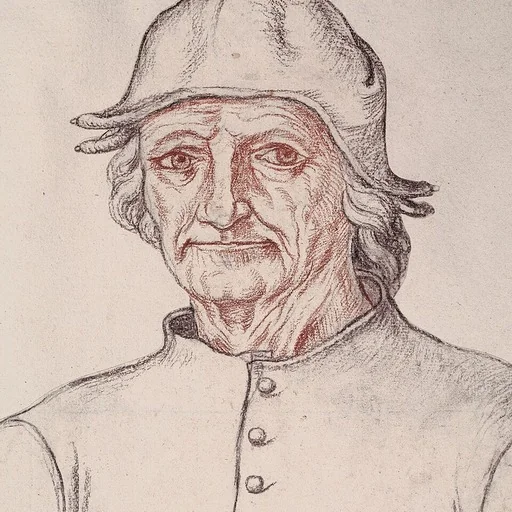
Hieronymus Bosch (; Dutch:; born Jheronimus van Aken; c. 1450 – 9 August 1516) was a Dutch painter from Brabant. He is one of the most notable representatives of the Early Netherlandish painting school. His work,…

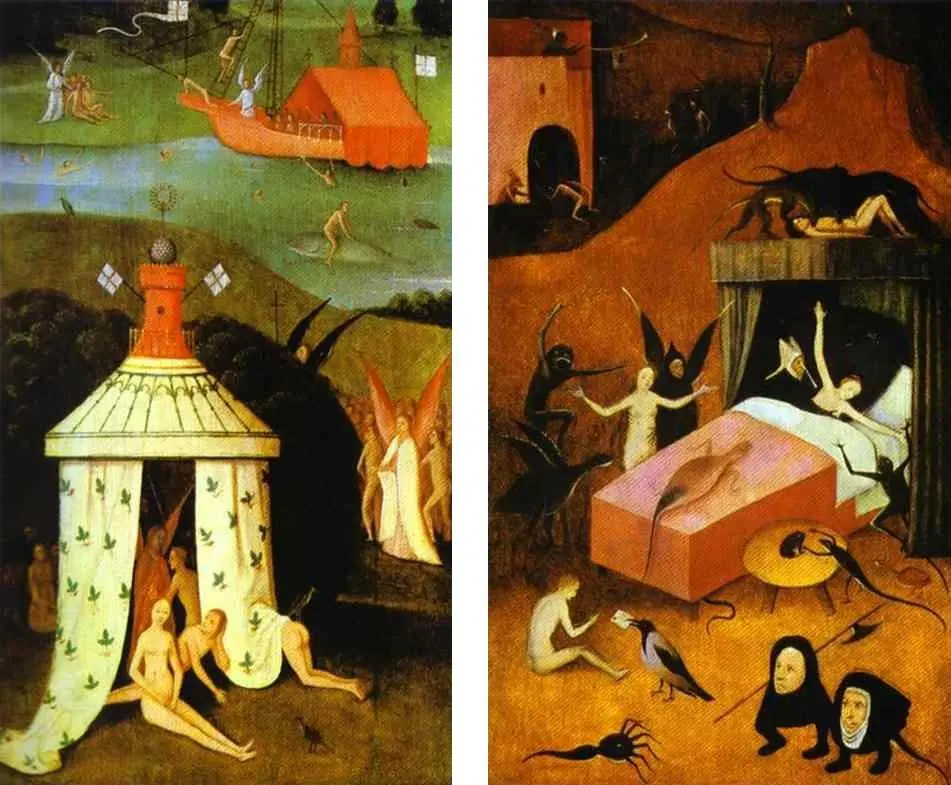
- The Hour of Death
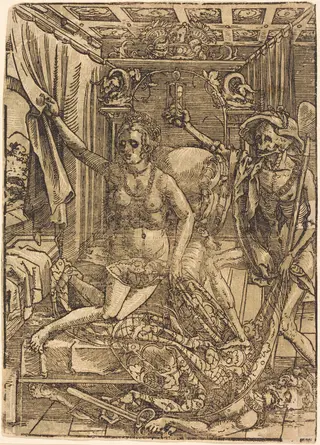
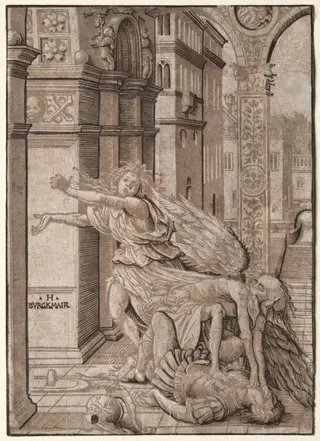 The Lovers Surprised by Death
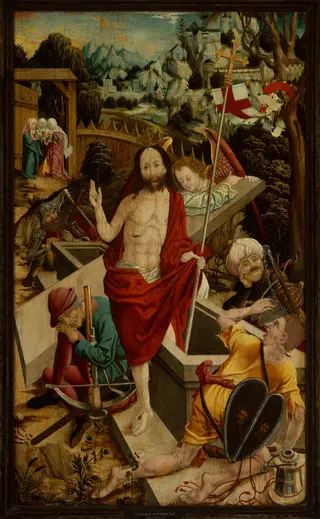 Resurrection of Christ
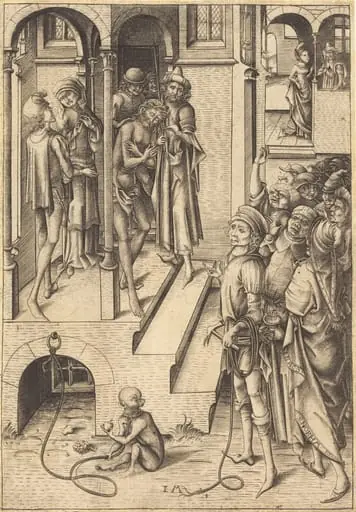 Ecce Homo
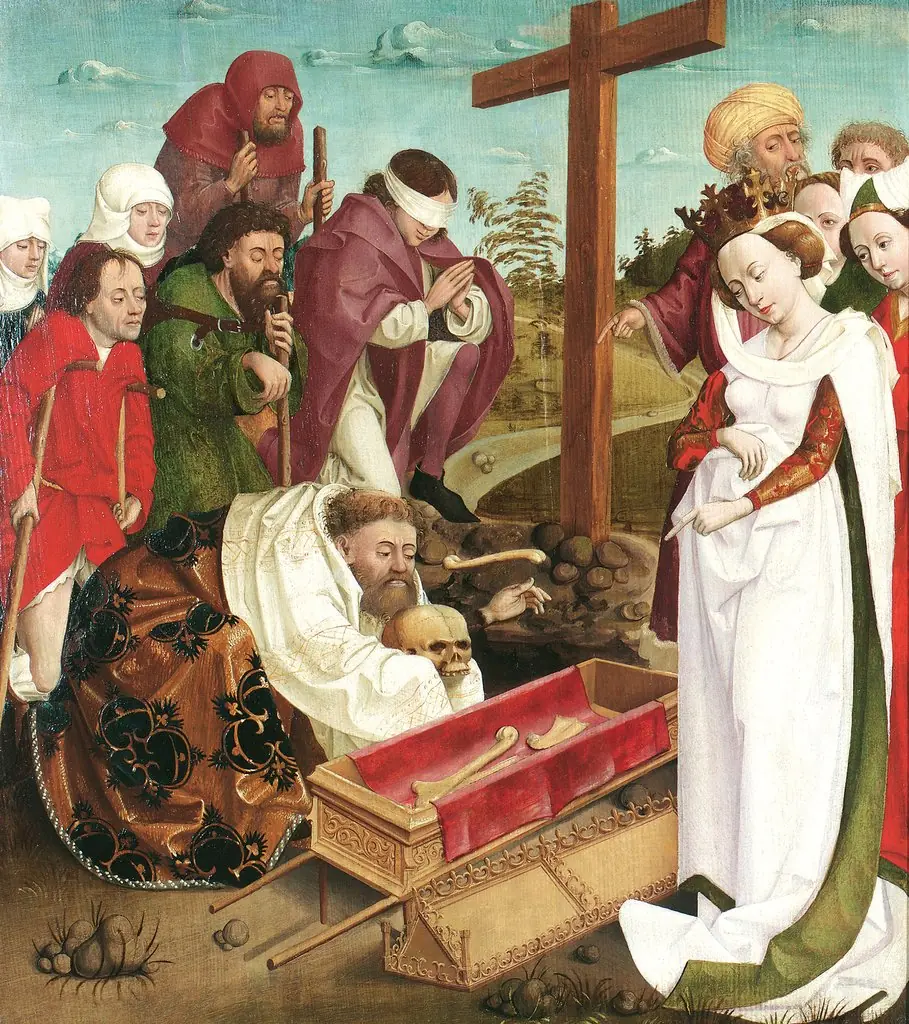 Überführung der Gebeine des hl. Oswald
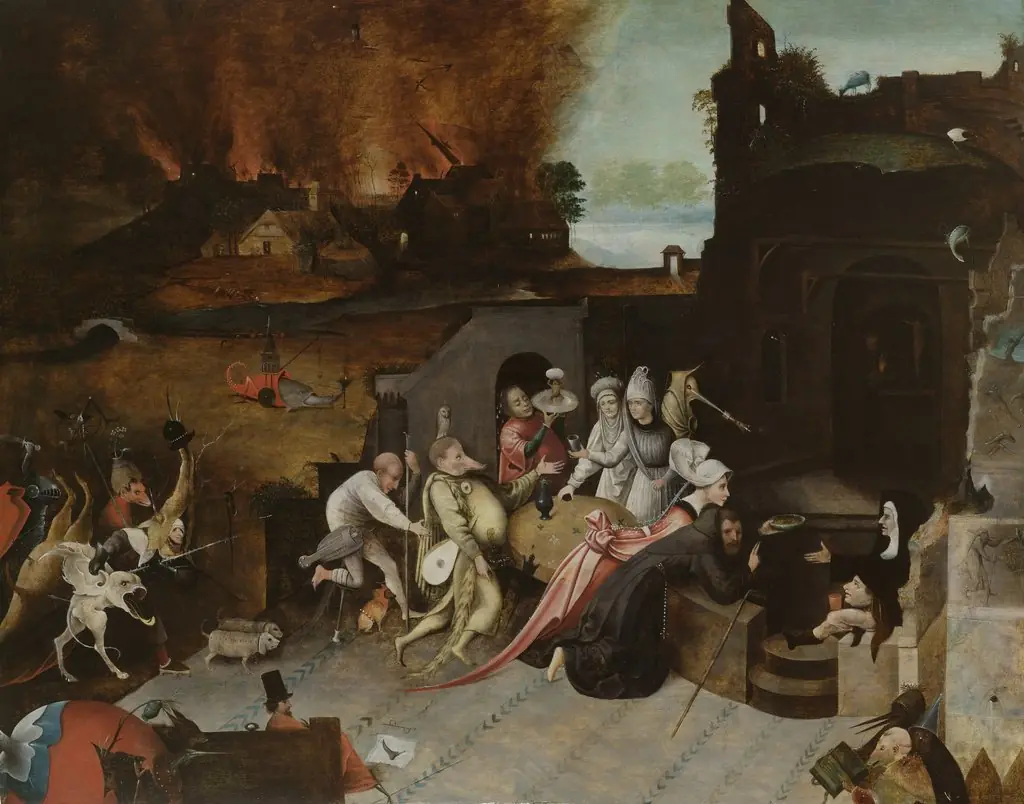
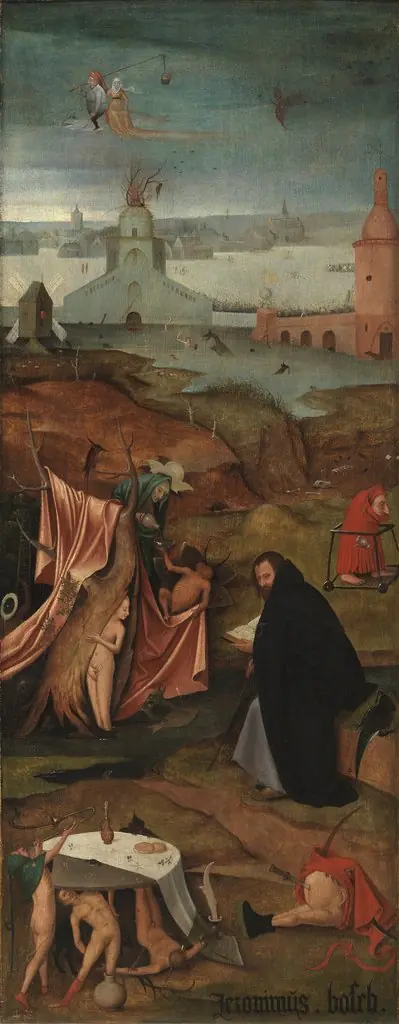 The Temptations of Saint Anthony
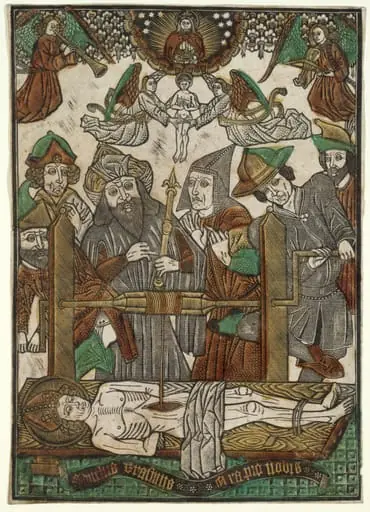 The Martyrdom of St. Erasmus
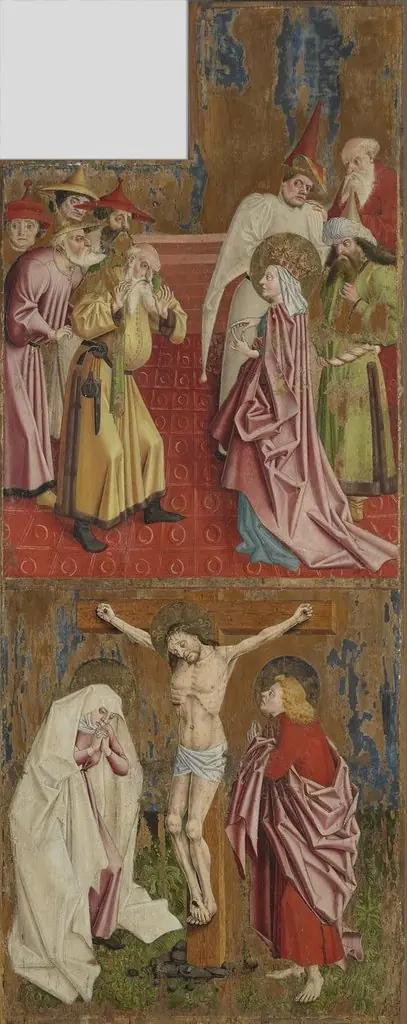 Kreuzaltar, Flügelaußenseite: Die Kaiserin Helena befragt die Juden und Kreuzigung Christi
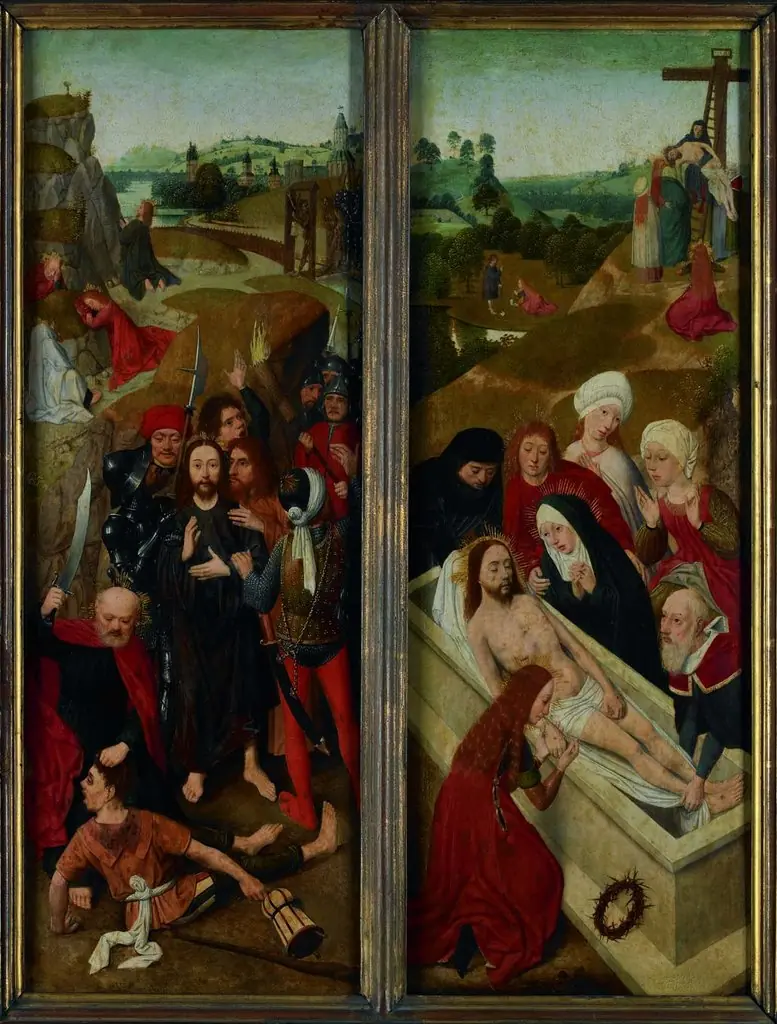 he taking of Christ and The entombment
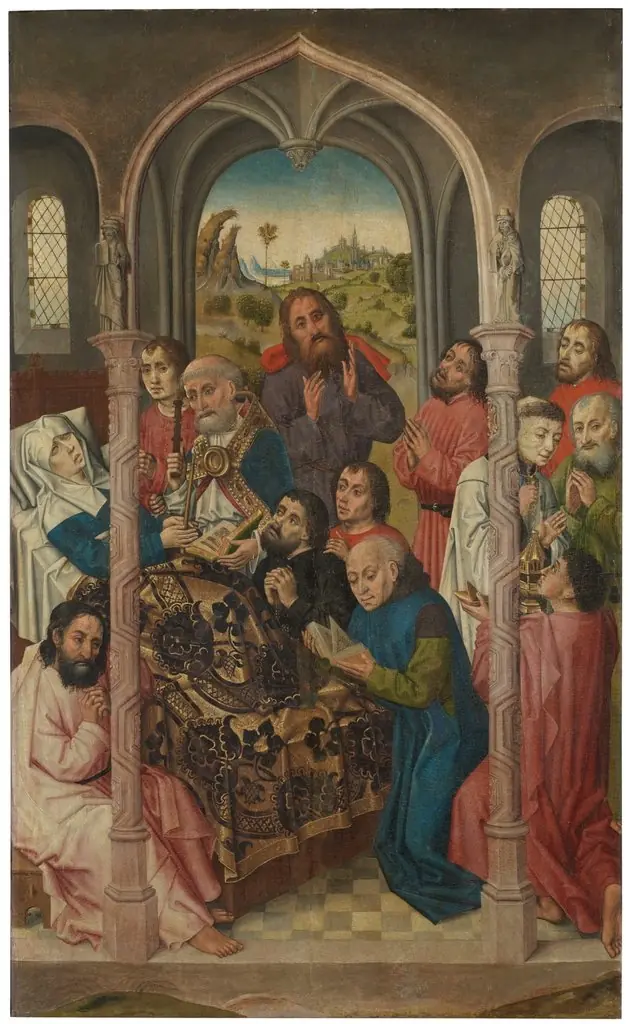 The Death of the Virgin
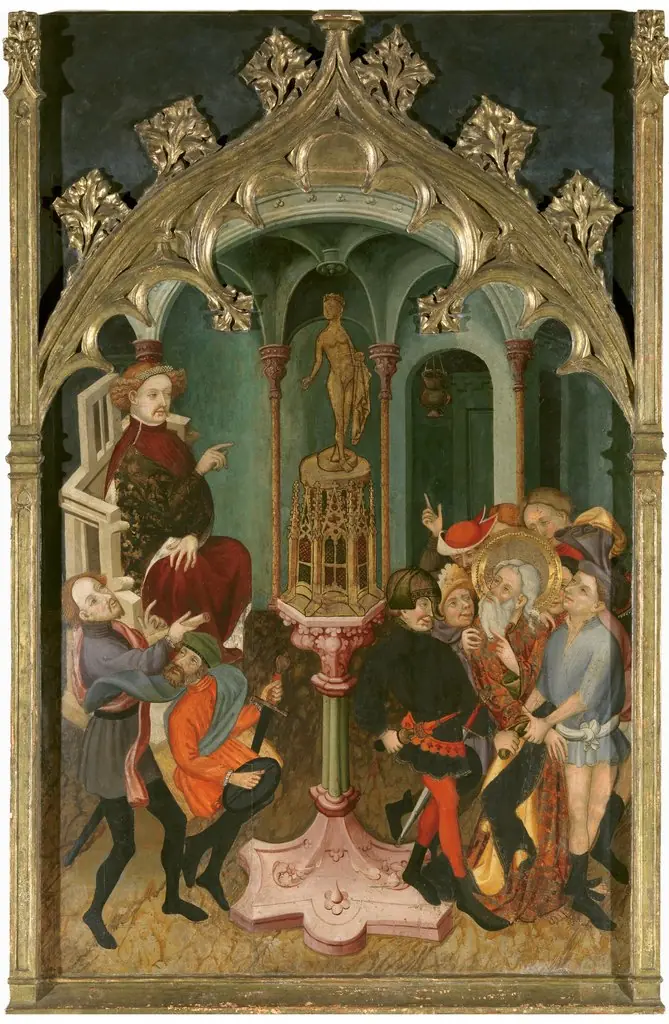 Saint Andrew refusing to worship the Idol
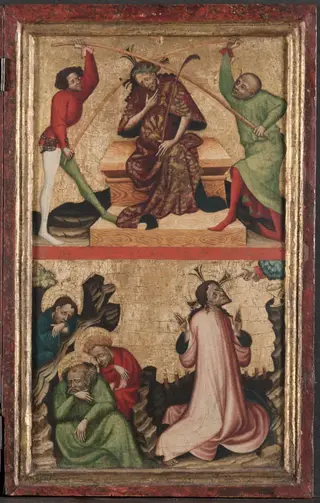 Diptych with the Passion of Christ (right wing): Crowning with Thorns and Agony on the Garden