Artwork
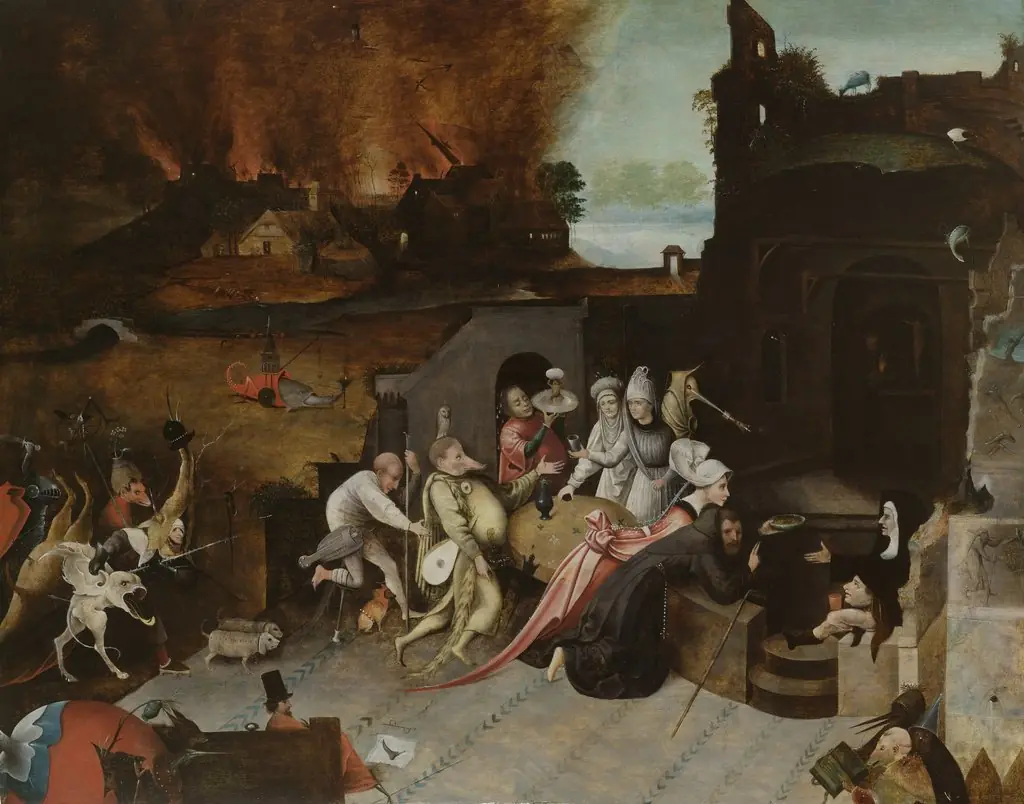
The Temptation of St Anthony
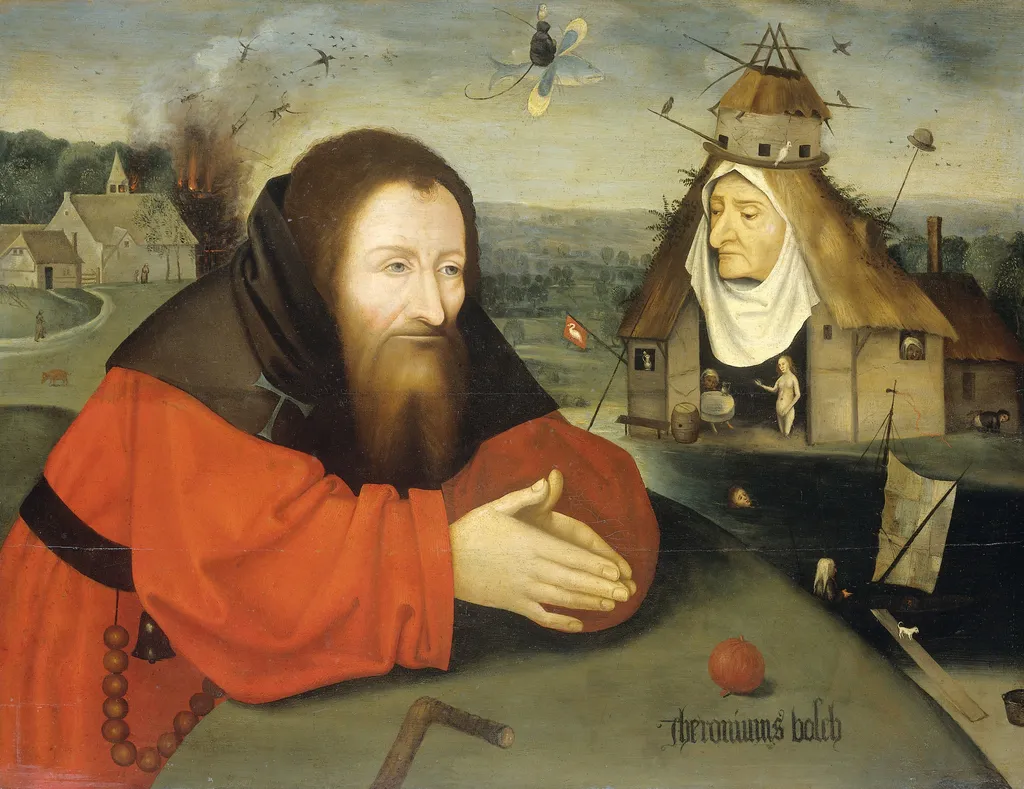
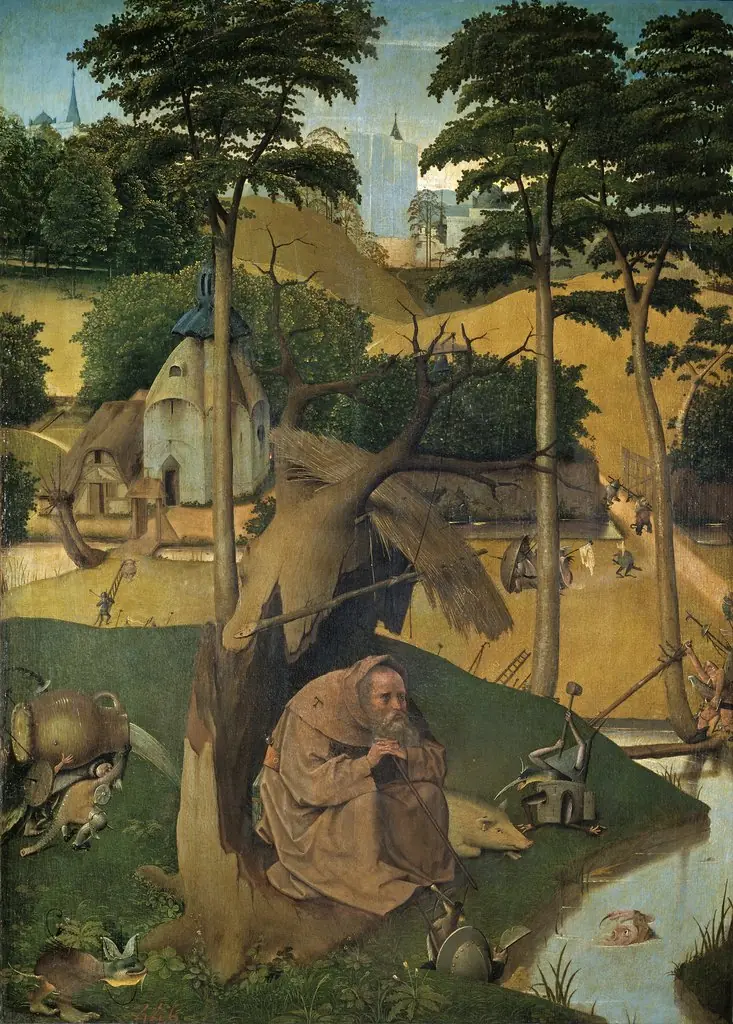
The Temptation of St Anthony is an oil painting by the Northern Renaissance artist Hieronymus Bosch. It is held in the collection of the Rijksmuseum.
About this work
Subject & Meaning
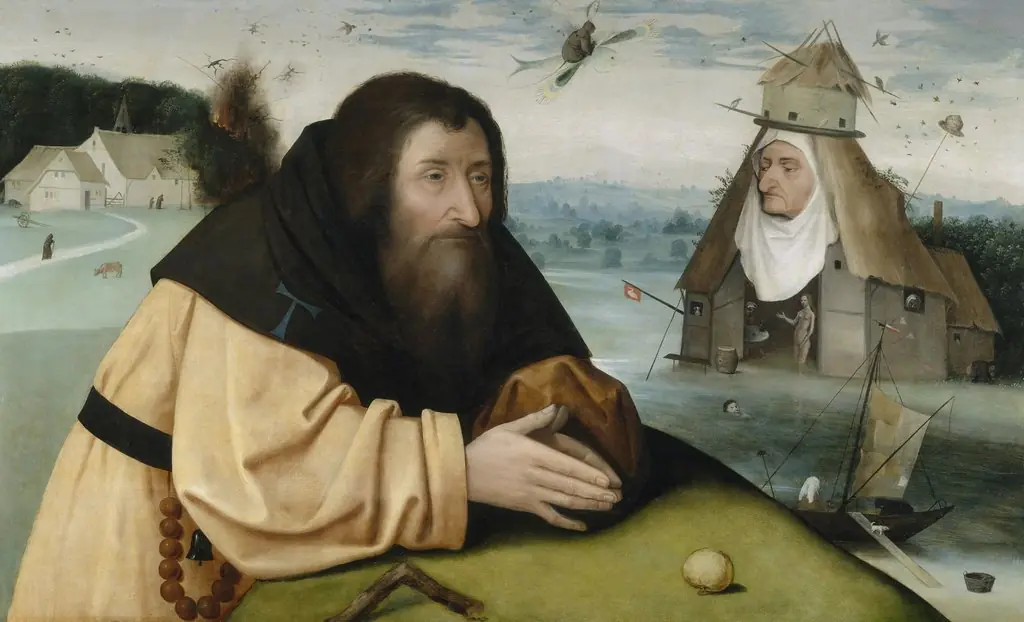
In the sky, a fish carries a demon with an owl on its head, the owl symbolising temptation in the sixteenth century.
The painting depicts the Temptation of Saint Anthony the Great, a subject drawn from the legend recorded by Athanasius of Alexandria, in which the saint was tested by the devil during his time in the desert. Saint Anthony is shown half-length at prayer, identifiable by the tau cross (Antonius cross) on his monk's habit and the bell at his belt, the latter referencing the Antonites, his followers who cared for plague victims and announced their presence with bells.
The iconography includes several symbolic elements. The saint leans on a rock bearing a staff and a pomegranate. A house with a woman's head represents a brothel, signalled by the dovecote on her head and the swan on the signboard; in sixteenth-century Dutch, such establishments were called "Duyf-huys" and prostitutes "swaentje."
To the left, insect-like monsters set fire to Anthony's priory. In the sky, a fish carries a demon with an owl on its head, the owl symbolising temptation in the sixteenth century.
Technique & Style
The Temptation of St Anthony is executed in oil paint on panel, a support consistent with Early Netherlandish practice. Dendrochronological analysis of the panel indicates a creation date of circa 1551 or later, which has informed assessments of its attribution and handling. The work is held in the collection of the Noordbrabants Museum in 's-Hertogenbosch, on long-term loan from the Rijksmuseum since 2001.
Stylistically, the painting is associated with the Early Netherlandish movement and is considered to be by a follower rather than by Bosch himself. The art historian Max Friedländer characterized the execution as 'rather crude' and suggested it was probably an old copy, while the composition is regarded as standing too far from Bosch's manner to be a direct copy of a lost original. The panel measures 61.8 cm in height by 79.7 cm in width.
History & Provenance
The painting, created by a follower of Hieronymus Bosch rather than the master himself, dates to approximately 1551 or later based on dendrochronological analysis. Although the composition bears a signature in the lower right corner, art historians Max Friedländer and Jacques Combe have characterized the execution as crude and likely a copy of a lost original. The work was first recorded in the possession of art dealer Charles Brunner before being donated to the Rijksmuseum in Amsterdam in July 1935 by Frederik Schmidt Degener to mark the institution's 50th anniversary.
In November 2001, the Rijksmuseum transferred the painting on loan to the Noordbrabants Museum in 's-Hertogenbosch, where it remains part of the collection.
The Temptation of St. Anthony is held by the Noordbrabants Museum in 's-Hertogenbosch, Netherlands. The work was originally donated to the Rijksmuseum in Amsterdam in July 1935 by Frederik Schmidt Degener. In November 2001, the Rijksmuseum transferred the painting to the Noordbrabants Museum as a long-term loan.
The source material does not provide a specific inventory or accession number for the work in either institution's collection.
Context
The Temptation of St Anthony is a religious painting in oil on panel created around 1550–1551, depicting Anthony the Great during his legendary temptation in the desert. The work shows the saint half-naked, identifiable by his attribute, the cross of St Anthony, and a bell on his habit that signaled the presence of the Antonites, a monastic order associated with plague care. The composition includes a brothel symbolized by a house marked with a dove weathervane and a swan, a detail noted by Bosch scholar Dirk Bax, and fantastical elements such as a fish carrying a demon with an owl perched on its head, where the owl symbolized temptation in the 16th century.
Two larger, nearly identical versions exist in the Prado Museum and the Monastery of San Lorenzo de El Escorial, where the brothel is replaced by a crucifix. Art historians Max Friedländer and Jacques Combe have described the 's-Hertogenbosch version as a crude copy, possibly derived from a lost original, based on its stylistic distance from Bosch’s known hand despite a signature in the lower right. The painting entered the Rijksmuseum in 1935 as a donation by Frederik Schmidt Degener and was later loaned to the Noordbrabants Museum in 2001.
Legacy
The painting influenced later artists through its vivid portrayal of saintly temptation, inspiring copies in the Prado and Escorial collections. Its attribution to Bosch's workshop sparked scholarly debate, with Max Friedländer describing it as a crude copy likely derived from a lost original. The work entered the Rijksmuseum in 1935 as a gift from Frederik Schmidt Degener and later moved to the Noordbrabants Museum on loan in 2001.
Overview
The Temptation of St Anthony is an oil painting created by Hieronymus Bosch around 1550, exemplifying the Northern Renaissance style. Characterized by fantastical and often unsettling elements, the work is a hallmark of Bosch's distinctive approach to illustrating religious themes.
Own this work as a print
Artist & collection
Artist
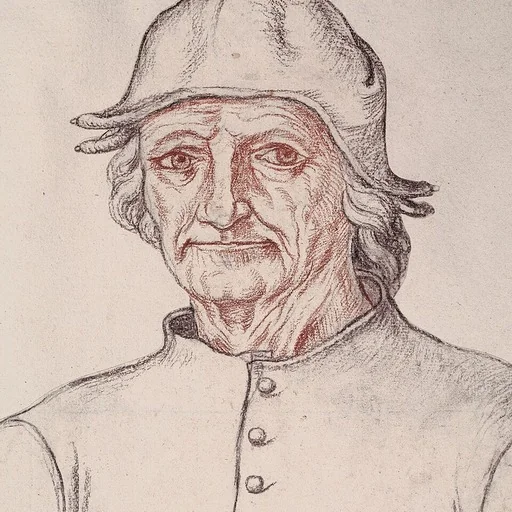
Hieronymus Bosch (; Dutch:; born Jheronimus van Aken; c. 1450 – 9 August 1516) was a Dutch painter from Brabant. He is one of the most notable representatives of the Early Netherlandish painting school. His work,…