Artwork
Madonna and Child and Saints
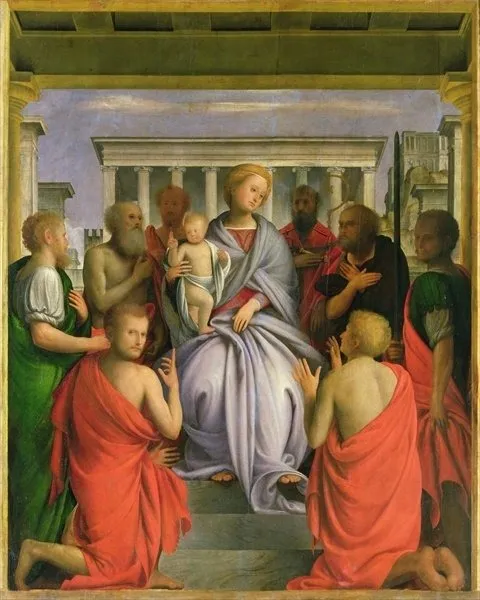
Madonna and Child and Saints is an oil painting by the High Renaissance artist Bramantino. It dates from 1515 and is held in the collection of the Uffizi Gallery.
About this work
Overview
Madonna and Child and Saints is a religious painting created by the Italian Renaissance painter and architect Bramantino around 1515 to 1520.
Madonna and Child and Saints is a religious painting created by the Italian Renaissance painter and architect Bramantino around 1515 to 1520. Executed in oil on canvas, the work measures 203 cm in height and 167 cm in width. It belongs to the sacra conversazione genre, depicting the Virgin and Child grouped with holy figures in a unified spatial setting. The painting was originally housed in the church of Santa Maria del Giardino in Milan and is currently held in the Contini Bonacossi collection at the Uffizi Gallery in Florence.
Subject & Meaning
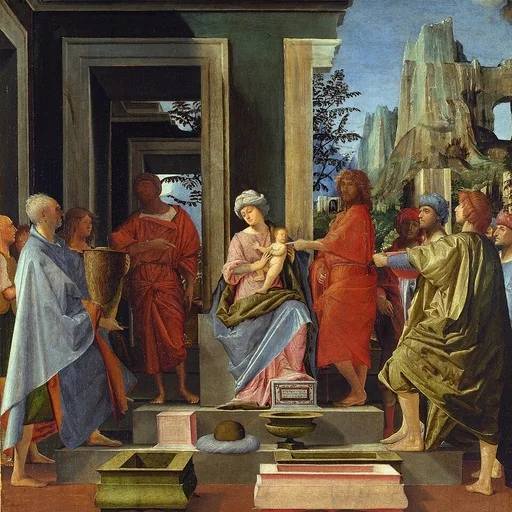
The composition centers on the Virgin Mary, who holds the Christ Child on her lap while seated on a raised platform beyond a short staircase. She is surrounded by eight male saints arranged in a semicircle. The figures lack traditional attributes, making specific identification difficult, though scholars have proposed several possibilities. The kneeling figure on the left, gesturing toward the infant, is likely John the Baptist in his role as precursor. The elderly, bare-chested, bearded man may be Job or Saint Jerome. On the right, the figures are thought to include a bishop, possibly Saint Ambrose, an unknown monk, a warrior saint holding a long sword who could be Saint George or Saint Sebastian, and a second kneeling saint without attributes. The figures engage the viewer and one another through reverential gestures, with several hands raised or placed on chests, and the Christ Child turns toward the viewer with one arm extended.
Technique & Style
Bramantino employed a pyramidal compositional model borrowed from Leonardo da Vinci and Bramante, which is restrained by the rigid horizontal scheme of the classical architecture. The setting features a foreground portico, symmetrical curtains of pillars, and a vast classical temple with an Ionic colonnade that closes the proscenium, allowing glimpses of buildings and a crenellated fortress in the distance. The architecture displays linear perspective, and gold trim accents the coffered ceiling beams. The palette features warm reds, cool blues, and muted greens, with a lightened tonality. Bramantino complicated the illumination by placing the group under a portico, introducing a light source in front of the figures and one behind. This complex lighting creates soft shadows that model the simplified anatomical forms and precise contours. The smooth, polished brushwork minimizes visible texture, contributing to an atmosphere of suspended, intellectual unreality. Symmetrical correspondences between the right and left halves, seen in the drapery, gestures, and physical types, further enhance this effect.
History & Provenance
The painting was originally located in the church of Santa Maria del Giardino in Milan. Its exact date of creation remains uncertain, but it was certainly executed after Bramantino's stay in Rome in 1508, as evidenced by the classical architectural reminiscences. Scholars typically assign the work to the final phase of the artist's career, which extends to around 1525, after which no further records of him exist. The painting subsequently entered the Contini Bonacossi collection. In 1969, it was among the works selected from this collection for donation to the Uffizi Gallery in Florence, where it remains today as part of the Contini Bonacossi collection.
Context
The painting reflects Bramantino's engagement with the artistic innovations of his contemporaries, particularly the complex lighting effects inaugurated in Milan by Leonardo da Vinci. This research into multiple light sources under a portico was carried forward not only by Bramantino but also by contemporaries such as Lorenzo Lotto in the Martinengo Altarpiece (1513 to 1516) and Romanino in the Pala di San Francesco di Brescia (1517). The integration of Leonardo's pyramidal composition and Bramante's architectural rigor demonstrates Bramantino's synthesis of High Renaissance principles, while the simplification of forms and the intellectual unreality of the scene point toward his distinct personal style at the end of his career.

Artist & collection