Artwork
Madonna and Child Enthroned with Saints
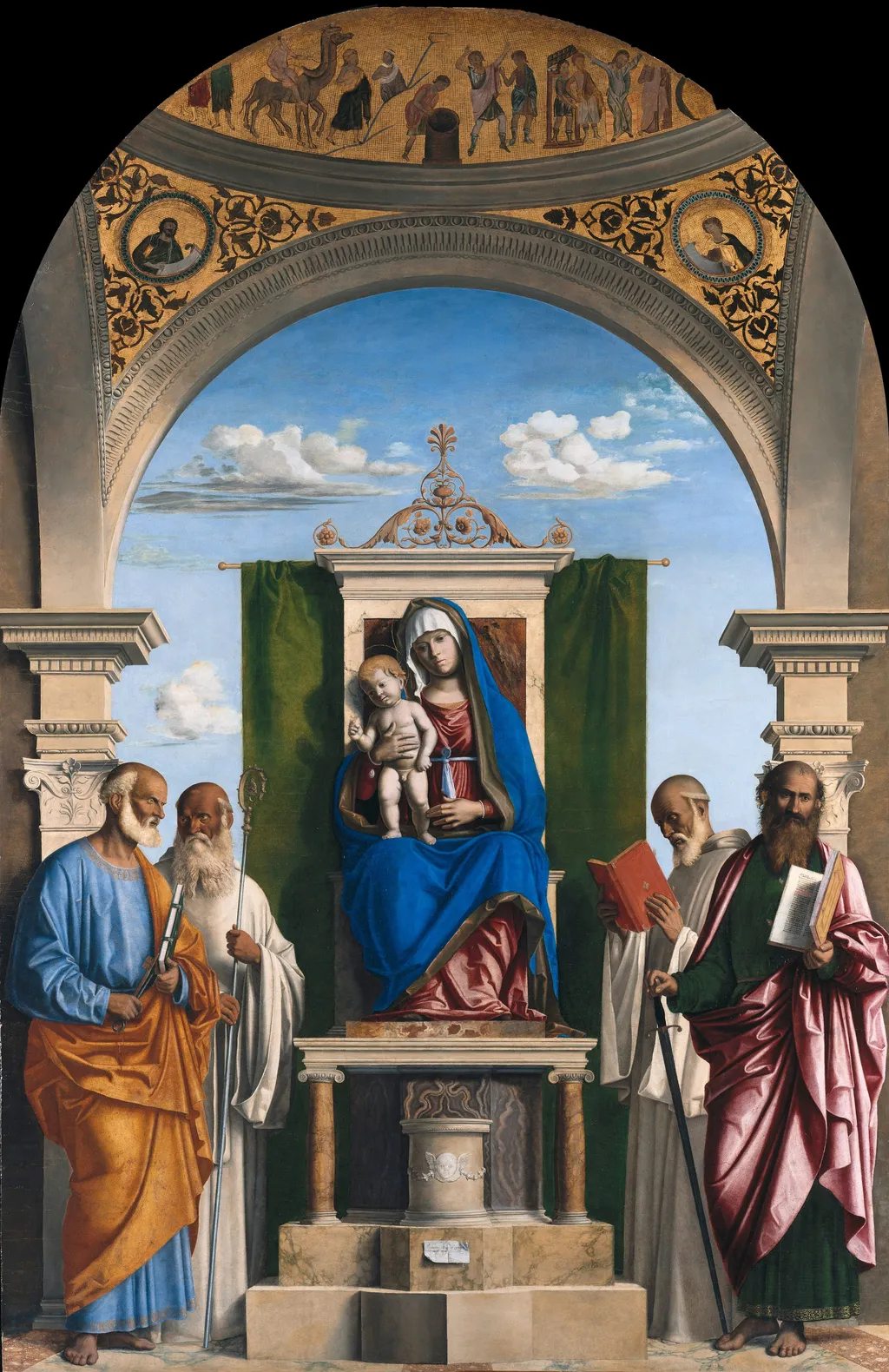
Madonna and Child Enthroned with Saints is an oil painting by the High Renaissance artist Giovanni Battista Cima da Conegliano. It dates from 1498 and is held in the collection of the Gemäldegalerie Berlin. Created in 1504, this oil painting on panel depicts the Virgin Mary seated with the infant Jesus, flanked by four saints.
About this work
Subject & Meaning
The two rear figures wear white monastic habits, while the front pair wear tunics and togas and stand barefoot, identifying them as apostles.
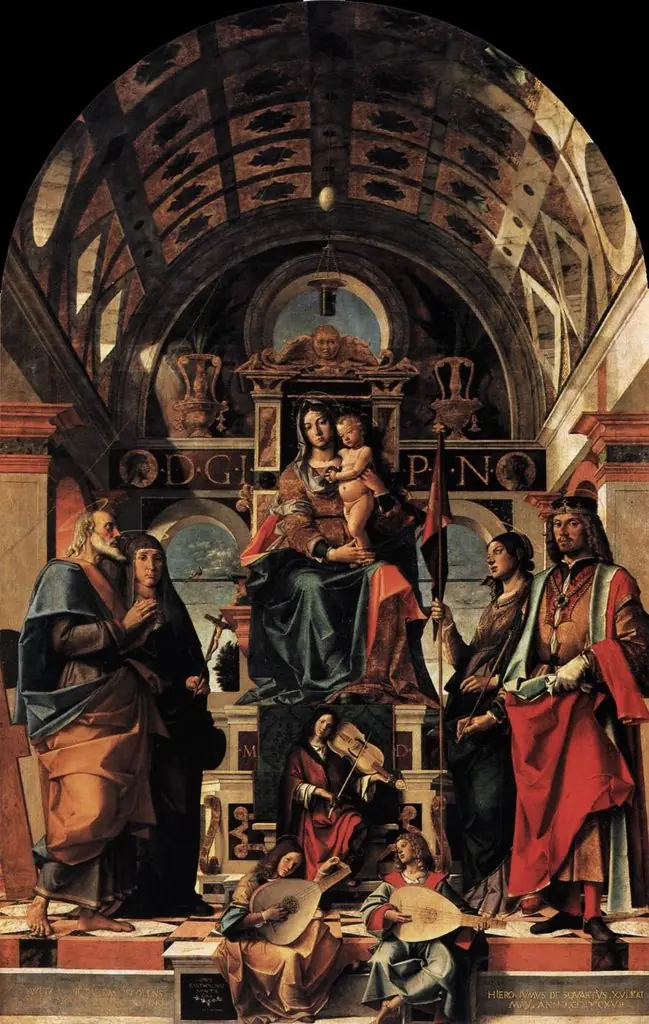
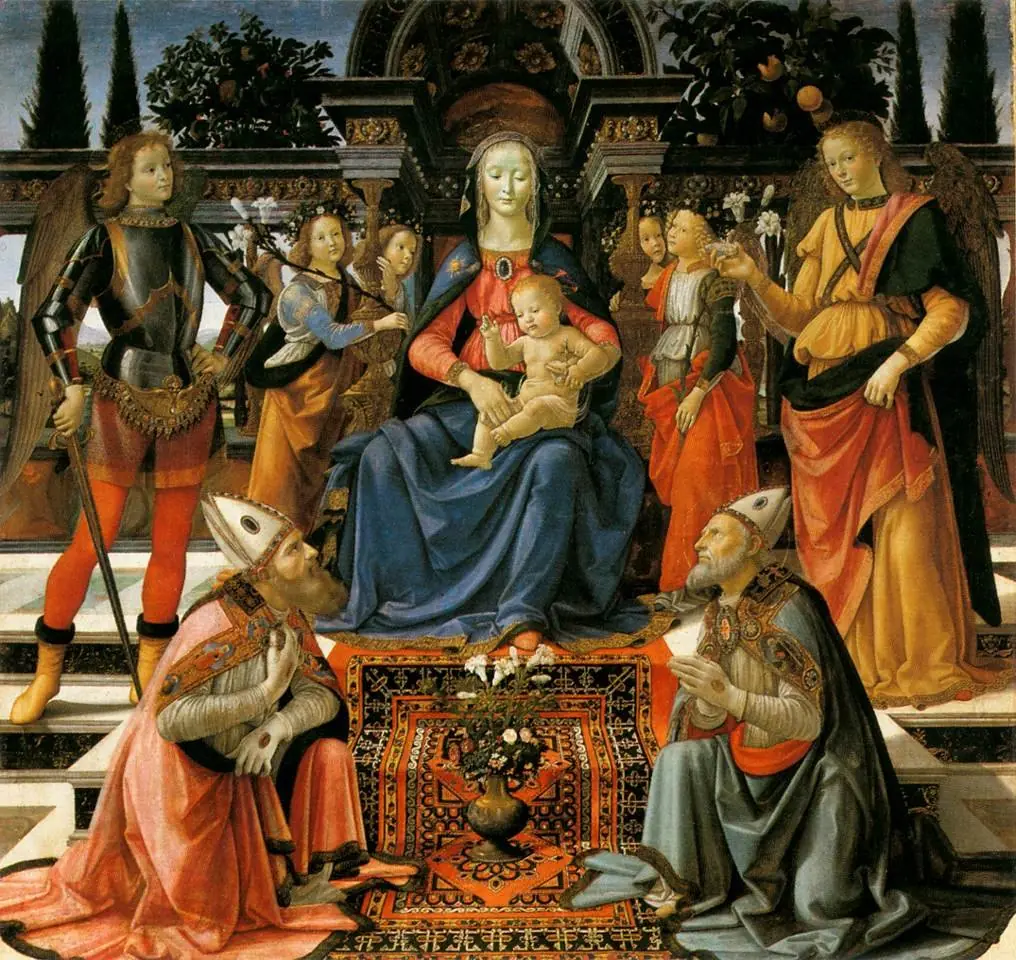
The painting belongs to the iconographic type known as the sacra conversazione, in which the Madonna and Child are shown enthroned among saints in a unified space rather than separated into discrete panels. The Virgin, wearing a red dress, white veil, and blue mantle, holds the standing Christ Child on her right leg; the Child raises his right hand in a gesture of blessing. All figures bear thin golden haloes.
Four male saints flank the throne: Peter (with keys), Romuald, Benedict of Nursia, and Paul (with a sword). Three hold books and one carries a crosier. The two rear figures wear white monastic habits, while the front pair wear tunics and togas and stand barefoot, identifying them as apostles. The figures are arranged within an open chapel-like structure crowned by a mosaic-decorated dome.
The dome mosaic depicts a narrative sequence, a young man on a camel, figures gathered around a well, and an agitated bearded man surrounded by others, generally interpreted as Old Testament scenes, likely relating to the patriarchs Rebecca and Isaac or the story of Moses. The mosaic medallions in the pendentives hold bust-length prophet or evangelist figures holding scrolls, turning toward the center.
Technique & Style
Executed in oil on a support of glued poplar wood panels, this altarpiece measures 206 by 136 cm and features a rounded arch top. The artist employed central perspective with a low horizon line to create an upward viewing angle, while a painted cartellino on the throne steps provides an illusionistic signature. Light enters from the front right, generating strong chiaroscuro contrasts on the figures' drapery and faces.
The composition is set within an architectural space resembling a ciborium, capped by a dome decorated with a gold-ground mosaic depicting narrative scenes and medallions. Figures are distinguished by thin golden halo rings. The work retains a narrow, partially gilded frame, and the paint surface exhibits detailed rendering of textures, from the marble throne to the floral decorations on the foreground cylinder.
History & Provenance
The work was created circa 1496 as an oil painting on panel by Giovanni Battista Cima da Conegliano, originally commissioned for private devotion and later entering the collection of Edward Solly, whose holdings formed the core of the Gemäldegalerie Berlin's early acquisitions. It was acquired by the Gemäldegalerie Berlin in the early 19th century, where it remains on display today.
The painting is documented in multiple sources as having been produced between 1495 and 1497 in Venice, with its creation date often cited as 1504 in later scholarly references. It was originally part of the Solly collection, which was sold to the Prussian state and incorporated into the Gemäldegalerie's holdings. The work has been part of the museum's permanent exhibition since its acquisition, forming a key example of Venetian Renaissance sacra conversazione.
The composition features the Virgin and Child enthroned among saints Peter, Romuald, Benedict of Nursia, and Paul, rendered in oil on panel with a rounded upper edge and a shallow, trompe-l'oeil inscription bearing the artist's signature. The painting measures 206 by 135 centimeters and is executed in oil on poplar wood, with a later-added gilded frame. It has undergone conservation treatment, though specific details of restoration are not widely documented.
The painting is held in the Gemäldegalerie in Berlin, part of the Staatliche Museen zu Berlin. It is currently displayed in the museum's permanent collection. The work was part of the renowned Solly collection before entering the state holdings; it is historically associated with the collector Edward Solly.
While specific accession numbers are not provided in the sources, the painting's provenance traces back to this significant private assembly. Regarding exhibition history, the sources confirm its long-term presence in the Berlin gallery but do not list specific temporary exhibitions or loan records. The artwork remains a key component of the museum's holdings of Venetian Renaissance art.
Legacy
The painting has been recognized as an early example of sacra conversazione that shaped later Venetian altarpieces. Its compositional innovations, particularly the use of perspective and the trompe-l'oeil inscription, influenced Giovanni Bellini and subsequent Venetian painters such as Lorenzo Lotto. The work entered the collection of Edward Solly in the early 19th century, forming a core part of the Berlin Gemäldegalerie's holdings and later became a reference point for studies of Venetian Renaissance art.
Scholars have highlighted its role in the development of narrative altarpieces and its impact on the visual language of sacred imagery in the 16th century.
The attribution to Giovanni Battista Cima da Conegliano was solidified through comparative analysis with other works, including documented altarpieces in Murano and Berlin, and the painting's stylistic parallels to Giovanni Bellini's workshop. Contemporary scholarship, such as Catarina Schmidt Arcangeli's 2015 study, emphasizes the painting's significance within the Berlin collection and its contribution to the understanding of Venetian religious art. The work remains a key piece in the Gemäldegalerie's display of early Renaissance masterpieces.
Overview
Created in 1504, this oil painting on panel depicts the Virgin Mary seated with the infant Jesus, flanked by four saints. The work is attributed to the Venetian painter Cima da Conegliano and is presently housed in the Gemäldegalerie in Berlin. The composition presents the holy figures in a linear arrangement, emphasizing their hierarchical relationship.
Context
Cima da Conegliano worked in the Veneto region during a period when Venetian artists were refining oil techniques to enhance color depth and atmospheric effects. This painting reflects the era’s emphasis on harmonious composition and the integration of saints into a unified devotional tableau, aligning with contemporary liturgical practices and the patronage of monastic orders.
Own this work as a print
Artist & collection
Artist
Giovanni Battista Cima da Conegliano
Giovanni Battista Cima, also called Cima da Conegliano (c. 1459 – c. 1517), was an Italian Renaissance painter, who mostly worked in Venice. He can be considered part of the Venetian school, though he was also…

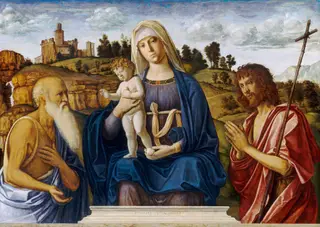 Madonna and Child with Saint Jerome and Saint John the Baptist
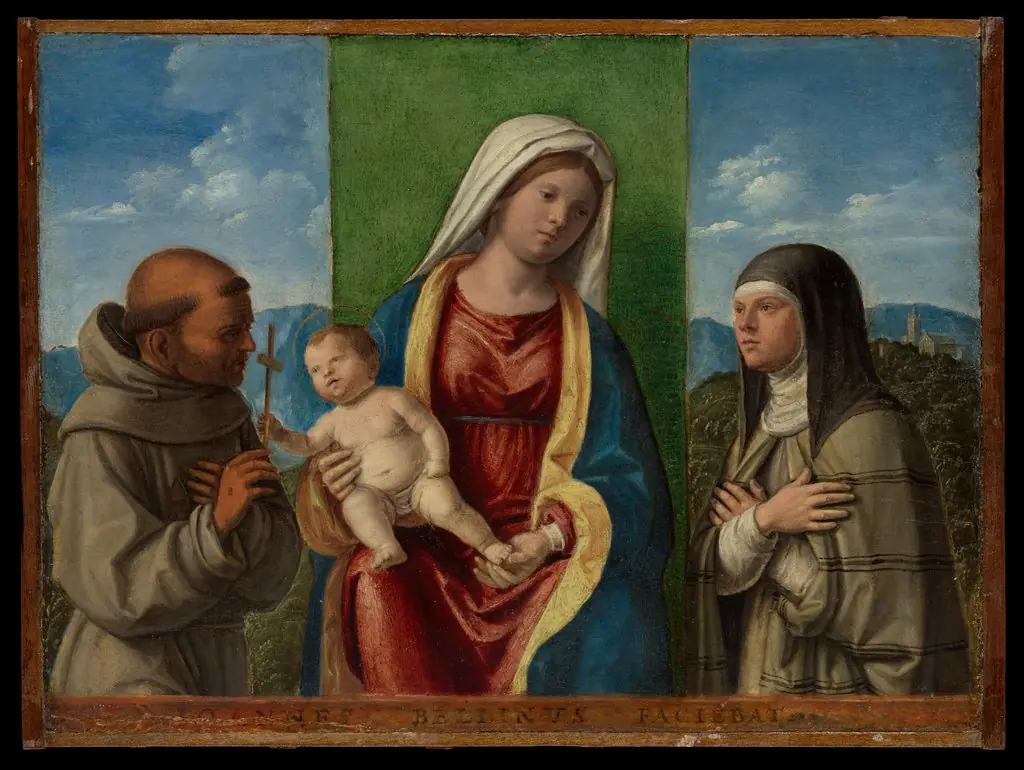 Madonna and Child with Saints Francis and Clare
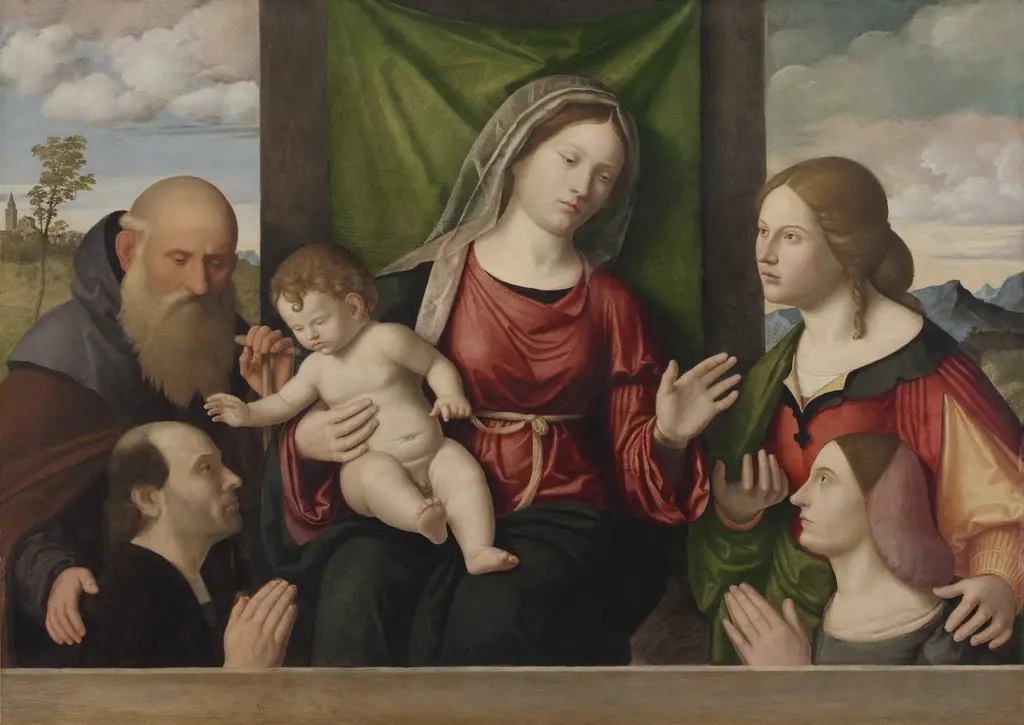 Virgin and Child with Saints and Donors
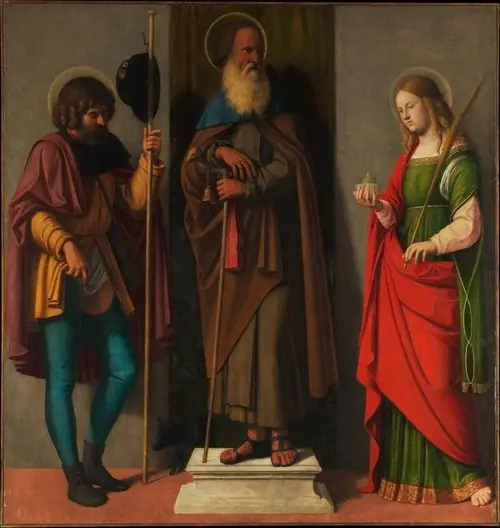 Saints Roch, Anthony Abbot and Lucy
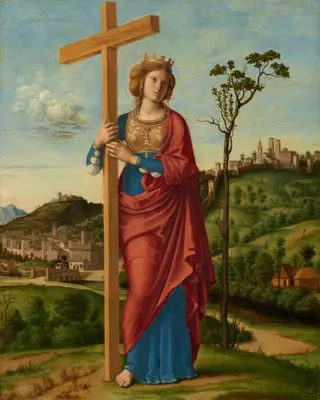 Saint Helena
 Saint Jerome in the Wilderness
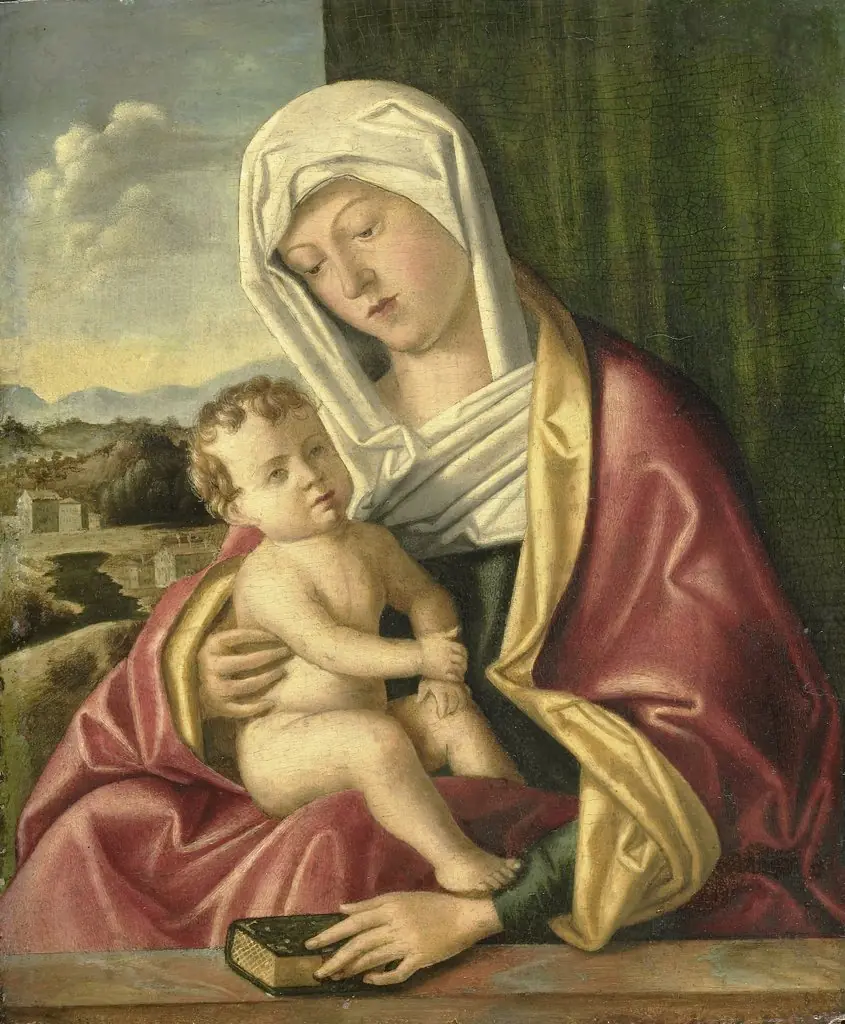 Virgin and Child
 The Judgement of Midas. The Musical Contest between Apollo and Marsyas
- Madonna and Child Enthroned with Saints
 Madonna and Child enthroned with Saints
 Madonna and Child Enthroned with Saints
 Madonna and Child Enthroned with Saints and Donor
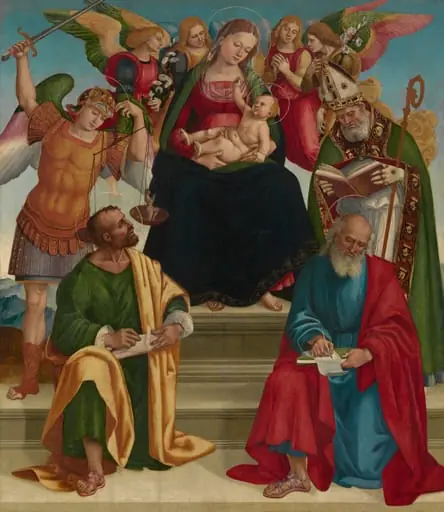 Madonna and Child with Saints and Angels
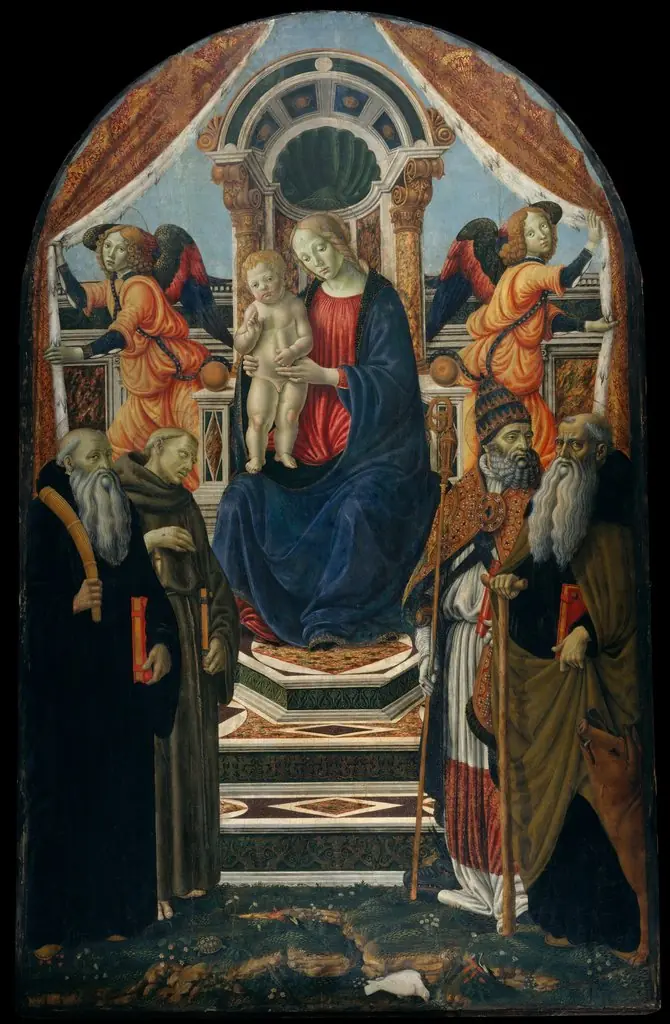 Madonna and Child Enthroned with Saints and Angels
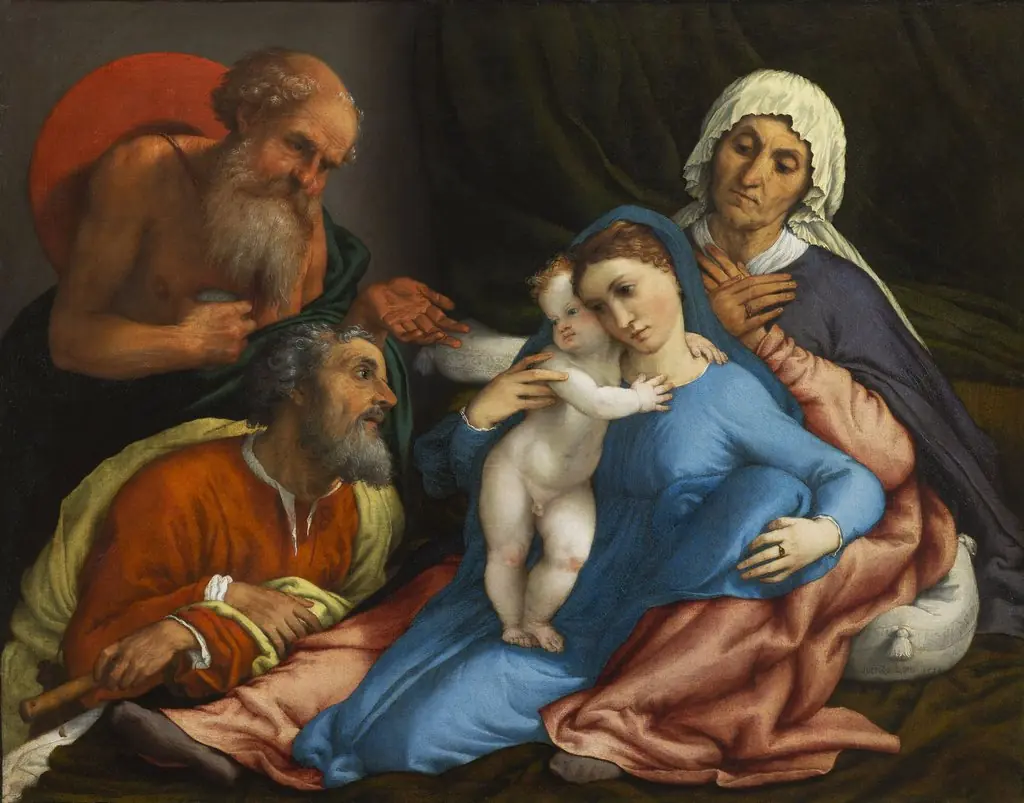 Madonna and Child with Saints
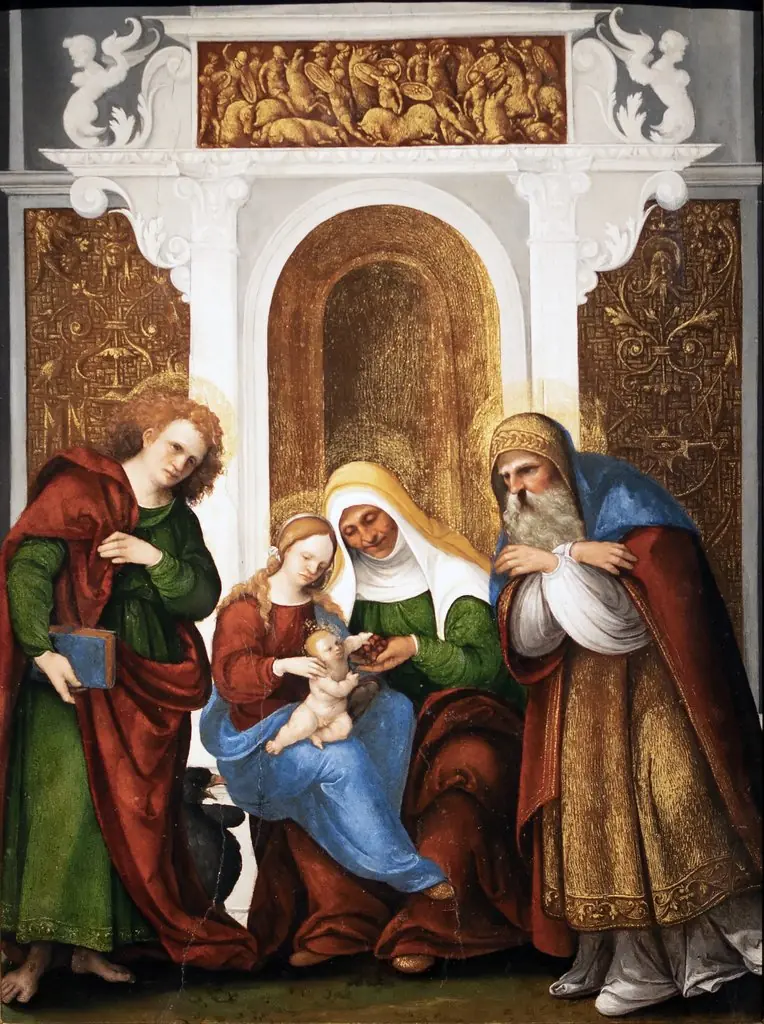 Madonna with Child and Saints
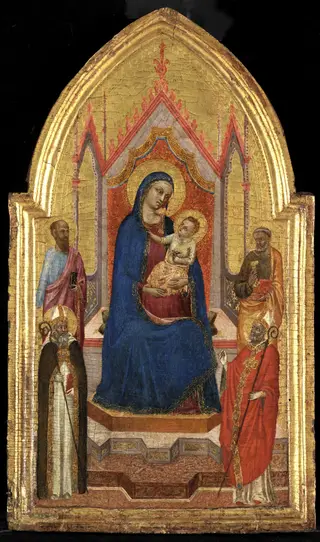 Madonna and Child Enthroned with Four Saints
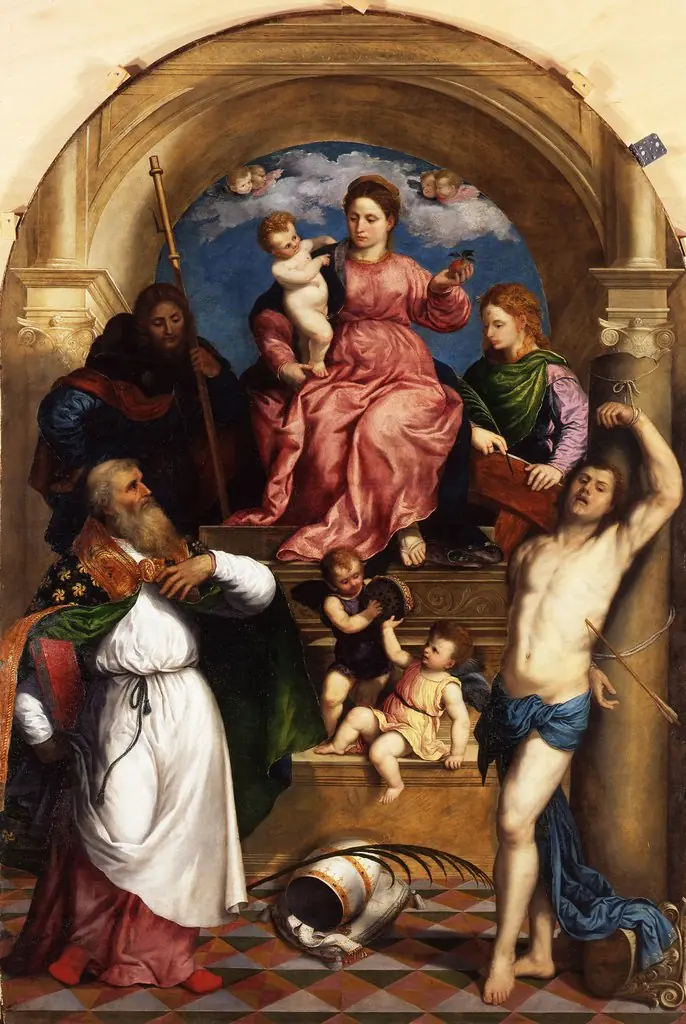 Enthroned Madonna with Child and Saints