Artwork
Upnor Castle
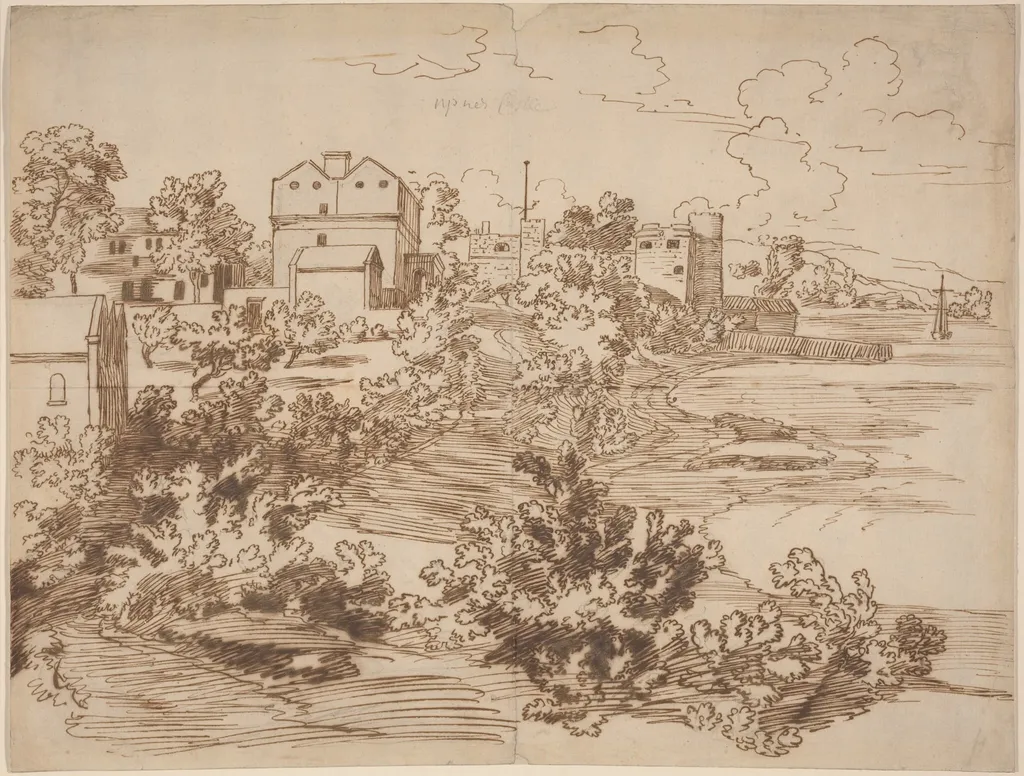
Upnor Castle is a graphite drawing by the Baroque artist British 18th Century. It is held in the collection of the National Gallery of Art.
- Inscription
- Inscribed:upper center in graphite: Upner Castle
About this work
Overview
5 centimetres (12 3/16 by 15 15/16 inches), the work depicts a landscape view of Upnor Castle, the Elizabethan artillery fort on the River Medway in Kent.
Upnor Castle is a pen and iron gall ink drawing over graphite on laid paper, executed by an anonymous British artist during the eighteenth century. Measuring 30.9 by 40.5 centimetres (12 3/16 by 15 15/16 inches), the work depicts a landscape view of Upnor Castle, the Elizabethan artillery fort on the River Medway in Kent. The drawing is held in the collection of the National Gallery of Art in Washington, D.C., under accession number 1995.52.8, having been gifted to the institution in 1995. As a rare eighteenth-century visual record of a strategically significant English coastal fortification, the drawing occupies an important place in the documentary tradition of British topographical art, bridging the gap between military cartography and the aesthetic conventions of the picturesque landscape.
Subject & Meaning
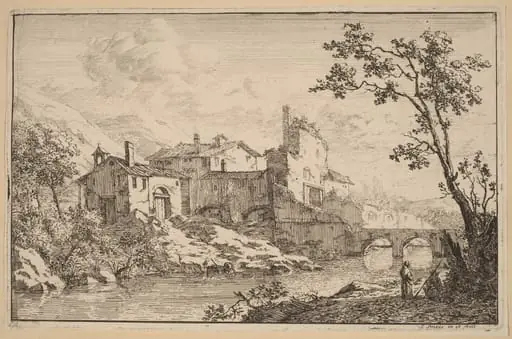
The drawing presents a view across water toward the castle complex, with dense foliage and trees in the foreground rendered through detailed hatching and cross-hatching that creates dark masses of leaves and branches. To the left, a building with a gabled roof and small arched window sits near the water's edge, while behind it a larger multi-gabled house with circular attic windows and a chimney rises above the trees. To the right of this house, the stone fortifications become visible, including a cylindrical tower with crenellations and a smaller tower, together suggesting the castle complex. A flagpole rises between the buildings, and a small wooden structure on a platform extends into the water near the castle. The water itself is indicated by horizontal parallel lines with slight curves, suggesting gentle movement, while in the far distance a small sailboat with a single mast appears and low hills recede toward the horizon. The sky contains scattered clouds drawn with looping, irregular outlines. The composition juxtaposes the domestic and the martial, the natural and the architectural, presenting the castle not merely as a military installation but as an inhabited site integrated into its riverside environment. The graphite inscription in the upper center, reading 'Upner Castle,' identifies the subject with the slight orthographic variation common in the period. The drawing thus serves both as topographical record and as an exercise in the eighteenth-century taste for landscapes that balance human industry with natural setting.
Technique & Style
The drawing relies entirely on line work, varying from fine contour lines to dense hatching for shadow and texture, with no wash or color beyond the brown iron gall ink. The technique demonstrates the characteristic precision of eighteenth-century British draftsmanship, with particular attention to the skewomorphic effects of foliage through layered parallel strokes and curving outlines. The artist employs a horizontal format that emphasizes the expansive river view, using the water as a compositional device to create spatial depth. A vertical crease runs through the center of the sheet, indicating the paper was folded, perhaps for storage or transport. The support is laid paper, typical of the period, and the use of graphite underdrawing beneath the ink suggests a careful preparatory process. The absence of wash indicates a preference for linear clarity over tonal atmosphere, distinguishing this work from the more painterly traditions of contemporary watercolor. The condition appears stable, with the iron gall ink having maintained its brown tone without excessive corrosion of the paper support.
History & Provenance
The drawing's provenance is well documented. It was owned by Sir Bruce Stirling Ingram (1877-1963), the prominent British collector and newspaper proprietor, at his Buckinghamshire residence. Following Ingram's death, the work passed through Thos. Agnew & Sons Ltd., the distinguished London dealers. William B. O'Neal of Charlottesville, Virginia, purchased the drawing from Agnew's in 1969 and retained it until his death in 1994. O'Neal's gift to the National Gallery of Art in 1995 brought the work into the public collection, where it is now accessible as part of the museum's holdings of European drawings. No exhibition history is recorded in the available sources, and the circumstances of the drawing's original commission or creation remain unknown, as does the specific identity of the artist, who is designated only as 'British 18th Century' in the museum's records.
Context
The artist's anonymity places the drawing within the broad tradition of British topographical draftsmen of the eighteenth century, a period when the accurate recording of estates, landscapes, and fortifications served both private patrons and an emerging antiquarian interest in Britain's built heritage. The subject itself carries substantial historical weight: Upnor Castle was constructed between 1559 and 1567 to designs by Sir Richard Lee, under orders from Queen Elizabeth I, to defend the naval dockyard at Chatham and Royal Navy vessels on the River Medway. The castle's significance was confirmed during the Dutch Raid on the Medway in June 1667, when it resisted more effectively than surrounding defenses, and it was subsequently converted to a naval ammunition storehouse in 1668. By the eighteenth century, when this drawing was made, the castle had assumed the picturesque character of a historic site, its military function diminished though not yet extinguished. The drawing thus participates in a wider cultural project of documenting Britain's architectural past, one that would accelerate with the rise of the Picturesque movement and the antiquarian publications of the later eighteenth and early nineteenth centuries. The work's presence in the collection of Sir Bruce Ingram, a noted collector of British historical material, confirms its recognition within this tradition of topographical and historical art.
Legacy
The drawing's legacy resides primarily in its documentary value and its representative status within the National Gallery of Art's collection of British drawings. Unlike the castle itself, which became a Scheduled Ancient Monument in 1960 and is now maintained by English Heritage as a public heritage site, the drawing has not been the subject of extensive scholarly attention or reproduction. Its acquisition by the National Gallery of Art in 1995 ensured its preservation and public accessibility, distinguishing it from many comparable topographical drawings that remain in private hands. The work serves as a visual anchor for understanding the appearance of Upnor Castle in the eighteenth century, before later alterations and the interventions of modern conservation. In the broader context of British art history, it exemplifies the period's investment in precise linear observation and the aesthetic appreciation of historical architecture within landscape settings, qualities that would influence the development of Romantic landscape sensibility even as they preserved earlier traditions of documentary draftsmanship.
Artist & collection

Artist
This artist left small, precise pictures from 18th-century Britain: buildings, faces, and landscapes etched or drawn in ink and chalk.

- The Woman and Tambourine
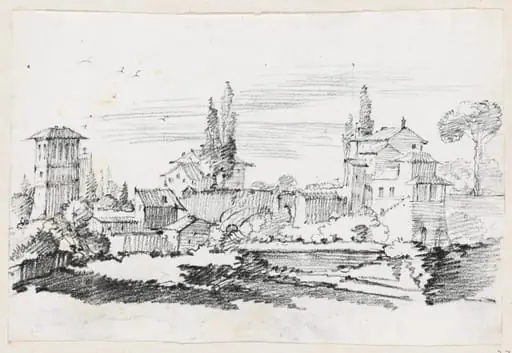 Houses in Italy
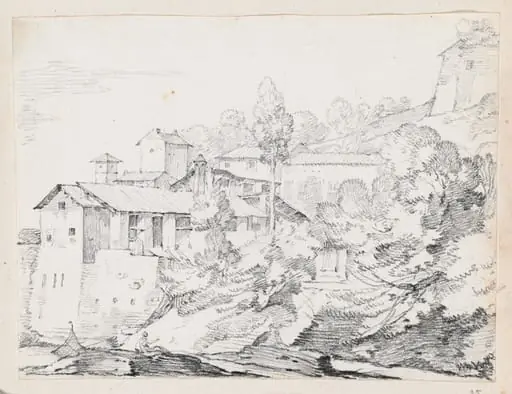 Italian Buildings on a Hillside
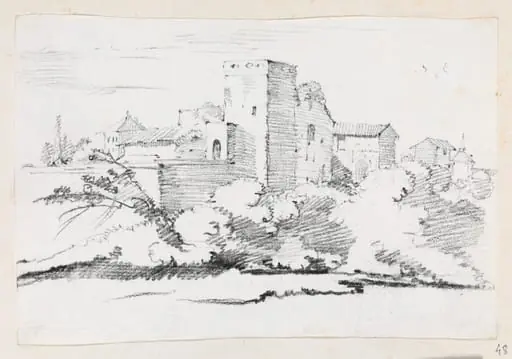 Buildings behind the Vatican
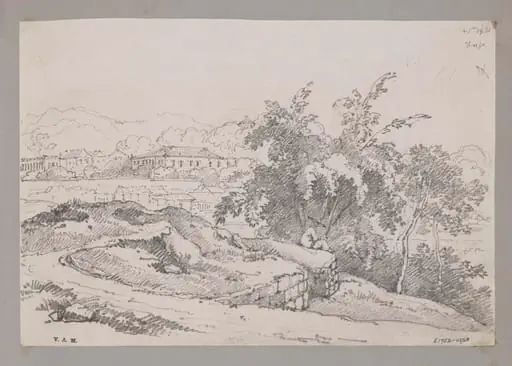 The Casa, Macao, in the gardens of which is Camoens' Cave (the residence of Lady Pereira), Macao
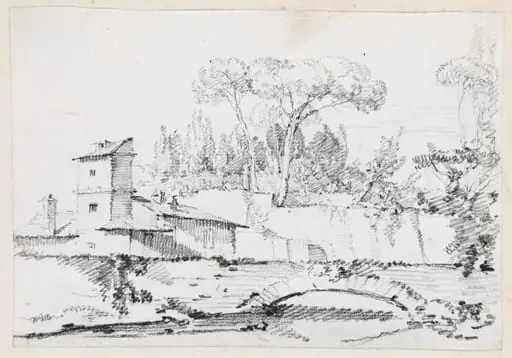 View of the Prato of the Villa Borghese
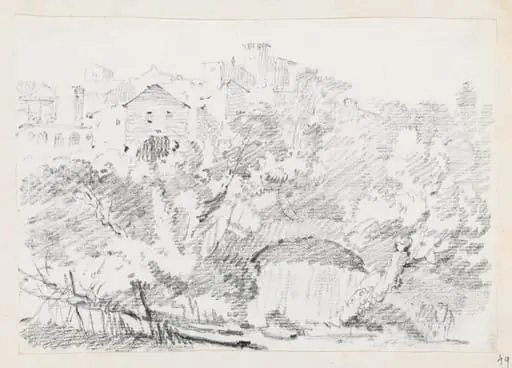 A Waterfall near a Hilltown in Italy
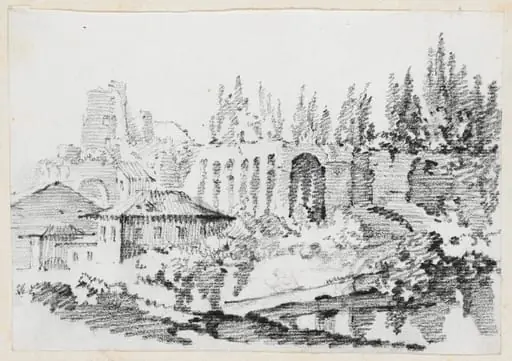 Ruins of the Imperial Palaces on the Palatine Hill
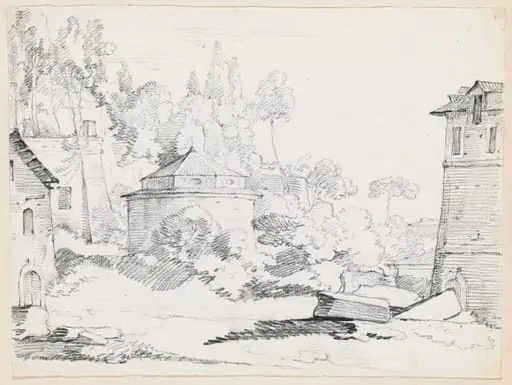 Landscape with the Church of San Teodoro
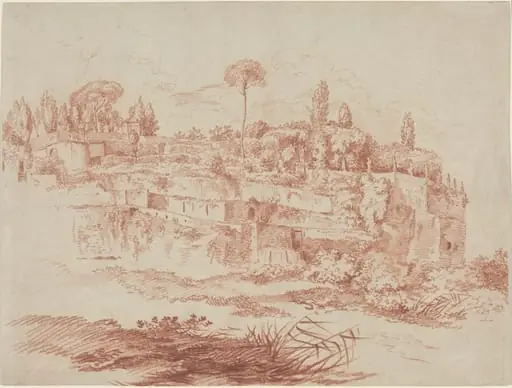 Gardens of the Villa Mattei
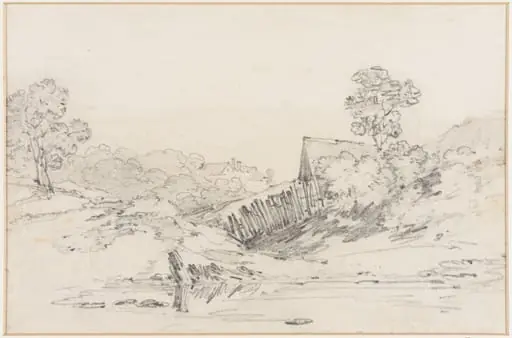 Cottage and landscape at Chirk, North Wales
 Houses at the Side of a River