Artwork
The Boating Party
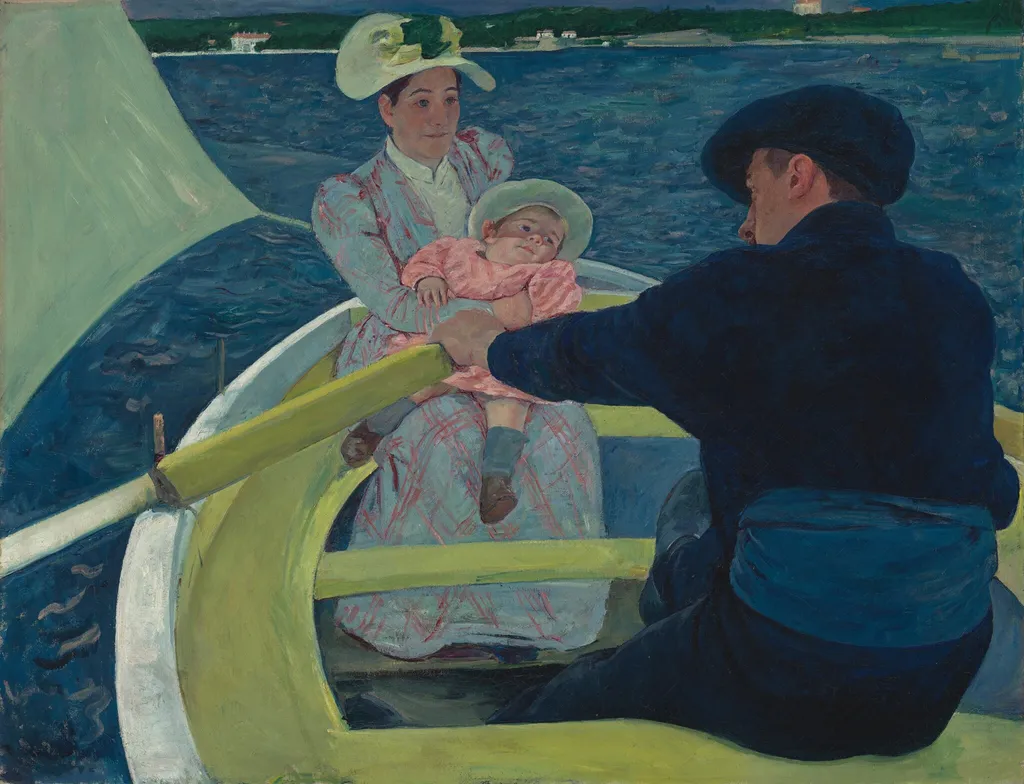
The Boating Party is an oil painting by the Impressionist artist Mary Cassatt. It dates from 1894 and is held in the collection of the National Gallery of Art.
About this work
Subject & Meaning
The composition places the oar diagonally across the canvas, a visual separator that isolates the man’s labor from the intimate space of mother and child.
The Boating Party portrays an unnamed woman cradling a child in a small sail‑boat while a man stands at the stern, his figure rendered in dark tones and marked by a sash and beret that identify him as a fisherman. The composition places the oar diagonally across the canvas, a visual separator that isolates the man’s labor from the intimate space of mother and child. Cassatt’s arrangement draws the viewer’s eye toward the mother‑child pair, underscoring her preoccupation with the nurturing role and the social significance of motherhood.
The figures’ gestures and the cropped view reflect Japanese print influences, while the bright colors heighten the sense of leisure and modernity.
Technique & Style
Created in 1893–1894, The Boating Party is an oil painting on canvas measuring 90 by 117.3 cm (nearly three by four feet), making it one of Mary Cassatt’s largest and most ambitious works. Stylistically, the painting merges Impressionist plein air vibrancy with the compositional strategies of Japanese woodblock prints. Cassatt employs bold, dark colors for the boatman in the foreground, contrasting sharply with the bright yellow of the boat's interior and the luminous depiction of the mother and child.
The composition is notably asymmetrical, featuring a high horizon line and a cropped, close-up view that cuts off parts of the boat. Diagonal lines formed by the oar, sail, and the man's arm converge to direct the viewer's focus toward the woman and child, while the man's back is turned to the audience, emphasizing a spatial and psychological distance between the figures.
History & Provenance
The Boating Party was painted by Mary Cassatt during the winter of 1893–1894 while she was staying at the Villa La Cigaronne in Antibes, France, accompanied by her mother. The work bears a date of 1893 and shows no indication of having been commissioned; the sources describe it as a self‑initiated piece. Cassatt retained ownership until at least 1918, lending the painting to the Six American Women traveling exhibition in 1917‑1918.
Thereafter it passed through Durand‑Ruel in New York and was sold on 1 October 1929 to collector Chester Dale. Upon Dale’s death in 1963, the painting was bequeathed to the National Gallery of Art, where it remains.
The Boating Party is held in the National Gallery of Art, Washington, D.C., where it has resided since 1963 as part of the Chester Dale Collection, acquired through Dale’s bequest that year. The work’s inventory reflects its accession as a Chester Dale gift, with provenance tracing from the artist’s possession until at least 1918, a period with Durand‑Ruel New York, and its sale to Chester Dale on 1 October 1929 before entering the museum. Exhibition history includes a loan by Cassatt to the traveling show Six American Women, which toured the United States in 1917‑1918.
Context
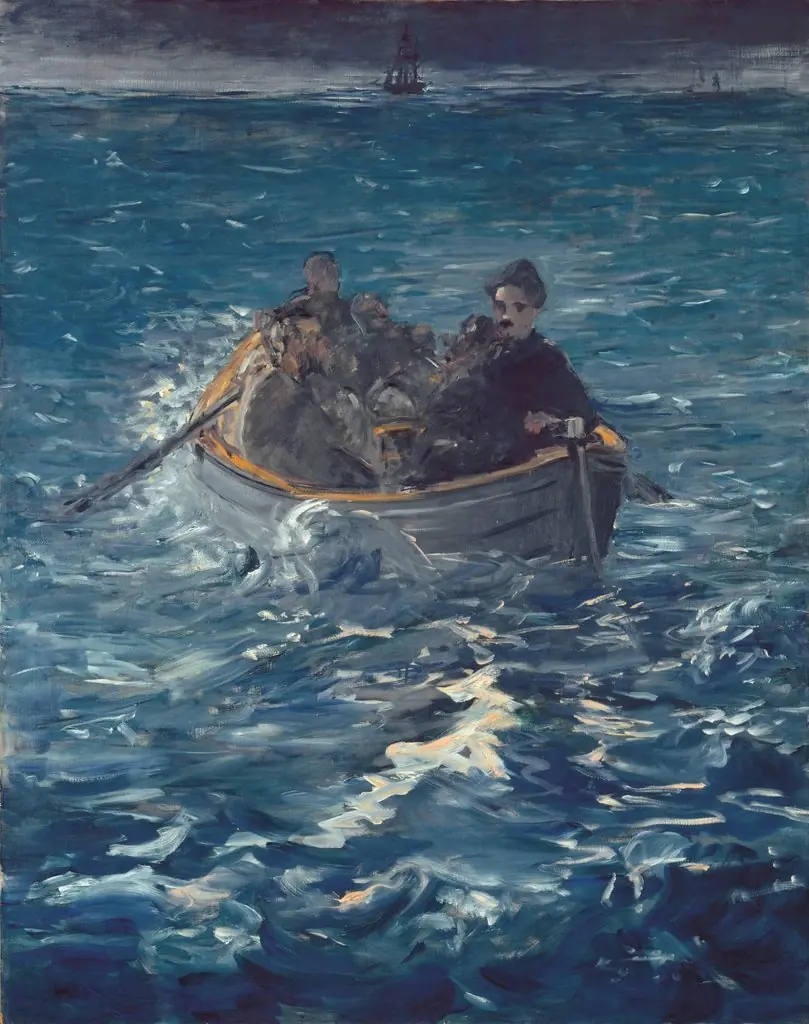
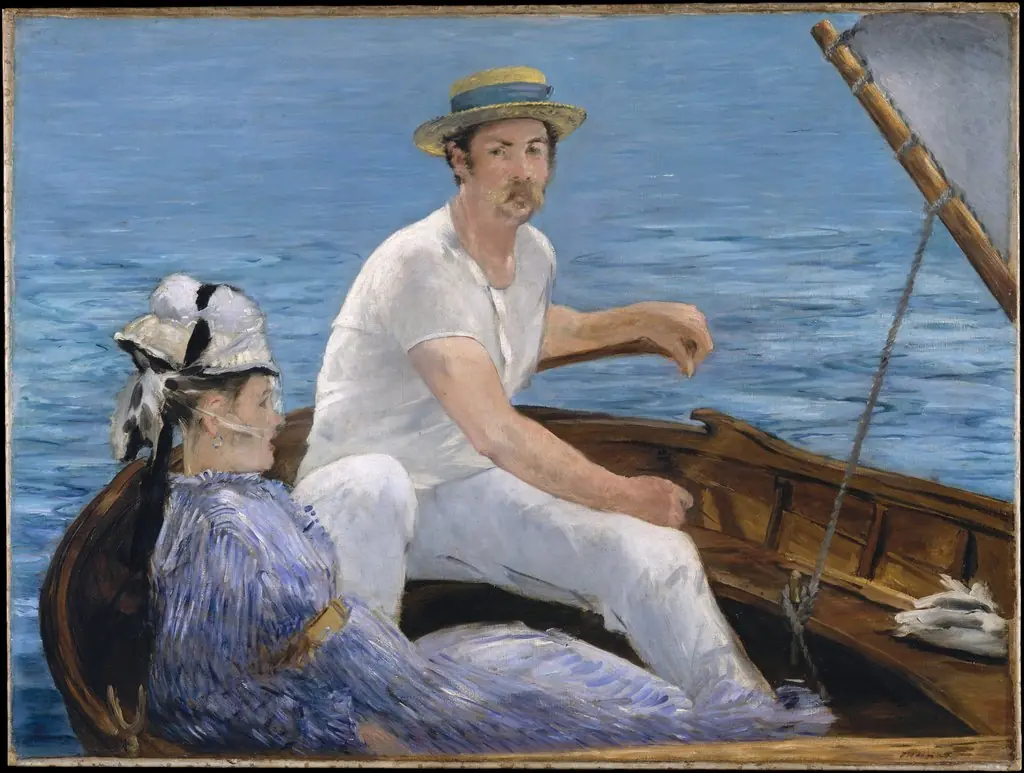
Painted in the winter of 1893–94 while Cassatt stayed at Villa La Cigaronne in Antibes, the work emerged after a breakthrough year that included the mural Modern Woman for the 1893 Chicago World’s Fair and a well‑received Durand‑Ruel exhibition, as well as a French state purchase for the Luxembourg Museum. Influences from Japanese ukiyo‑e prints, the art of Correggio, and Édouard Manet’s Boating shaped its composition, a connection noted by scholars such as Griselda Pollock and Frederick A. Sweet. The painting’s rare depiction of a man, its diagonal framing that draws the eye to mother and child, and its bold coloration reflect Cassatt’s exploration of family dynamics and Impressionist plein‑air concerns.
After being sold to Chester Dale in 1929 and bequeathed to the National Gallery of Art in 1963, it later appeared on a 1966 U.S. postage stamp.
Legacy
Although Cassatt originally kept the canvas for personal reasons, she later placed it on the market, indicating a change in its perceived value;. After its acquisition by the National Gallery of Art in 1963, the painting became one of her most widely recognized works, appearing on a U.S. postage stamp in 1966 and being described by Frederick A. Sweet as one of her most ambitious paintings and by Breeskin as unparalleled among female artists;. Scholars also cite it as one of Cassatt’s best‑known pieces and as a clear example of Japanese print influence that shaped her later style. These acknowledgments reflect its lasting reputation and influence in art history.
Overview
Mary Cassatt's 1893 oil painting, "The Boating Party," is a significant work in her oeuvre. Executed on canvas, this composition measures approximately three by four feet, making it one of the artist's most expansive and complex undertakings. It is also known by several French titles, including "La partie en bateau."
Own this work as a print
Artist & collection
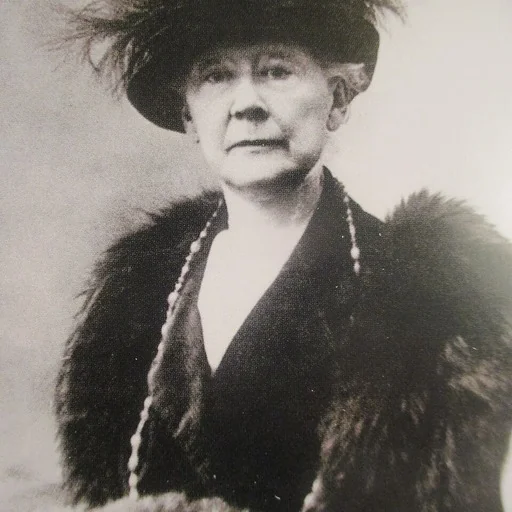
Artist
Mary Stevenson Cassatt (; May 22, 1844 – June 14, 1926) was an American painter and printmaker.