Artwork
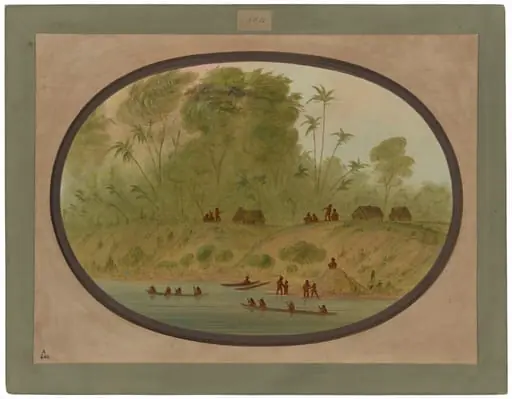
A Small Lengua Village
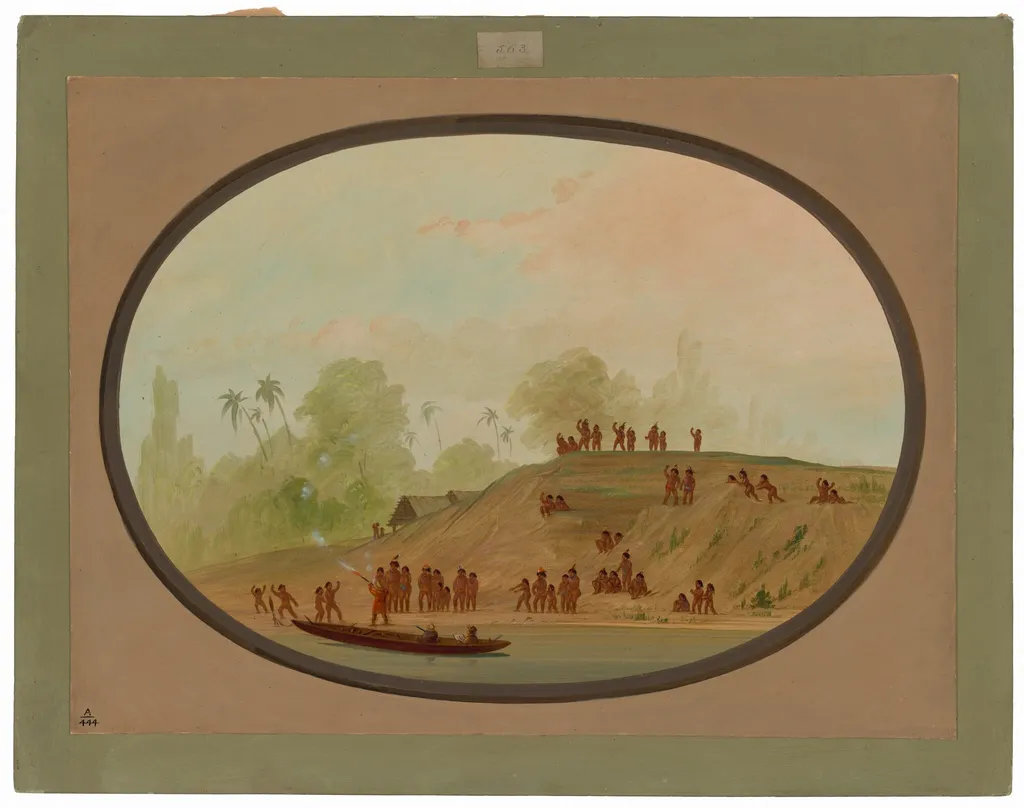
A Small Lengua Village is an oil painting by the American Folk Art artist George Catlin. It dates from 1862 and is held in the collection of the National Gallery of Art.
About this work
Technique & Style
These formal choices support the painting's function as both artifact and aesthetic statement within Catlin's broader project of visual ethnography.
Oil on card mounted on paperboard creates a textured surface that supports the landscape depiction. The painting measures 46.7 cm in height by 62.3 cm in width, characteristic of Catlin's field sketches adapted to finished compositions. Brushwork combines precise detail in the village structures with looser atmospheric handling in the surrounding terrain, reflecting his interest in documenting indigenous lifeways with both ethnographic accuracy and romanticized stylization.
The work's handling emphasizes flattened spatial depth and outlined forms, aligning with 19th-century American landscape conventions while retaining the immediacy of field observation. These formal choices support the painting's function as both artifact and aesthetic statement within Catlin's broader project of visual ethnography.
History & Provenance
The work was painted in 1861 by George Catlin. It descended by family inheritance to his daughters Clara Gregory Catlin, Louise Catlin Kinney, and Elizabeth Wing Catlin.
In 1912 the American Museum of Natural History, New York, acquired it from Elizabeth Wing Catlin. The museum sold the painting in 1959 through Kennedy Galleries, New York, to Paul Mellon, Upperville, Virginia. Mellon donated it in 1965 to the National Gallery of Art, Washington, D.C., where it remains.
The painting A Small Lengua Village is currently held by the National Gallery of Art in Washington, D.C. Its provenance traces from the artist George Catlin to his daughters, from whom the American Museum of Natural History purchased the work in 1912. The museum sold it in 1959 through Kennedy Galleries in New York to Paul Mellon of Upperville, Virginia. Mellon subsequently gifted the piece to the National Gallery of Art in 1965.
The provided sources detail this ownership history but do not list specific inventory numbers or record any exhibition history for the work.
Overview
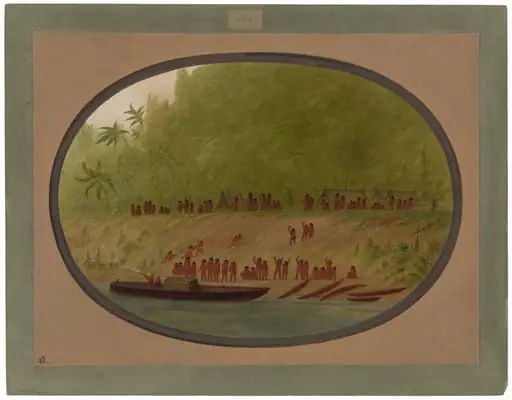
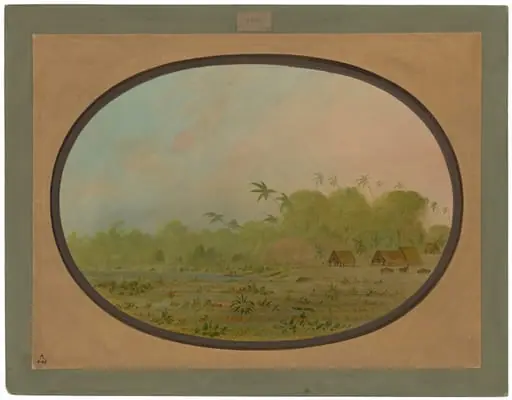
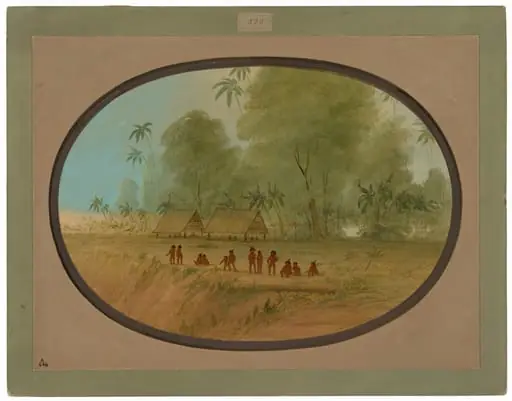
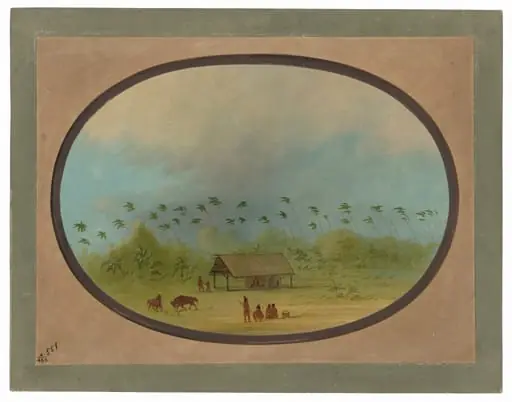
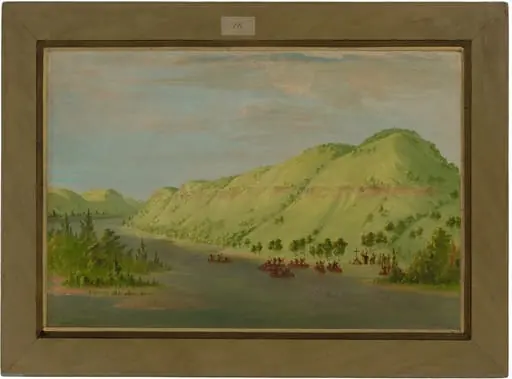
Created in 1862, A Small Lengua Village is an oil painting executed on card that has been mounted on a paperboard support. The work presents a modest settlement on a gentle slope, with a few thatched huts, palm foliage and a small boat on a calm waterway. The composition is rendered in a restrained palette of pale blues, muted greens and earthy browns, giving the scene a quiet, observational tone.
Subject & Meaning
The picture portrays members of a Lengua community engaged in everyday activities, some standing, others seated, gathered near the hillside. Though the title identifies the group, the visual details, simple dwellings, a modest watercraft, and surrounding vegetation, suggest a focus on the routine life of a small indigenous village rather than a dramatic narrative.
Context
The work fits within Catlin’s extensive visual archive of indigenous peoples, produced during a period of rapid displacement and cultural change for many tribes. By 1862, the United States was engulfed in civil war, yet Catlin persisted in documenting remote communities, offering a counterpoint to the dominant political narratives of his time.
Own this work as a print
Artist & collection

Artist
George Catlin ( KAT-lin; July 26, 1796 – December 23, 1872) was an American lawyer, painter, author, and traveler, who specialized in portraits of Native Americans in the American frontier.

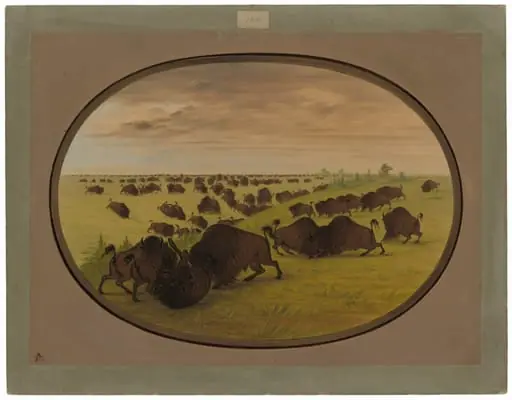 Bulls Fighting
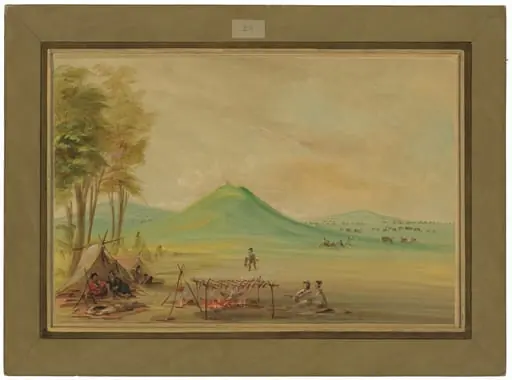 Expedition Encamped on a Texas Prairie. April 1686
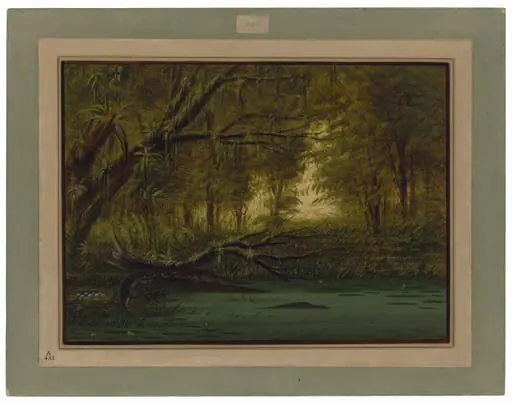 An Alligator's Nest
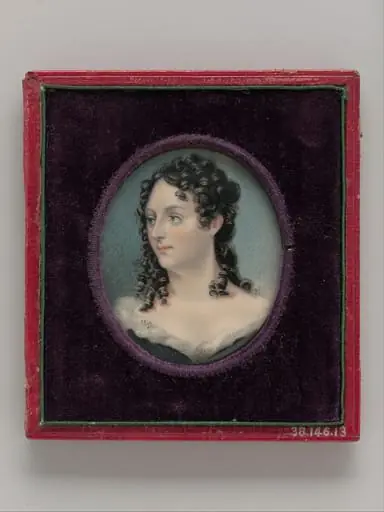 Mrs. George Catlin (Clara Bartlet Gregory)
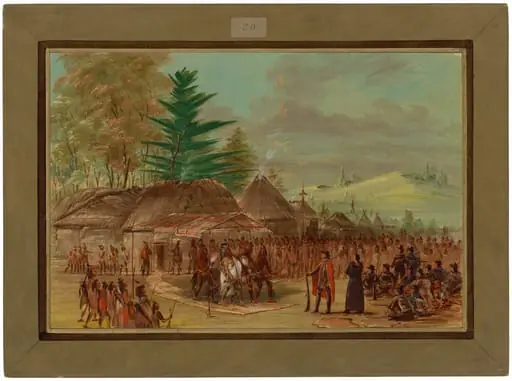 Chief of the Taensa Indians Receiving La Salle. March 20, 1682
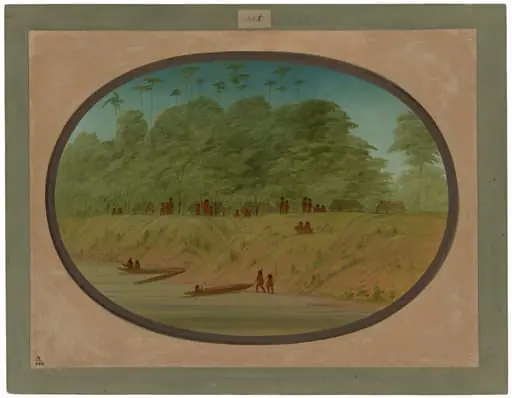 A Small Village - Payaguas Indians
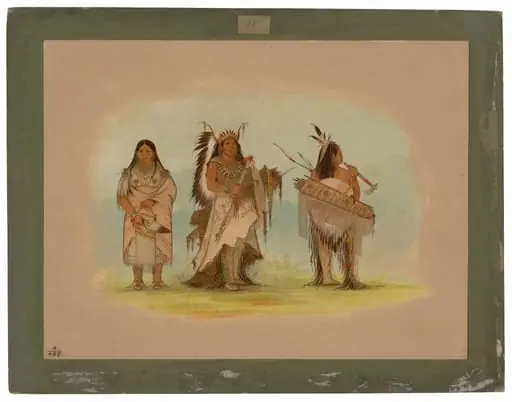 Omaha Chief, His Wife, and a Warrior
 Father Hennepin Leaving the Mississippi to Join La Salle. May 8, 1680