Artwork
Defile of a Camanchee War Party
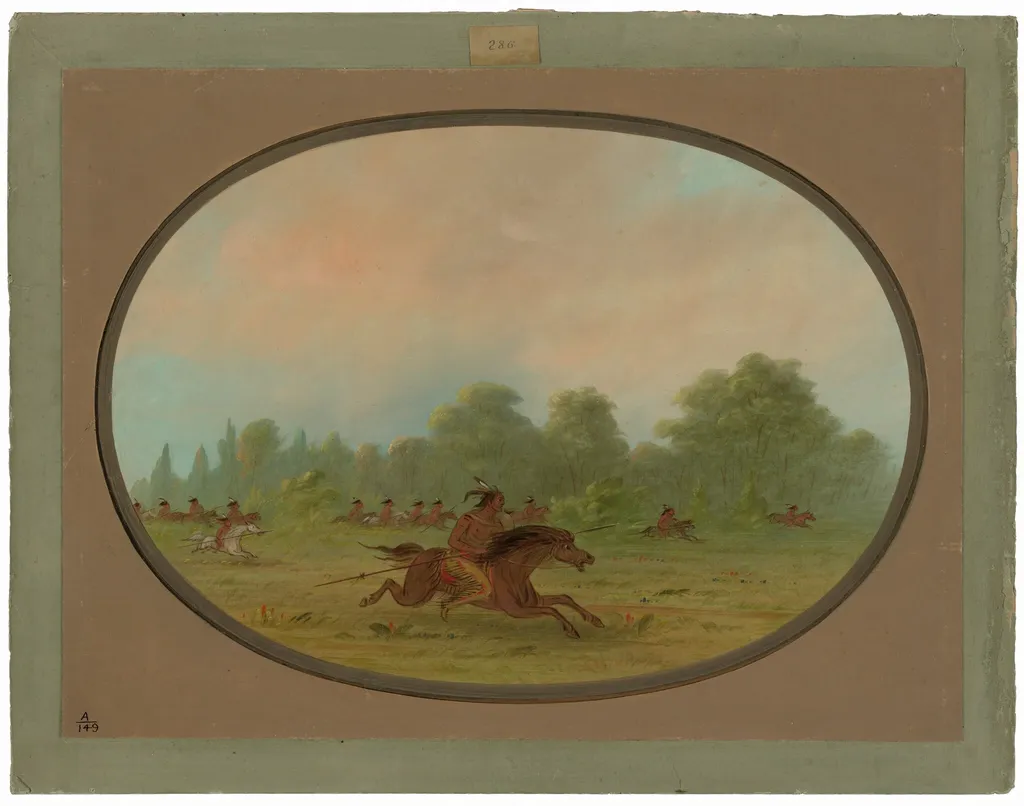
Defile of a Camanchee War Party is an oil painting by the Impressionist artist George Catlin. It dates from 1865 and is held in the collection of the National Gallery of Art.
About this work
Technique & Style
Among the formal elements documented for the work, a tree is identified as a depicted feature, anchoring the landscape setting of the scene.
Defile of a Camanchee War Party is executed in oil on card mounted on paperboard, a support choice consistent with George Catlin's practice of working on portable, relatively lightweight grounds suited to field and studio use. The painting is classified as a history painting within the corpus. Its modest scale, 46.7 by 62.9 centimeters, supports the handling of a compact, horizontally oriented composition.
Among the formal elements documented for the work, a tree is identified as a depicted feature, anchoring the landscape setting of the scene.
History & Provenance
George Catlin painted Defile of a Camanchee War Party in 1865, creating an oil on card mounted on paperboard history painting. The work descended through Catlin's daughters Clara Gregory Catlin, Louise Catlin Kinney, and Elizabeth Wing Catlin before being purchased in 1912 from Elizabeth Wing Catlin by the American Museum of Natural History. It was later sold in 1959 through Kennedy Galleries, New York, to Paul Mellon of Upperville, Virginia, and gifted to the National Gallery of Art in 1965.
Defile of a Camanchee War Party is held in the collection of the National Gallery of Art in Washington, D.C. Its provenance traces from George Catlin to his daughters, and subsequently to Elizabeth Wing Catlin, from whom it was purchased in 1912 by the American Museum of Natural History before entering the current collection.
Overview
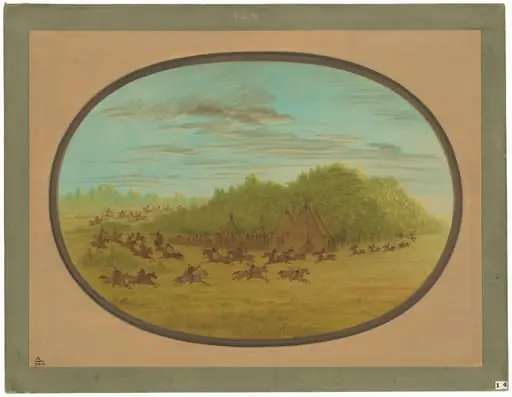
Created in 1865, Defile of a Camanchee War Party is an oil painting executed on card that has been affixed to a paperboard support. The work belongs to George Catlin’s extensive series documenting Native American life, a project that occupied much of his career after he turned from law to art. The composition centers on a lone tree, framing a group of mounted warriors as they traverse a wooded landscape.
Subject & Meaning
The scene depicts a war party of Plains Indians on horseback, moving swiftly through a forested area. The figures are rendered in a dynamic pose that conveys urgency and collective purpose, suggesting a moment of conflict or mobilization. By focusing on the warriors’ motion rather than individual portraiture, Catlin emphasizes the communal aspect of tribal warfare.
Own this work as a print
Artist & collection

Artist
George Catlin ( KAT-lin; July 26, 1796 – December 23, 1872) was an American lawyer, painter, author, and traveler, who specialized in portraits of Native Americans in the American frontier.

 Bulls Fighting
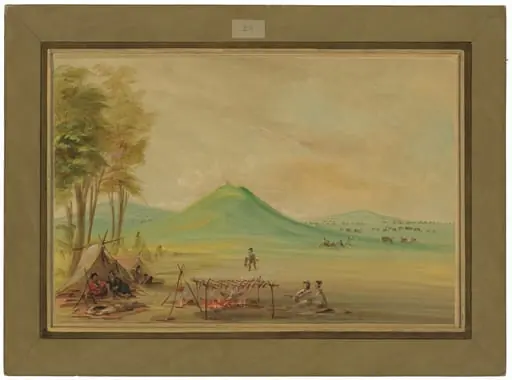 Expedition Encamped on a Texas Prairie. April 1686
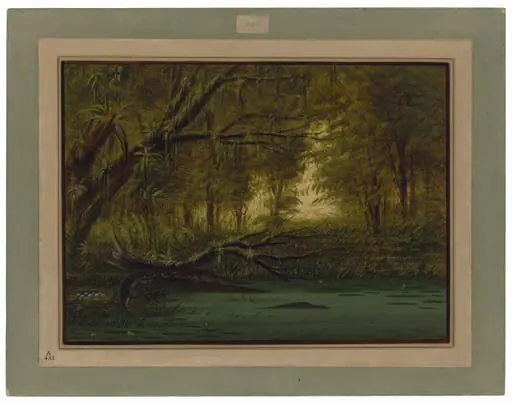 An Alligator's Nest
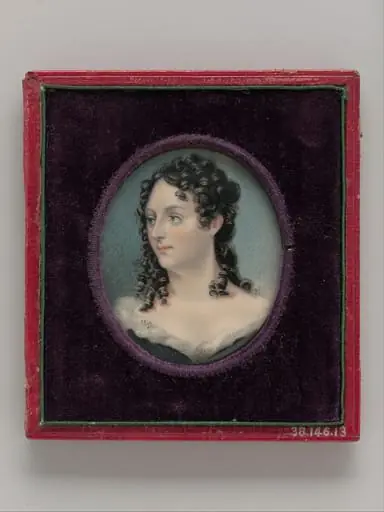 Mrs. George Catlin (Clara Bartlet Gregory)
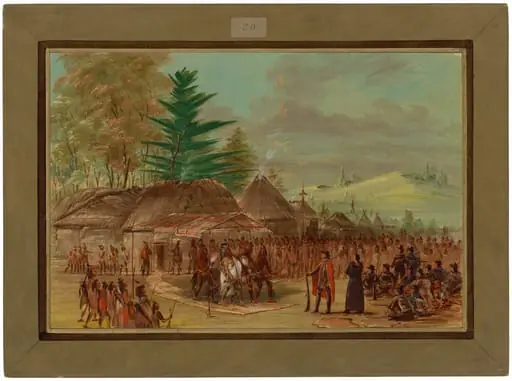 Chief of the Taensa Indians Receiving La Salle. March 20, 1682
 A Small Village - Payaguas Indians
 Omaha Chief, His Wife, and a Warrior
 Father Hennepin Leaving the Mississippi to Join La Salle. May 8, 1680