Artwork
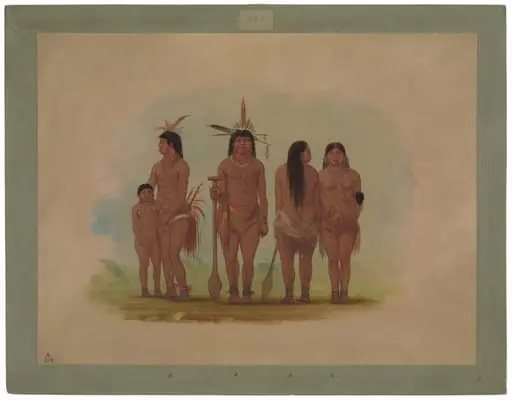
Five Iquito Indians
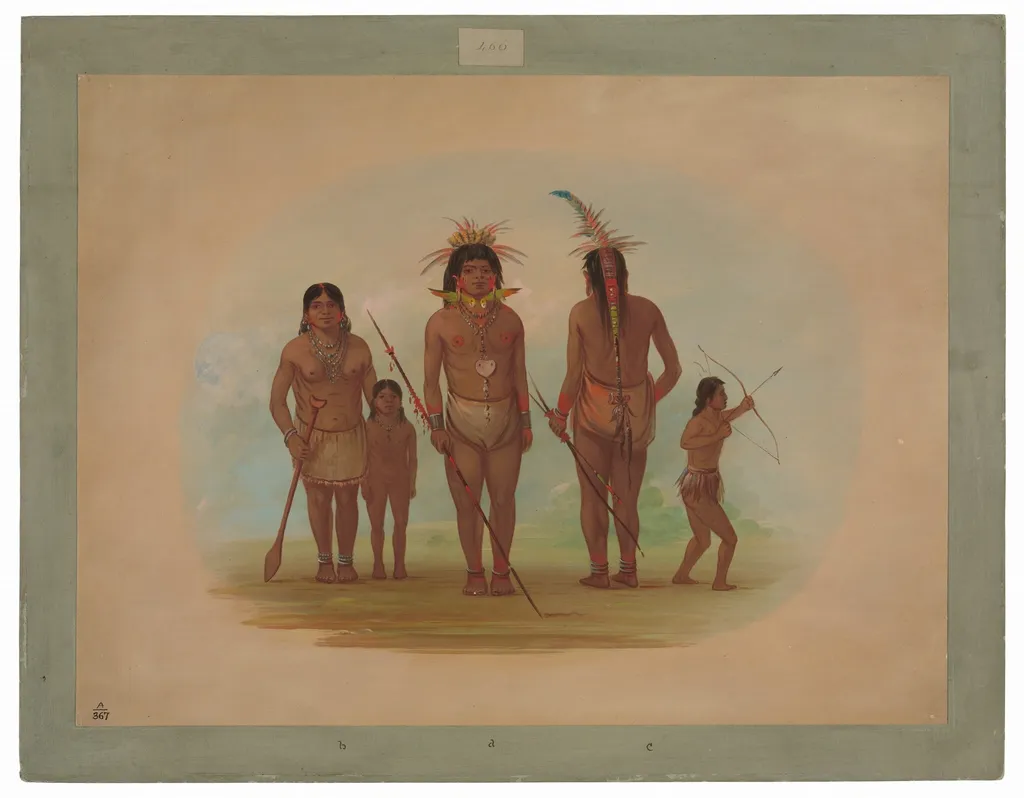
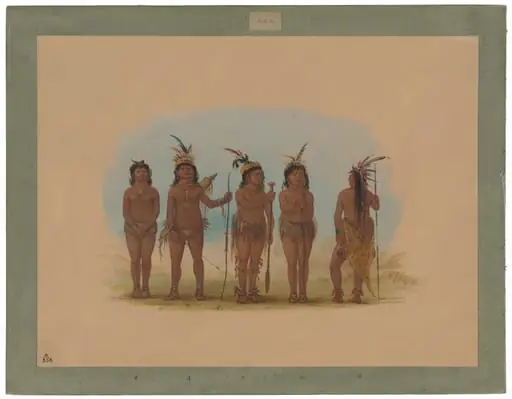
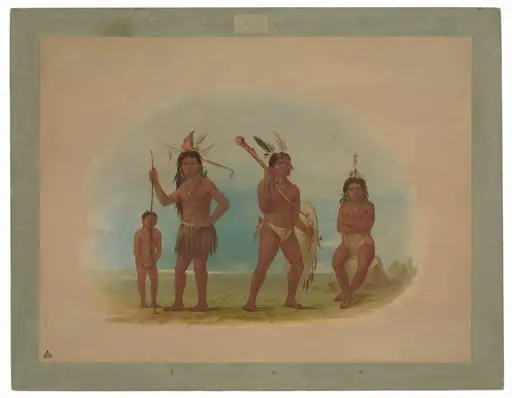
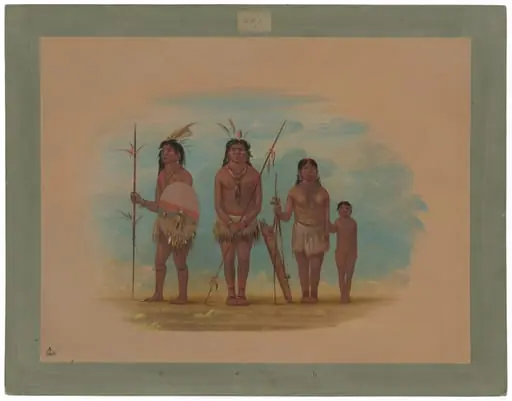
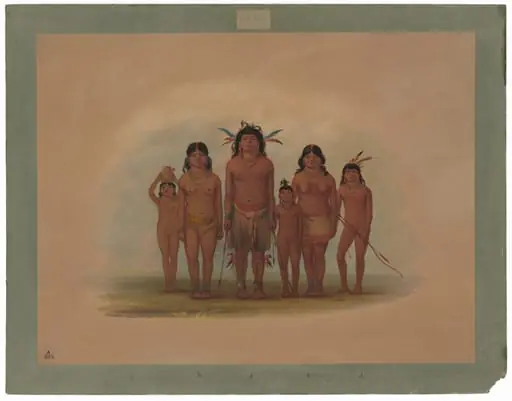
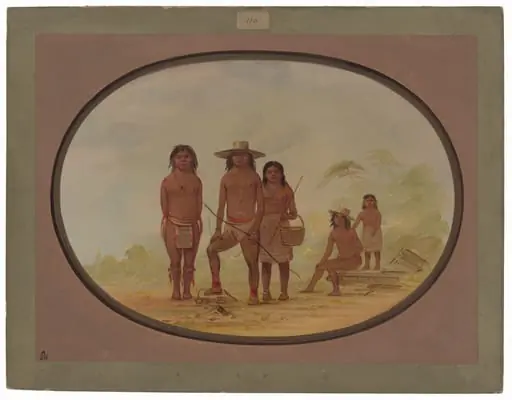
Five Iquito Indians is an oil painting by the American Folk Art artist George Catlin. It dates from 1862 and is held in the collection of the National Gallery of Art. Created in 1862, this oil work depicts five individuals from the Iquito community standing side by side.
About this work
Subject & Meaning
Their distinctive adornments, feathered headdresses, necklaces, and body paint, signify tribal affiliation and ceremonial status within Iquito social structure.
The painting depicts five members of the Iquito community from the Peruvian Amazon, rendered as individual portrait subjects rather than generic representations. Their distinctive adornments, feathered headdresses, necklaces, and body paint, signify tribal affiliation and ceremonial status within Iquito social structure. The composition emphasizes direct engagement with the viewer through steady gaze and upright posture, reflecting 19th-century ethnographic interest in documenting Indigenous peoples as distinct cultural entities.
Created in 1861 by George Catlin, the work functions as both artistic record and anthropological documentation of Amazonian groups encountered during his travels, aligning with contemporary scientific expeditions that sought to classify and preserve perceived vanishing cultures.
Technique & Style
Five Iquito Indians is an oil painting on card mounted on paperboard created in 1861. The canvas measures 46.5 cm in height by 62.5 cm in width. Executed in the portrait genre, the work reflects George Catlin's approach to depicting Indigenous subjects with attention to individual detail and compositional clarity.
The painting entered the collection of the National Gallery of Art in Washington, D.C., through a series of inheritances and acquisitions beginning in 1912.
History & Provenance
George Catlin executed Five Iquito Indians in 1861 as an oil painting on card mounted to paperboard. Upon the artist's death in 1872, the work passed by descent to his daughters: Clara Gregory Catlin, Louise Catlin Kinney, and Elizabeth Wing Catlin. In 1912, the American Museum of Natural History acquired the piece directly from Elizabeth Wing Catlin.
The museum retained the painting until 1959, when it was sold through Kennedy Galleries of New York to Paul Mellon of Upperville, Virginia. Mellon subsequently donated the work to the National Gallery of Art in Washington, D.C., in 1965, where it remains in the collection.
Five Iquito Indians is held by the National Gallery of Art in Washington, D.C. Its accession occurred in 1965 as a gift from Mr. Paul Mellon. The work was previously owned by George Catlin, then passed to his daughters, and was sold in 1959 through Kennedy Galleries before entering the collection. It has not been recorded in any major exhibition beyond its inclusion in the National Gallery’s holdings.
Overview
Created in 1862, this oil work depicts five individuals from the Iquito community standing side by side. Executed on card that has been adhered to a paperboard support, the piece belongs to the portrait tradition within American folk painting and reflects the artist’s systematic effort to record Indigenous peoples.
Context
During the mid‑nineteenth century, interest in cataloguing Native American cultures grew among both scholars and the public. This painting reflects that period’s ethnographic impulse, serving as a visual supplement to written descriptions and contributing to contemporary understandings of diverse Indigenous societies.
Own this work as a print
Artist & collection

Artist
George Catlin ( KAT-lin; July 26, 1796 – December 23, 1872) was an American lawyer, painter, author, and traveler, who specialized in portraits of Native Americans in the American frontier.

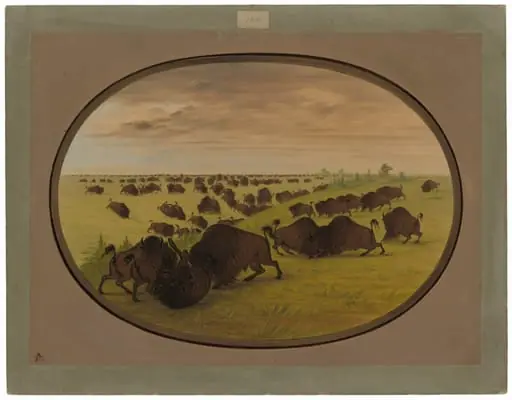 Bulls Fighting
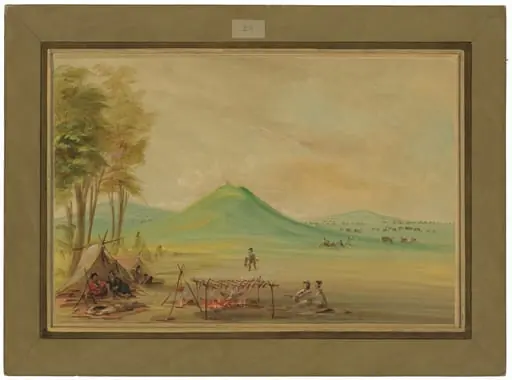 Expedition Encamped on a Texas Prairie. April 1686
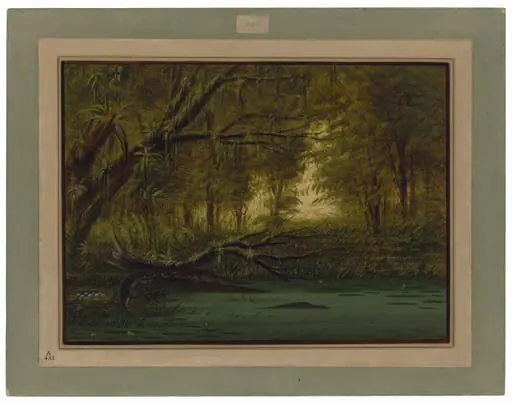 An Alligator's Nest
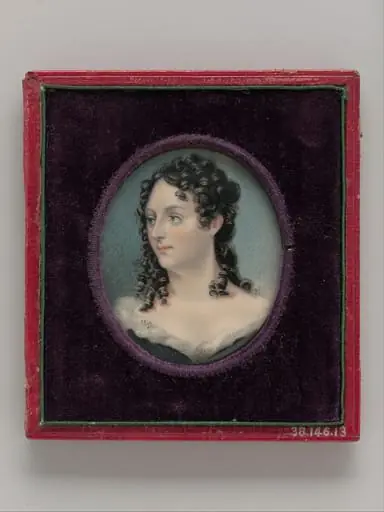 Mrs. George Catlin (Clara Bartlet Gregory)
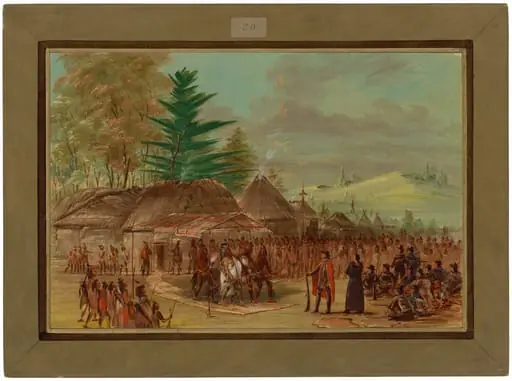 Chief of the Taensa Indians Receiving La Salle. March 20, 1682
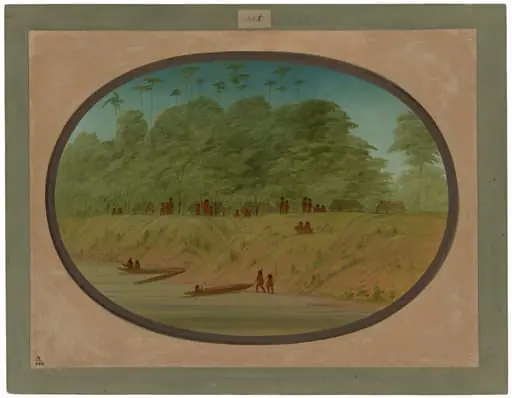 A Small Village - Payaguas Indians
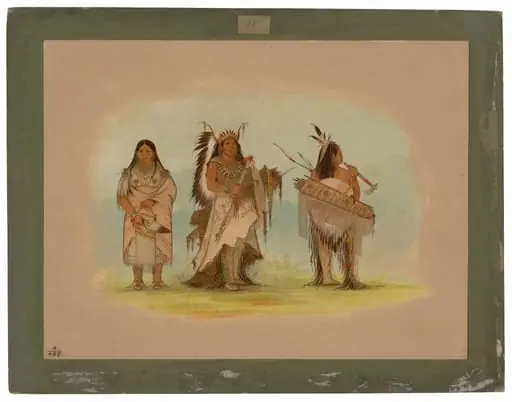 Omaha Chief, His Wife, and a Warrior
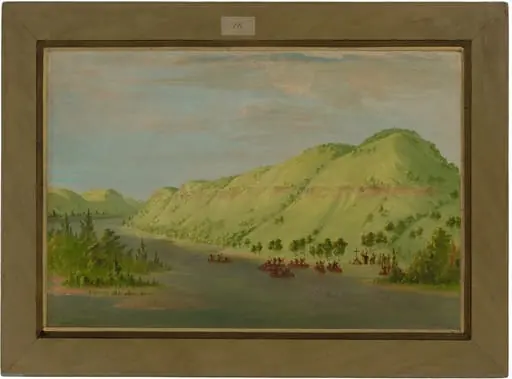 Father Hennepin Leaving the Mississippi to Join La Salle. May 8, 1680