Artwork
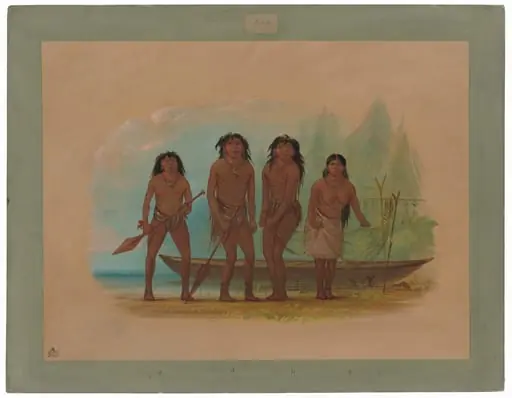
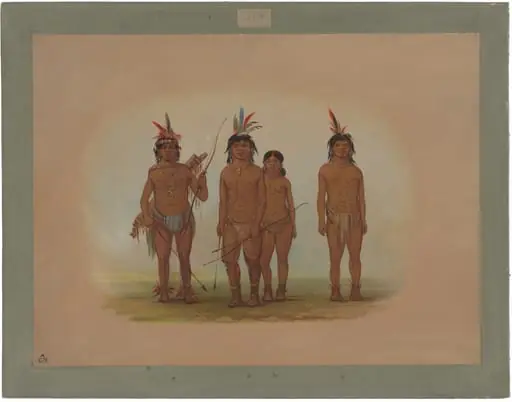
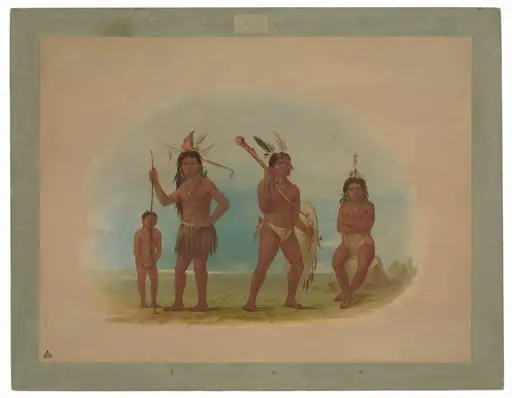
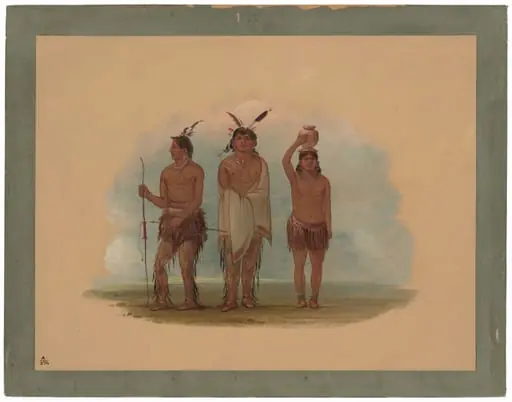
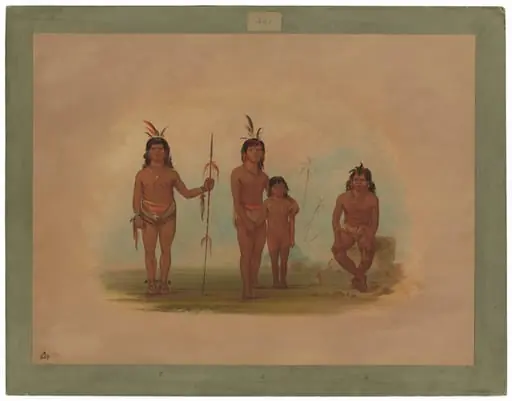
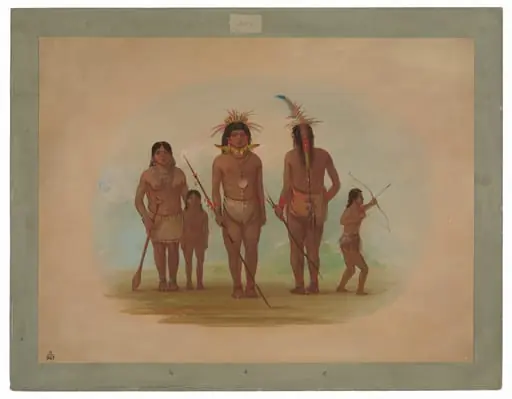
Four Sepibo Indians
Four Sepibo Indians is an oil painting by the American Folk Art artist George Catlin. It dates from 1862 and is held in the collection of the National Gallery of Art.
About this work
Technique & Style
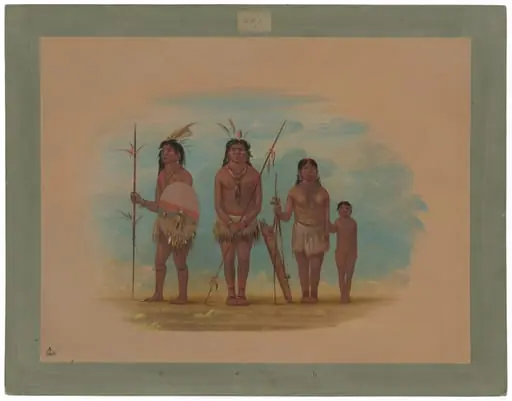
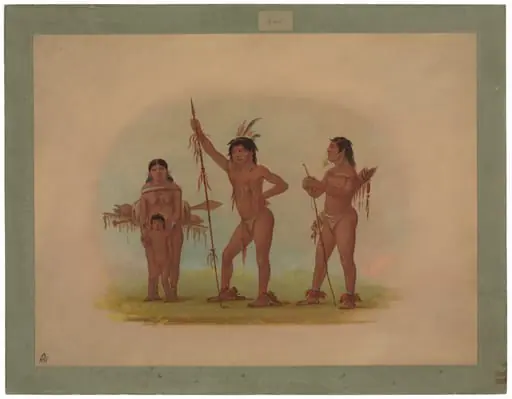
The composition arranges four figures in a shallow, staged space, their postures and regalia rendered with descriptive precision rather than painterly bravura.
The painting employs oil on card mounted on paperboard as its primary medium, executed in 1861 by George Catlin. The support’s small scale, 46.7 cm in height and 61.6 cm in width, suggests a portable format suited to travel or studio study.
Catlin’s handling emphasizes linear definition and subtle tonal modeling, with careful attention to costume and physiognomy. The composition arranges four figures in a shallow, staged space, their postures and regalia rendered with descriptive precision rather than painterly bravura. The condition appears stable, reflecting conservation practices typical of 19th-century oil sketches on prepared card.
History & Provenance
George Catlin executed Four Sepibo Indians in 1861 as an oil painting on card mounted to paperboard. Upon the artist's death in 1872, the work passed by descent to his daughters: Clara Gregory Catlin, Louise Catlin Kinney, and Elizabeth Wing Catlin. In 1912, the American Museum of Natural History purchased the piece directly from Elizabeth Wing Catlin.
The museum retained the painting until 1959, when it was sold through Kennedy Galleries of New York to Paul Mellon of Upperville, Virginia. Mellon subsequently donated the work to the National Gallery of Art in Washington, D.C., in 1965.
Four Sepibo Indians is an oil on card mounted on paperboard portrait painted by George Catlin in 1861. The work entered the collection of the National Gallery of Art in Washington, D.C. through a 1965 gift from Paul Mellon, following its acquisition in 1959 from Kennedy Galleries, New York, and prior ownership by the American Museum of Natural History and Catlin's descendants.
The painting measures 46.7 centimeters in height and 61.6 centimeters in width.
Overview
Created in 1862, Four Sepibo Indians is an oil painting executed on a card support that has been affixed to a paperboard backing. The work belongs to the tradition of American folk portraiture and presents a small group of Native individuals against a simplified, pastel-hued landscape.
Subject & Meaning
The figures represent members of the Sepibo, a band within the larger network of Plains peoples that George Catlin recorded during his field trips. By placing them on a grassy foreground with modest vegetation, the composition emphasizes their presence within a natural environment while offering a dignified, individualized view of each sitter.
Context
Catlin’s documentation of Native peoples coincided with a period of rapid expansion and displacement across the United States. His visual records, including this Sepibo portrait, were intended to preserve cultural details that he feared would soon vanish. The piece also reflects his prior experience with lithographic illustration, evident in its clear delineation and compositional balance.
Own this work as a print
Artist & collection

Artist
George Catlin ( KAT-lin; July 26, 1796 – December 23, 1872) was an American lawyer, painter, author, and traveler, who specialized in portraits of Native Americans in the American frontier.

 Bulls Fighting
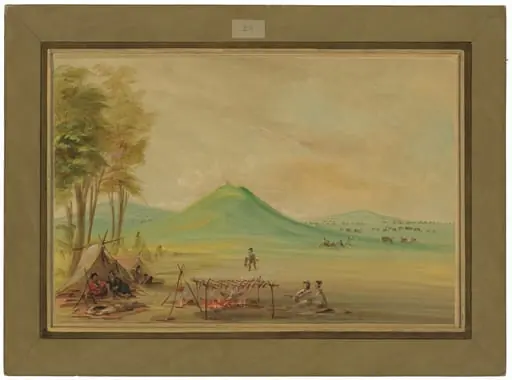 Expedition Encamped on a Texas Prairie. April 1686
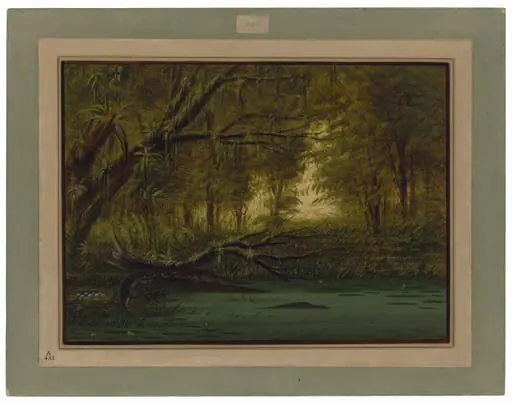 An Alligator's Nest
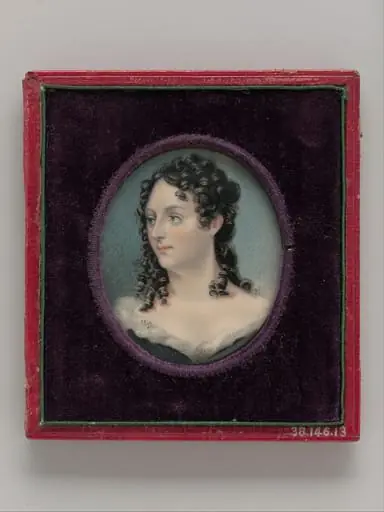 Mrs. George Catlin (Clara Bartlet Gregory)
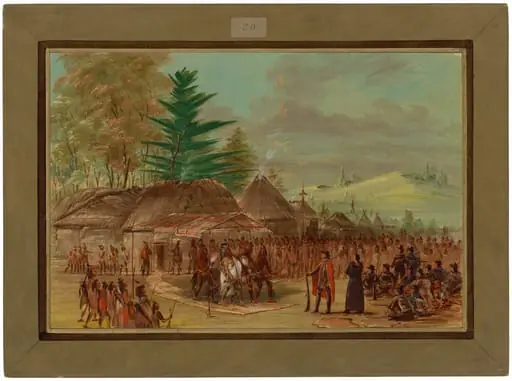 Chief of the Taensa Indians Receiving La Salle. March 20, 1682
 A Small Village - Payaguas Indians
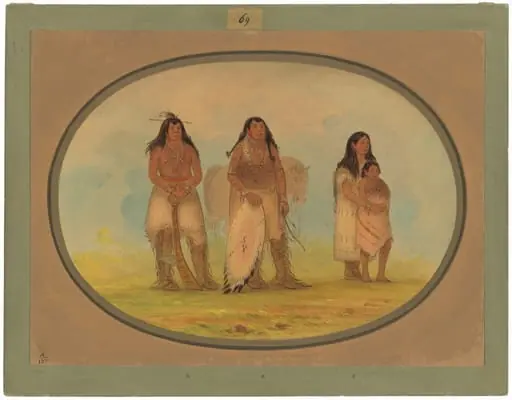
 Omaha Chief, His Wife, and a Warrior
 Father Hennepin Leaving the Mississippi to Join La Salle. May 8, 1680