Artwork
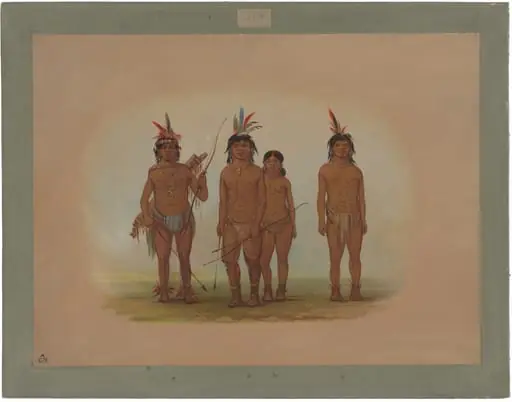
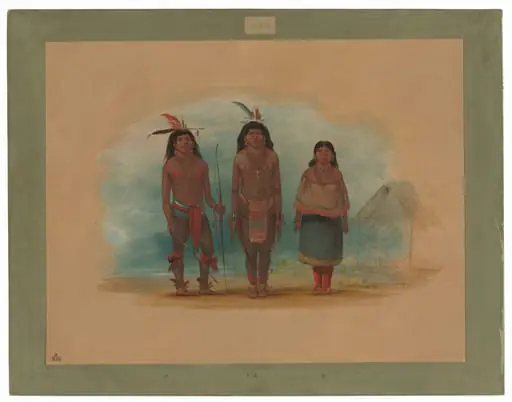
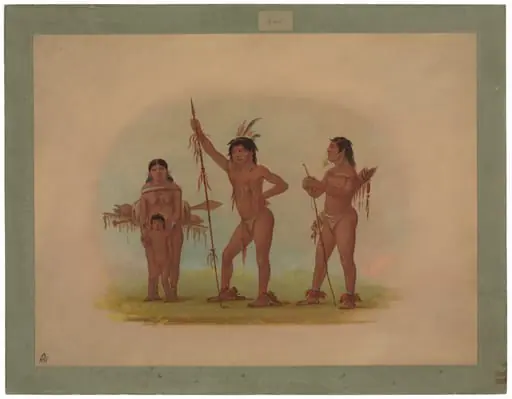
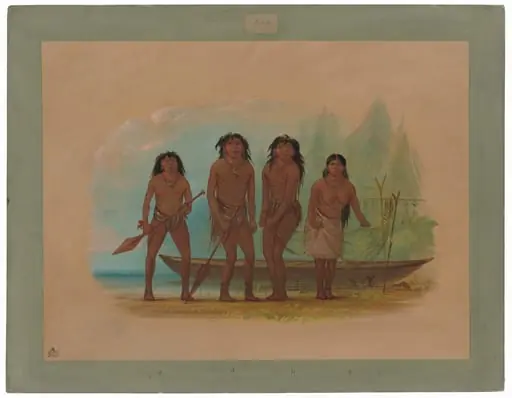
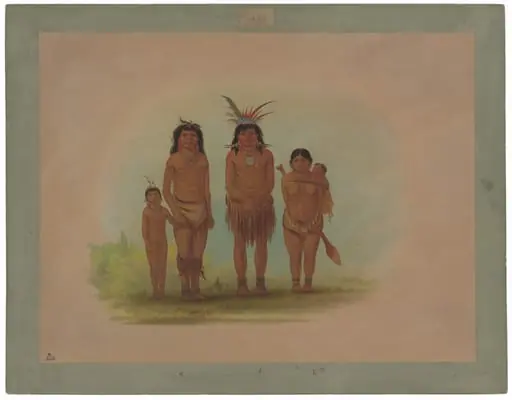
Four Xingu Indians
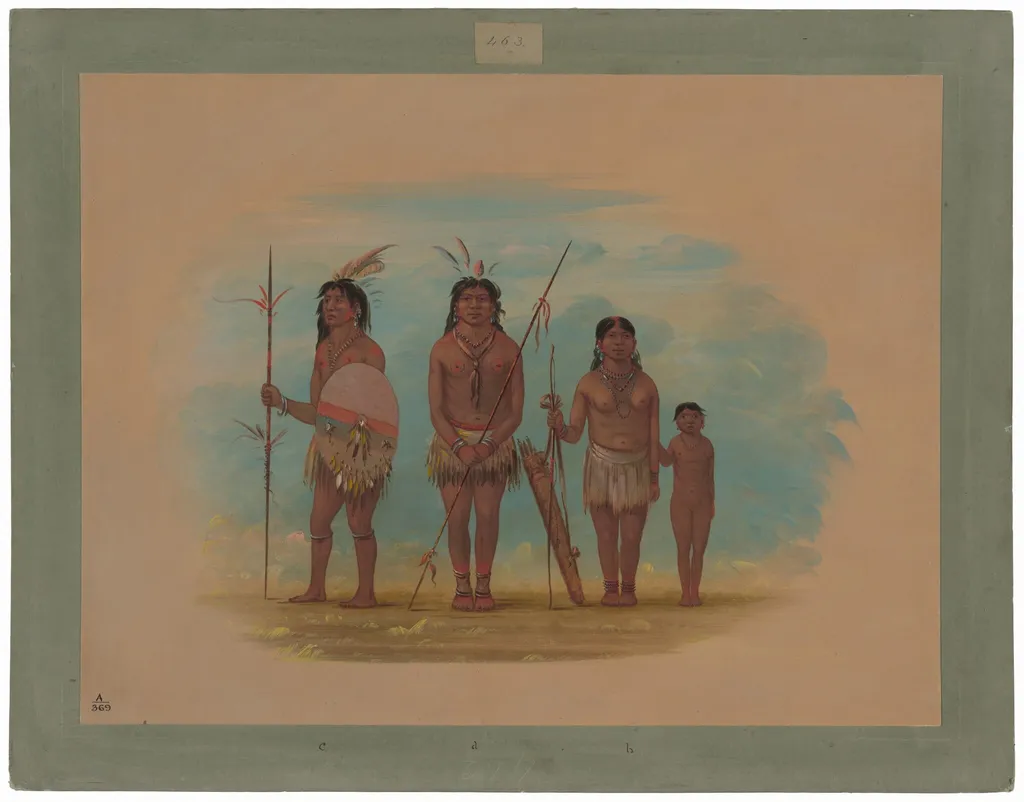
Four Xingu Indians is an oil painting by the American Folk Art artist George Catlin. It dates from 1862 and is held in the collection of the National Gallery of Art.
About this work
Technique & Style
Stylistically, the composition presents a frontal arrangement of four figures, rendered with careful attention to individual facial features and costume.
The work is an oil painting on a card support mounted to paperboard, executed in 1861 by George Catlin. The dimensions are 45.8 cm in height and 60.5 cm in width. Stylistically, the composition presents a frontal arrangement of four figures, rendered with careful attention to individual facial features and costume.
Catlin’s handling emphasizes linear definition and restrained modeling, typical of portraiture intended to document physiognomy and attire. There is no indication in the sources of later conservation or condition issues.
History & Provenance
The painting Four Xingu Indians by George Catlin was created in 1861. It is executed in oil on card mounted on paperboard. The work remained in the possession of the artist until his death in 1872, after which it passed by descent to his daughters: Clara Gregory Catlin, Louise Catlin Kinney, and Elizabeth Wing Catlin.
In 1912, the American Museum of Natural History purchased the piece from Elizabeth Wing Catlin. The museum later sold the work in 1959 through Kennedy Galleries in New York to Paul Mellon of Upperville, Virginia. Mellon subsequently gifted the painting to the National Gallery of Art in Washington, D.C., in 1965, where it remains part of the collection.
The painting Four Xingu Indians by George Catlin is held in the National Gallery of Art in Washington, D.C., where it is accessioned as part of the museum's collection. It entered the museum's possession in 1965 as a gift from Paul Mellon, following its acquisition from Kennedy Galleries in New York in 1959. Prior to this, the work descended through the artist's family and was purchased from Elizabeth Wing Catlin in 1912 by the American Museum of Natural History.
Overview
George Catlin’s 1862 work Four Xiang Indians is an oil painting executed on a card that has been mounted to a paperboard support. The composition presents a small group of indigenous figures set against a minimal, flat landscape under a light sky, rendered in muted blues and beiges.
Subject & Meaning
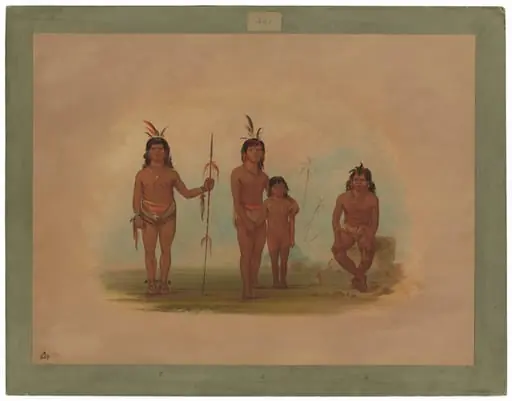
The scene depicts two adult men adorned with feathered headdresses, necklaces, and loincloths, each grasping a tall staff, a woman holding a bow, and a barefoot child nearby. By emphasizing attire and implements rather than facial features, Catlin highlights cultural markers of the Xingu people.
Context
The painting belongs to a larger body of work in which Catlin documented Plains Indian life for audiences in the eastern United States. His portraits served both ethnographic and artistic purposes, providing contemporary viewers with visual records of cultures then considered remote.
Own this work as a print
Artist & collection

Artist
George Catlin ( KAT-lin; July 26, 1796 – December 23, 1872) was an American lawyer, painter, author, and traveler, who specialized in portraits of Native Americans in the American frontier.

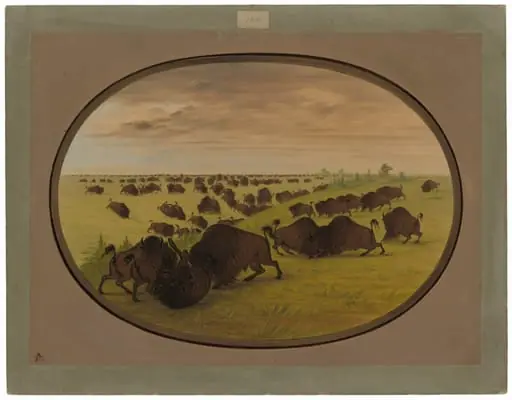 Bulls Fighting
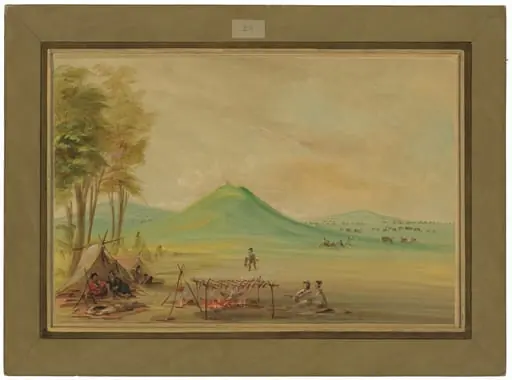 Expedition Encamped on a Texas Prairie. April 1686
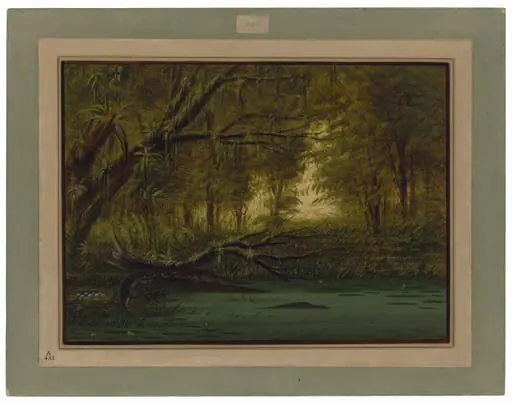 An Alligator's Nest
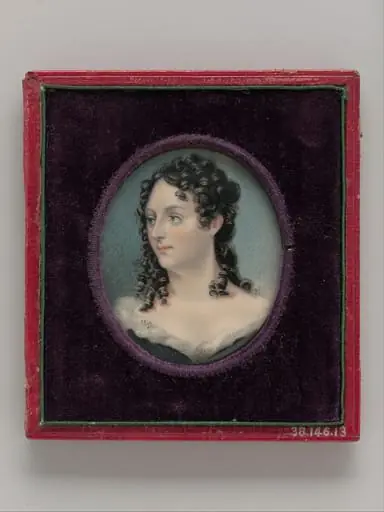 Mrs. George Catlin (Clara Bartlet Gregory)
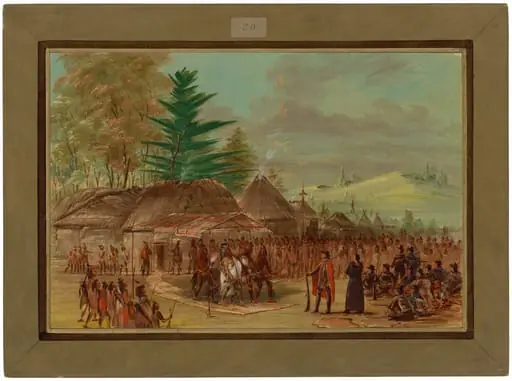 Chief of the Taensa Indians Receiving La Salle. March 20, 1682
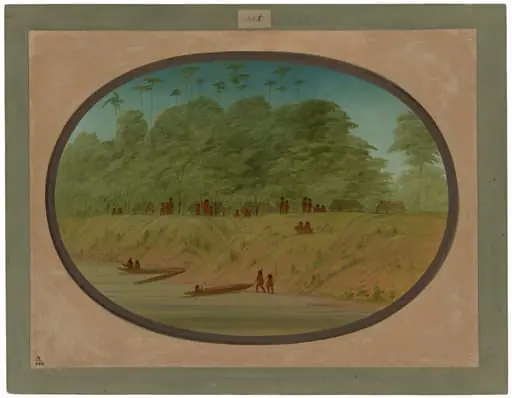 A Small Village - Payaguas Indians
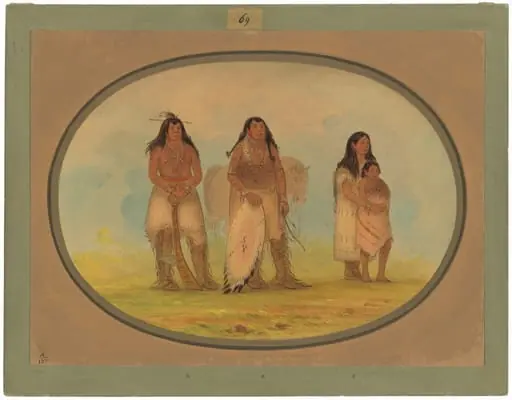
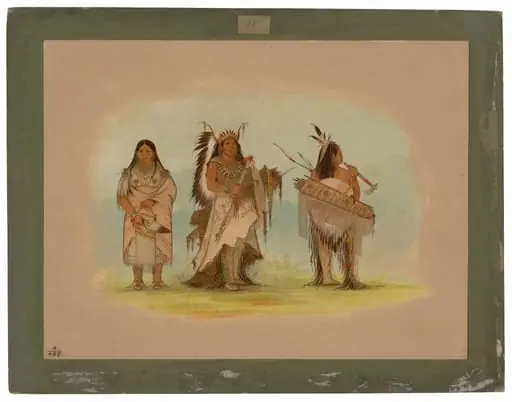 Omaha Chief, His Wife, and a Warrior
 Father Hennepin Leaving the Mississippi to Join La Salle. May 8, 1680