Artwork
Mandan War Chief with His Favorite Wife
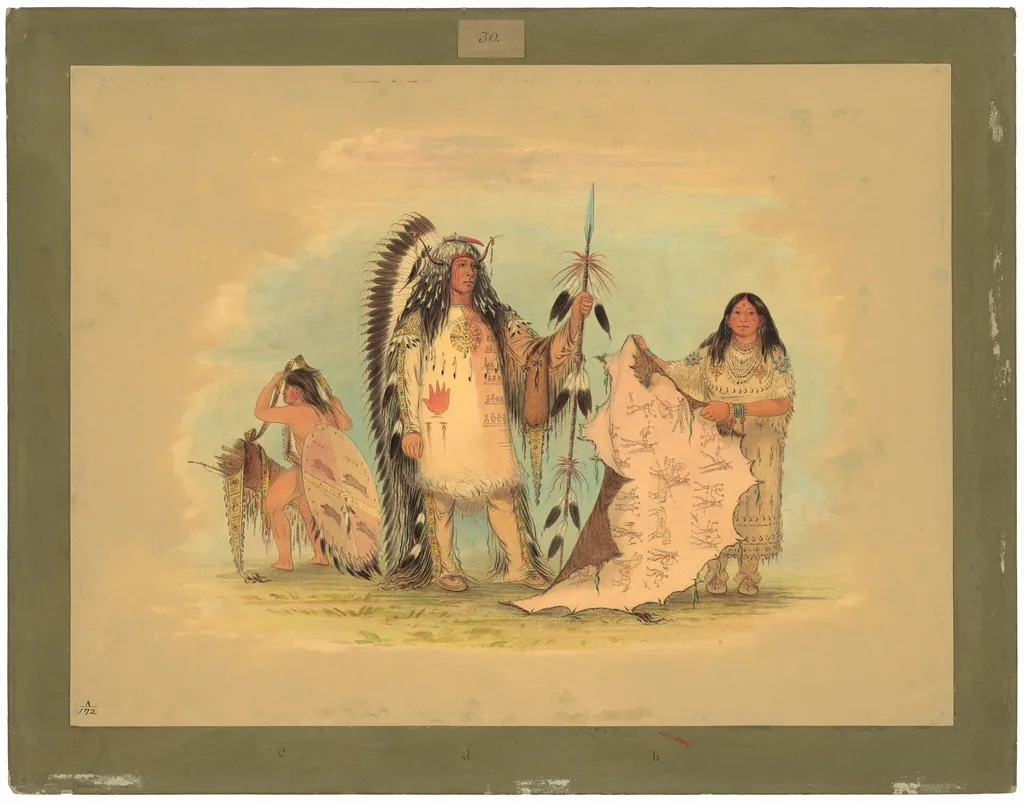
Mandan War Chief with His Favorite Wife is an oil painting by the Impressionist artist George Catlin. It dates from 1865 and is held in the collection of the National Gallery of Art. Created in 1865, the work portrays a Mandan war chief alongside his favored wife.
- Inscription
- Inscribed:lower center: Catlin p.
About this work
Overview
Mandan War Chief with His Favorite Wife is an 1861 painting by American artist George Catlin.
Mandan War Chief with His Favorite Wife is an 1861 painting by American artist George Catlin. Executed in oil on card mounted on paperboard, the work measures 46.4 by 61.7 centimeters and is currently held in the National Gallery of Art in Washington, D.C., as part of the Paul Mellon Collection. The painting belongs to Catlin's later Cartoon Collection, a series of over 600 works created during the 1850s and 1860s that revisited the subjects of his earlier Indian Gallery. It holds accession number 1965.16.72.
Subject & Meaning
The painting depicts the Mandan war chief Mah-to-toh-pa, or The Four Bears, alongside his favorite wife, Mý-neek-e-súnk-te-ca, known as The Mink. A third figure, nearly nude, attends to a large decorated shield and headdress. The central chief stands prominently, adorned in a white painted hide shirt bearing a red hand symbol and geometric designs, wearing fringed leggings, and holding a spear with feather attachments in his raised right hand. His elaborate headdress, made of eagle quills and ermine, cascades to the ground and is surmounted by horns, which Catlin noted as symbols of authority. The Mink stands to his right, holding up a painted animal hide covered with small figures and symbols that document the chief's battles, a visual record of his martial exploits. Catlin identified the original scene as dating to 1832.
Technique & Style
Catlin executed this work in oil on card mounted on paperboard, a technique characteristic of his Cartoon Collection rather than the canvas supports of his earlier Indian Gallery. The composition is arranged across a shallow, open landscape under a pale, clouded sky, with sparse ground and gentle shadows falling to the right. The palette relies on soft earth tones, pale blues, and cream, punctuated by accents of red and yellow. The surface appears smooth, featuring careful linear detail that delineates the intricate costume elements and the pictographs on the painted hide. A dark green border frames the scene, and a small numbered label reading 30 appears at the top center, corresponding to the catalog entry. The lower left corner bears the inscription A 172, while the lower center is inscribed Catlin p.
History & Provenance
Created between 1861 and 1869, the painting remained with George Catlin until his death in 1872. It then descended to his three daughters, Clara Gregory Catlin, Louise Catlin Kinney, and Elizabeth Wing Catlin. In 1912, the American Museum of Natural History in New York purchased the work from Elizabeth Wing Catlin. When the museum deaccessioned the collection, Paul Mellon acquired the painting in 1959 through Kennedy Galleries in New York. Mellon gifted the work to the National Gallery of Art in 1965. It has been exhibited widely, including long-term loans to the Buffalo Bill Historical Center in Cody, Wyoming, from 1964 to 1974 and 1976 to 1983, and exhibitions at the Amon Carter Museum in 1981, the New Orleans Museum of Art in 2003, and the Sid Richardson Museum in 2014.
Context
This painting is a product of Catlin's Cartoon Collection, his second major body of work depicting Native American life, created during the 1850s and 1860s. This later series of over 600 works followed his original Indian Gallery of the 1830s, which comprised more than 500 paintings and is now largely housed at the Smithsonian American Art Museum. When Catlin exhibited the Cartoon Collection in New York in 1871, he published a catalog that provided additional context for the subjects, identifying the figures and explaining the significance of their attire and the battle records on the painted robe. The catalog entry for this work, listed as Cart. No. 30, offered contemporary viewers an interpretive guide to the Mandan subjects and their symbols of status and history.
Own this work as a print
Artist & collection

Artist
George Catlin ( KAT-lin; July 26, 1796 – December 23, 1872) was an American lawyer, painter, author, and traveler, who specialized in portraits of Native Americans in the American frontier.

 Bulls Fighting
 Expedition Encamped on a Texas Prairie. April 1686
 An Alligator's Nest
 Mrs. George Catlin (Clara Bartlet Gregory)
 Chief of the Taensa Indians Receiving La Salle. March 20, 1682
 A Small Village - Payaguas Indians
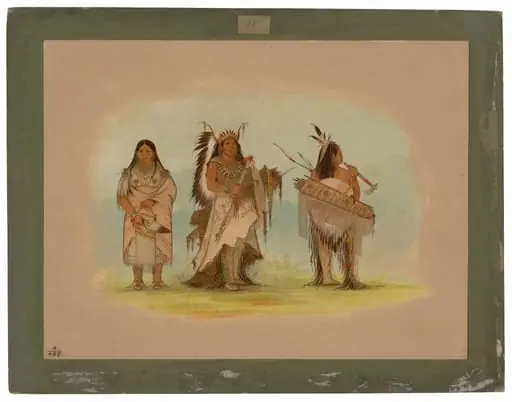 Omaha Chief, His Wife, and a Warrior
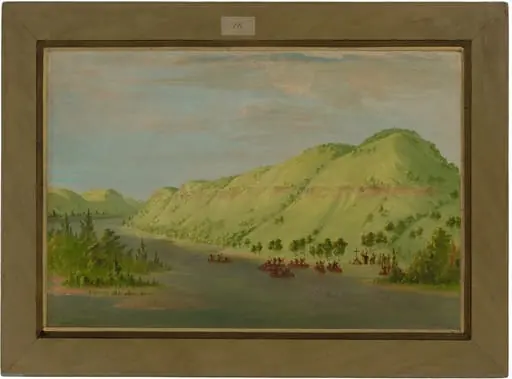 Father Hennepin Leaving the Mississippi to Join La Salle. May 8, 1680
- Crow Chief, His Wife, and a Warrior
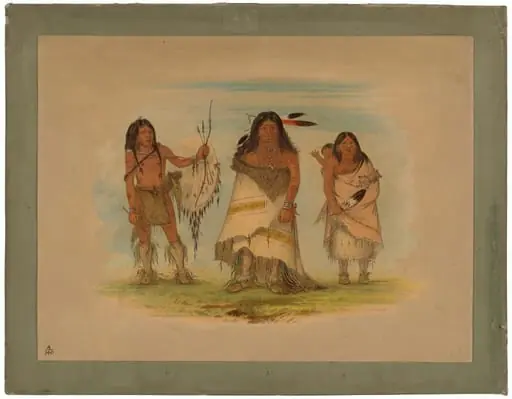 Camanchee Chief, His Wife, and a Warrior
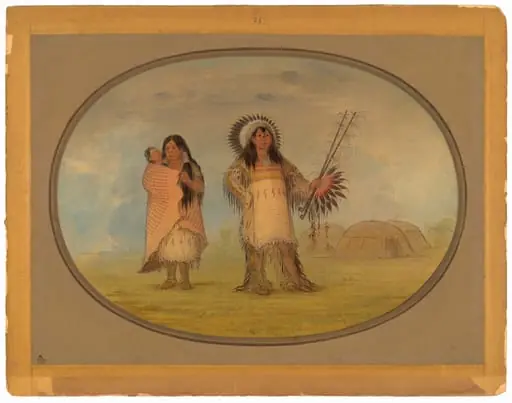 Mandan Civil Chief, His Wife, and Child
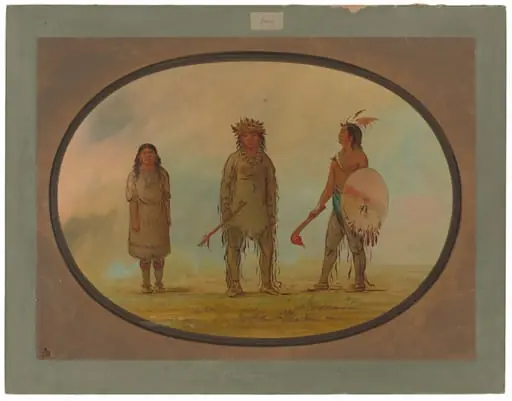 Athapasca Chief, His Wife, and a Warrior
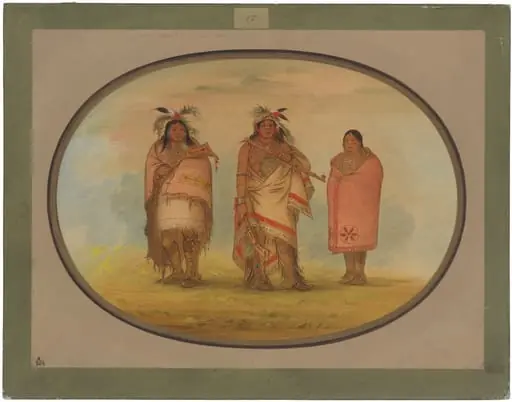 Menomonie Chief, His Wife, and Son
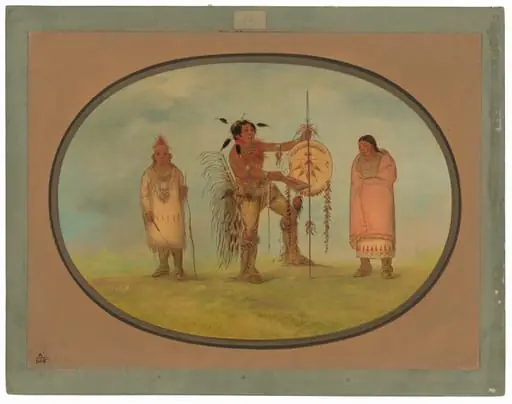 Saukie Warrior, His Wife, and a Boy
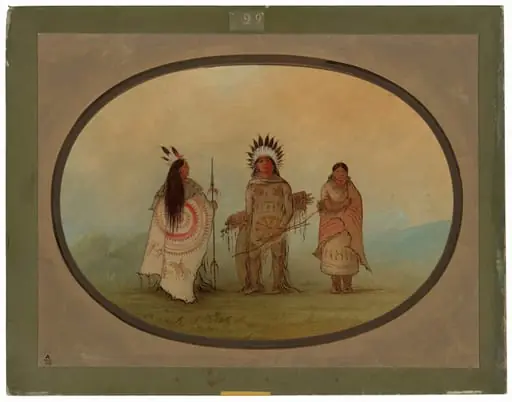 A Crow Chief, a Warrior, and His Wife
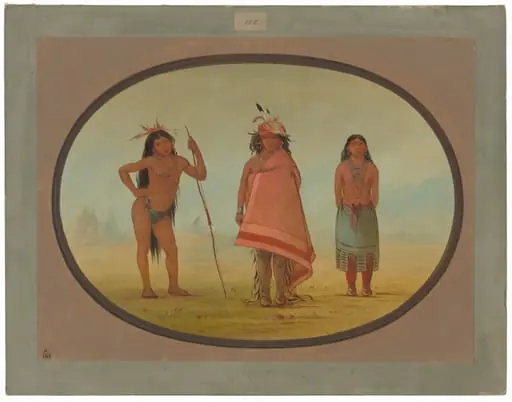 Cochimtee Chief, His Wife, and a Warrior