Artwork
Marahua Indians
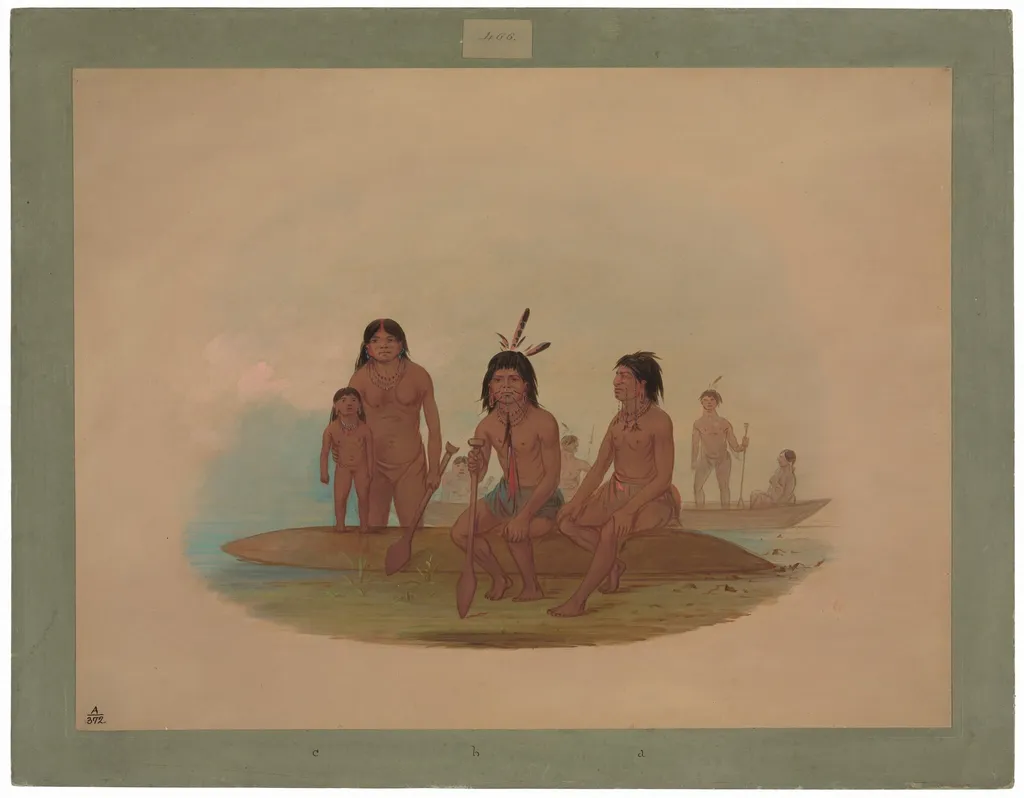
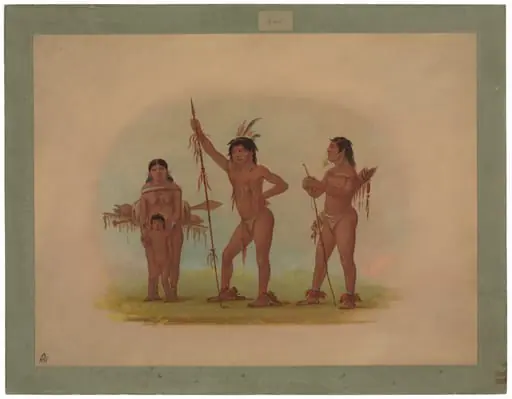
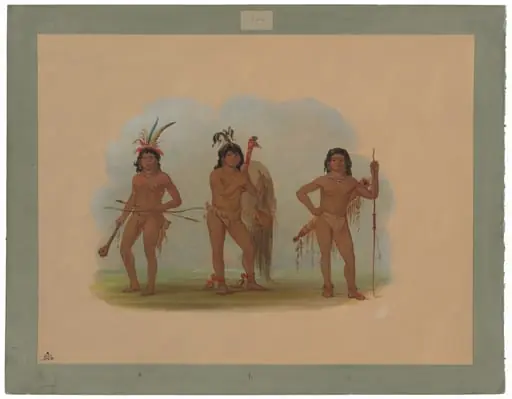
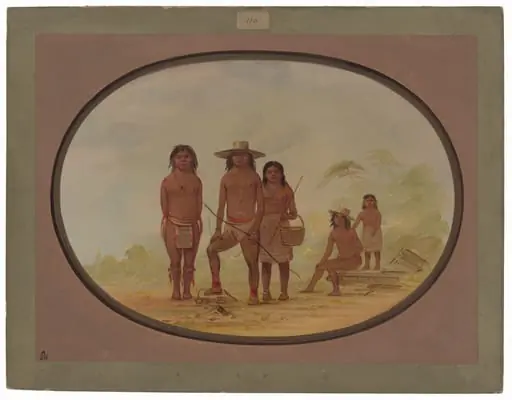
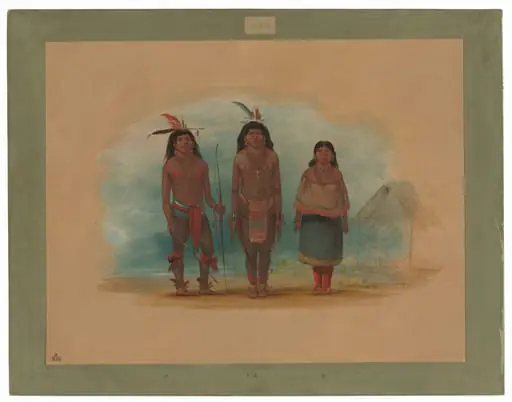
Marahua Indians is an oil painting by the American Folk Art artist George Catlin. It dates from 1862 and is held in the collection of the National Gallery of Art.
About this work
Technique & Style
The modest dimensions and portable mounting suggest the work was intended for travel and exhibition rather than as a formal studio production.
Marahua Indians is a small-scale oil painting executed in 1869 by George Catlin. According to the National Gallery of Art's catalogue, the work is painted in oil on card that has been mounted on paperboard, a support combination consistent with Catlin's later portable practice rather than traditional stretched canvas. It is classified as a portrait and measures 46.6 by 61.6 centimeters.
The handling reflects Catlin's characteristic direct, documentary approach: the oil medium is applied in a relatively straightforward manner suited to recording ethnographic subjects, with the card-and-paperboard support providing a lightweight, field-friendly ground. The modest dimensions and portable mounting suggest the work was intended for travel and exhibition rather than as a formal studio production.
History & Provenance
George Catlin painted Marahua Indians in 1869 as an oil on card mounted on paperboard portrait. The work descended through Catlin's daughters Clara Gregory Catlin, Louise Catlin Kinney, and Elizabeth Wing Catlin before being purchased in 1912 from Elizabeth Wing Catlin by the American Museum of Natural History. Kennedy Galleries in New York sold the painting in 1959 to Paul Mellon of Upperville, Virginia, and it was gifted to the National Gallery of Art in 1965.
The National Gallery of Art in Washington, D.C. now holds the piece, which measures 46.6 cm by 61.6 cm.
Marahua Indians has been held by the National Gallery of Art in Washington, D.C. since 1965, when it was given by Mr. Paul Mellon of Upperville, Virginia. Mellon had acquired the painting in 1959 through Kennedy Galleries in New York, which had purchased it from the American Museum of Natural History that same year. The American Museum of Natural History had itself acquired the work in 1912, purchasing it from Elizabeth Wing Catlin, one of three daughters who inherited it from the artist George Catlin.
No specific inventory or accession number for the National Gallery of Art holding is recorded in the available sources, and no exhibition history is documented.
Legacy
The painting Marahua Indians has maintained a documented presence in major American art institutions since its creation, reflecting its enduring significance within the corpus of 19th-century portraiture. It entered the collection of the National Gallery of Art in Washington, D.C., through a documented acquisition pathway involving the Kennedy Galleries and Paul Mellon, ensuring its preservation and accessibility for scholarly study. Its inclusion in the National Gallery of Art's collection, as recorded in authoritative sources, underscores its recognized position in the historical narrative of American art.
Overview
George Catlin’s 1862 work titled Marahua Indians is an oil painting executed on card that has been mounted on paperboard. The piece belongs to the American folk‑art tradition and exemplifies Catlin’s lifelong effort to record the appearance and customs of Native peoples encountered during his multiple journeys into the western frontier.
Subject & Meaning
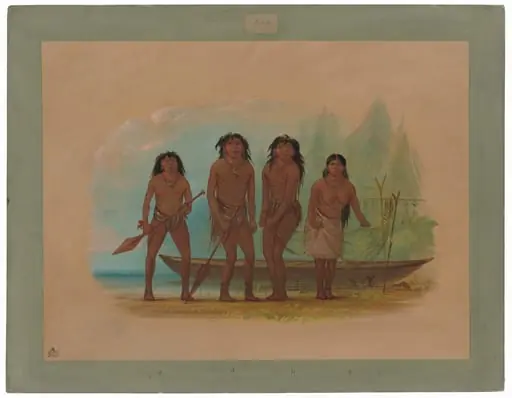
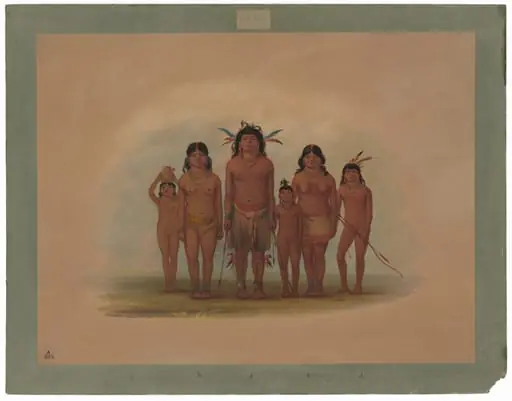
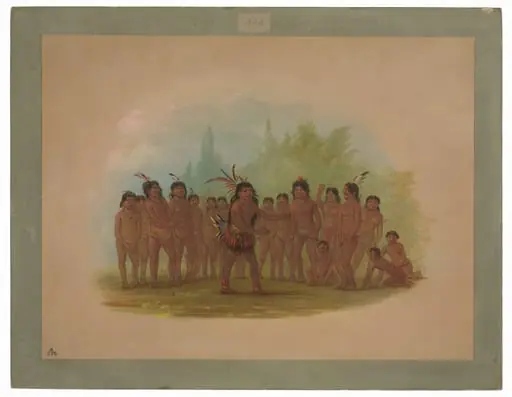
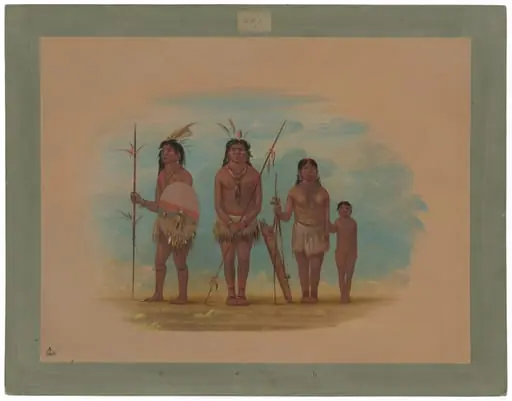
The composition presents a small group of Indigenous individuals aboard a boat, their bodies minimally clothed and their long hair adorned with feathers. Some hold tools or weapons, suggesting everyday activities or ceremonial roles. By portraying these figures together, Catlin aimed to document a specific tribal community and its material culture for a broader audience.
Own this work as a print
Artist & collection

Artist
George Catlin ( KAT-lin; July 26, 1796 – December 23, 1872) was an American lawyer, painter, author, and traveler, who specialized in portraits of Native Americans in the American frontier.

 Bulls Fighting
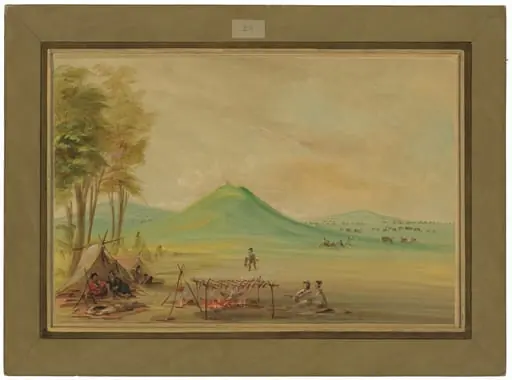 Expedition Encamped on a Texas Prairie. April 1686
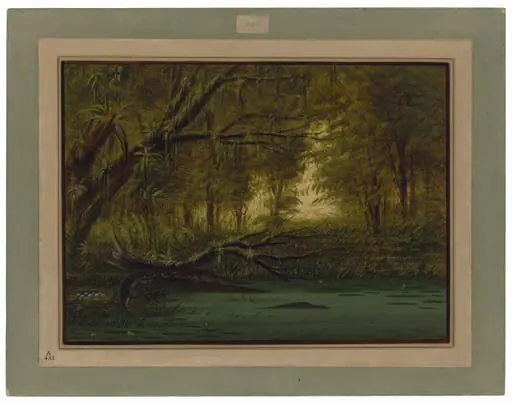 An Alligator's Nest
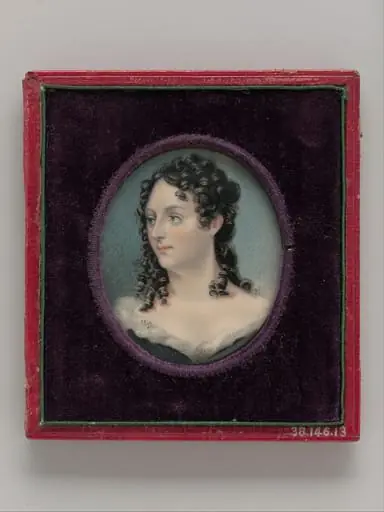 Mrs. George Catlin (Clara Bartlet Gregory)
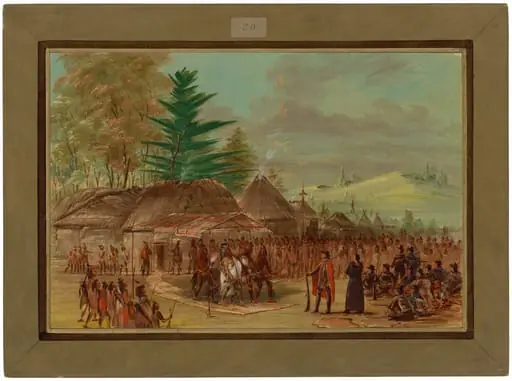 Chief of the Taensa Indians Receiving La Salle. March 20, 1682
 A Small Village - Payaguas Indians
 Omaha Chief, His Wife, and a Warrior
 Father Hennepin Leaving the Mississippi to Join La Salle. May 8, 1680