Artwork
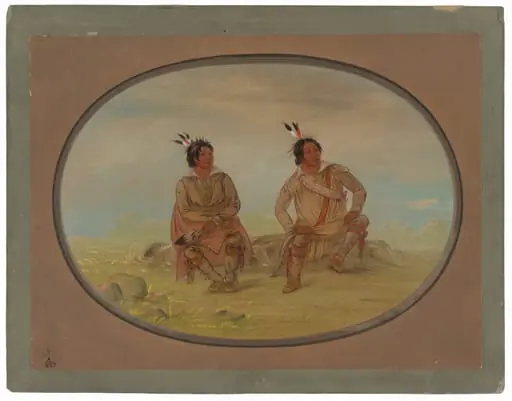
Two Cherokee Chiefs
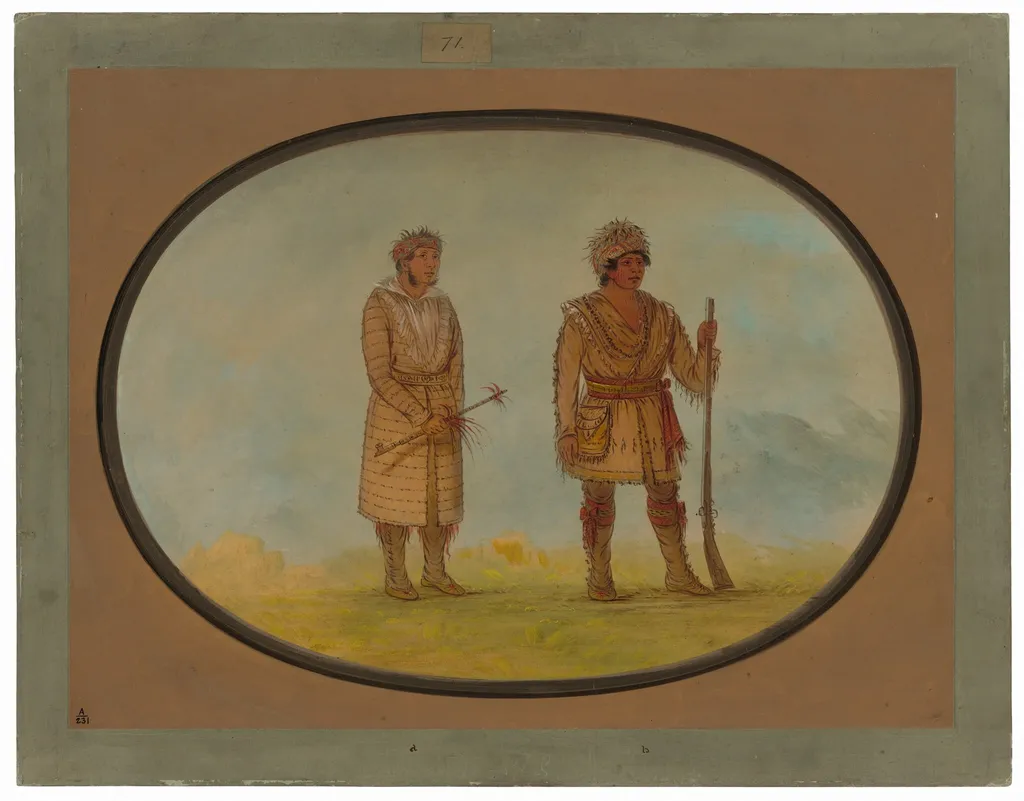
Two Cherokee Chiefs is an oil painting by the American Folk Art artist George Catlin. It dates from 1865 and is held in the collection of the National Gallery of Art.
About this work
Technique & Style
The handling of light and color reflects Catlin's ethnographic approach, capturing texture in garments and the subtle interplay of tones on the subjects' skin.
The work is an oil painting executed on card that has been mounted onto paperboard, classifying it as a painted portrait. Its formal qualities include a realistic rendering of two Cherokee leaders set against a muted background, emphasizing individual character through detailed facial expression and clothing. The handling of light and color reflects Catlin's ethnographic approach, capturing texture in garments and the subtle interplay of tones on the subjects' skin. The rigidity of the support contributes to the preservation of fine brushwork and crisp edge definition.
History & Provenance
The painting Two Cherokee Chiefs by George Catlin was created in 1865 as an oil work on card mounted on paperboard. Following the artist's death in 1872, the piece passed by descent to his daughters, Clara Gregory Catlin, Louise Catlin Kinney, and Elizabeth Wing Catlin. In 1912, the American Museum of Natural History purchased the work from Elizabeth Wing Catlin.
The museum subsequently sold it in 1959 through Kennedy Galleries in New York to Mr. Paul Mellon of Upperville, Virginia. The National Gallery of Art in Washington, D.C., received the painting as a gift from Mellon in 1965, where it is recorded as accession number 1965.16.1.
Overview
Created in 1865, Two Cherokee Chiefs is an oil painting executed on card that has been affixed to a paperboard support. The work presents a pair of Cherokee leaders standing side by side in an open landscape, each holding a weapon and wearing distinctive feathered headgear. The composition conveys a calm, respectful presence, set against a muted background with distant trees.
Subject & Meaning
The two figures are rendered as Cherokee chiefs, identifiable by their traditional clothing and headdresses. The left figure bears a long, striped coat and a spear, while the right wears a shorter, fringed coat and a rifle, suggesting a blend of ceremonial and martial roles. Their poised stance and quiet demeanor reflect a dignified representation of Native leadership during a period of cultural transition.
Context
By the mid‑1860s, Cherokee communities were adapting to forced relocation and new political realities. Catlin’s portrait captures this moment of cultural resilience, juxtaposing traditional regalia with contemporary weaponry. The painting thus serves as a visual record of Cherokee identity during the Reconstruction era, complementing Catlin’s broader ethnographic project across the American frontier.
Own this work as a print
Artist & collection

Artist
George Catlin ( KAT-lin; July 26, 1796 – December 23, 1872) was an American lawyer, painter, author, and traveler, who specialized in portraits of Native Americans in the American frontier.

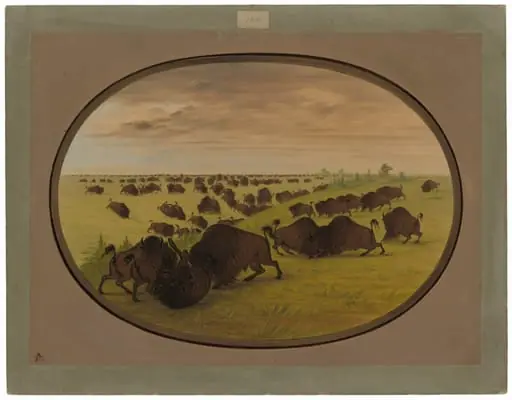 Bulls Fighting
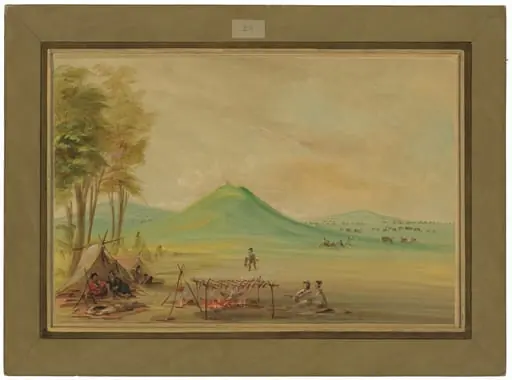 Expedition Encamped on a Texas Prairie. April 1686
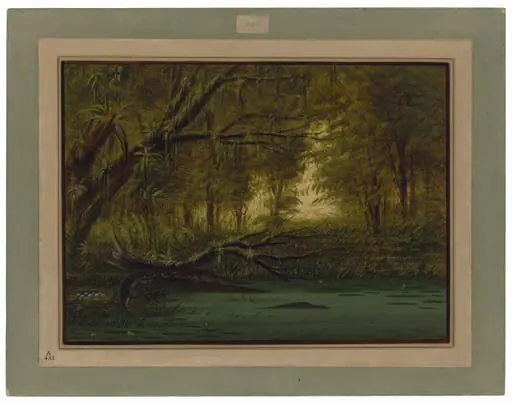 An Alligator's Nest
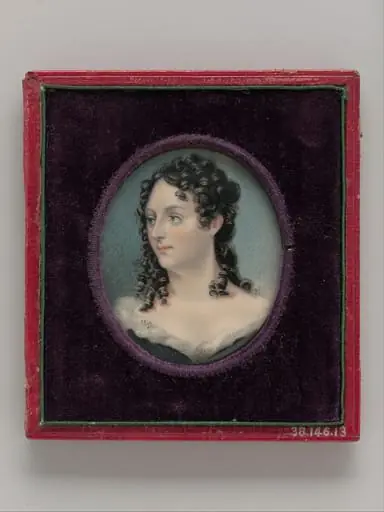 Mrs. George Catlin (Clara Bartlet Gregory)
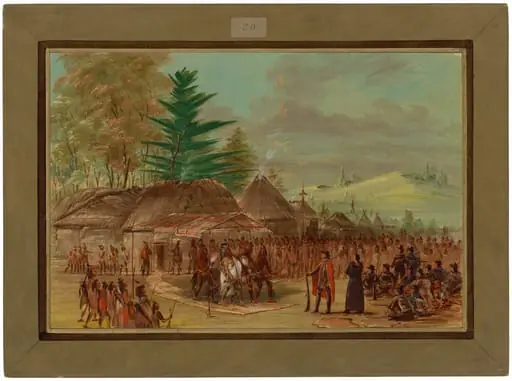 Chief of the Taensa Indians Receiving La Salle. March 20, 1682
 A Small Village - Payaguas Indians
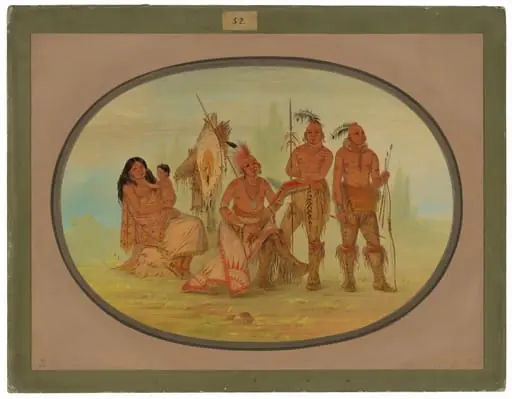
 Omaha Chief, His Wife, and a Warrior
 Father Hennepin Leaving the Mississippi to Join La Salle. May 8, 1680