Artwork
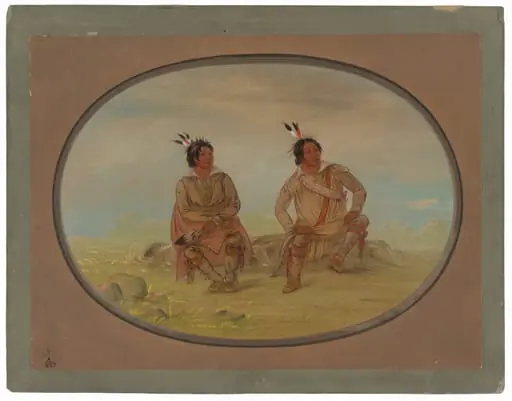
Two Unidentified North American Indians
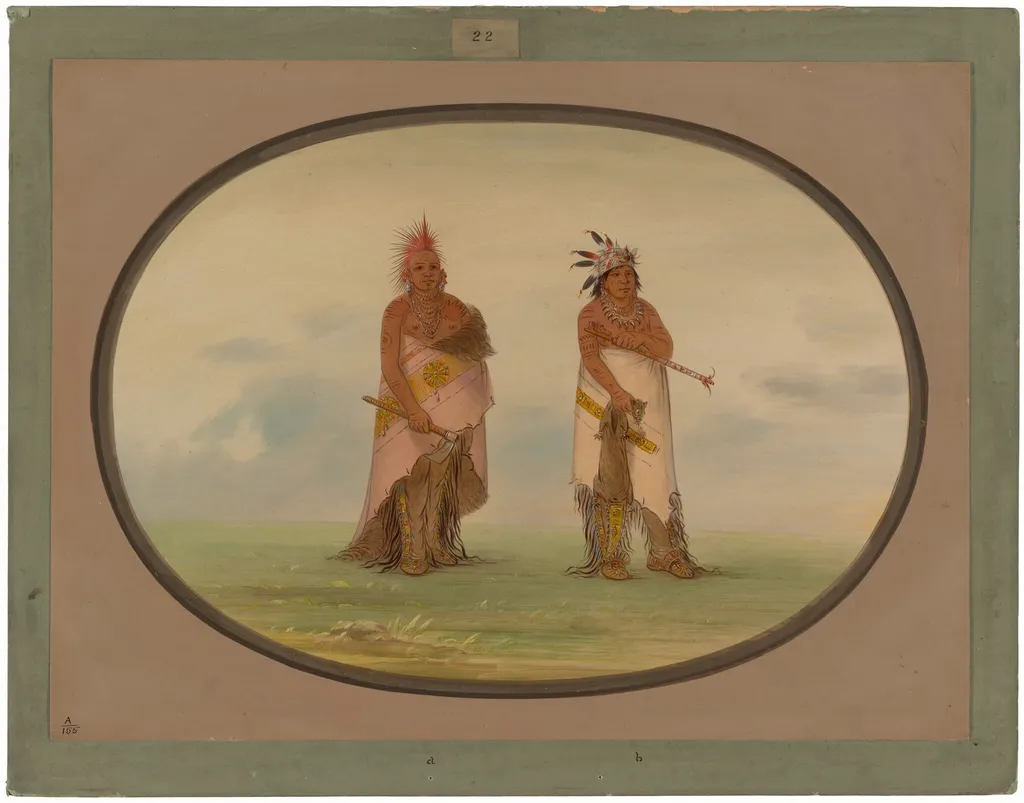
Two Unidentified North American Indians is an oil painting by the American Folk Art artist George Catlin. It dates from 1865 and is held in the collection of the National Gallery of Art. Created in 1865, this oil work on card mounted to paperboard portrays two Native American figures standing together in an open landscape.
About this work
Technique & Style
Painted in 1861, the work is classified as a portrait genre painting within the National Gallery of Art collection.
Two Unidentified North American Indians is a small-scale oil painting executed on card that has been mounted on paperboard, a support typical of George Catlin's later portable field-and-studio practice. The composition measures 47.4 by 64 centimeters in a horizontal format suited to a paired double portrait. Painted in 1861, the work is classified as a portrait genre painting within the National Gallery of Art collection.
Stylistically, the piece reflects Catlin's characteristic documentary approach to Native American subjects, presenting the two sitters frontally with attention to facial features, dress, and ethnographic detail. The oil medium on a rigid card-and-paperboard support allows for crisp, linear handling rather than the broader atmospheric effects of canvas painting, emphasizing the descriptive clarity that defines Catlin's portraiture.
History & Provenance
Created in 1861 by George Catlin, the oil-on-card portrait titled Two Unidentified North American Indians was originally part of the artist's personal collection. Following Catlin's death in 1872, the work passed by descent to his daughters: Clara Gregory Catlin, Louise Catlin Kinney, and Elizabeth Wing Catlin. In 1912, the American Museum of Natural History purchased the painting from Elizabeth Wing Catlin.
The institution later sold the piece in 1959 through Kennedy Galleries in New York to Paul Mellon of Upperville, Virginia. Mellon subsequently donated the work to the National Gallery of Art in Washington, D.C., in 1965, where it remains part of the permanent collection.
The painting is held in the collection of the National Gallery of Art in Washington, D.C., where it is catalogued under the accession number 1965.17. It entered the museum through a 1965 gift from Paul Mellon. Its exhibition history includes display in the 1970 exhibition "American Portraits, 1700-1900," as recorded in the National Gallery of Art exhibition archives.
Context
Painted in 1861, this portrait exemplifies George Catlin's documentation of Indigenous subjects during a period when many Native American cultures were undergoing profound change. The work entered the National Gallery of Art's collection through a 1965 gift from Paul Mellon, following its 1959 acquisition from Kennedy Galleries, New York. Its presence in a major American art institution underscores ongoing scholarly and public interest in Catlin's ethnographic approach to portraiture.
Legacy
The painting has remained in the National Gallery of Art's collection since its 1965 donation, where it continues to be exhibited as part of the museum's American art holdings. Its presence in a major public institution has contributed to ongoing scholarly attention on Catlin's body of work depicting Indigenous peoples of North America, though specific later influence on artistic movements or movements is not documented in the provided sources.
The work's legacy is primarily tied to its historical and cultural significance within the museum's collection rather than documented impact on subsequent art or artists, with no further provenance changes noted after its 1965 gift.
Overview
Created in 1865, this oil work on card mounted to paperboard portrays two Native American figures standing together in an open landscape. The scene is rendered with muted tones and a loosely applied brushwork that suggests a documentary intent rather than elaborate composition. The figures are positioned side by side, their attire and accessories forming the focal point of the image.
Subject & Meaning
Both individuals are dressed in traditional regalia: one wears a feathered headdress and a fringed cloak, while the other is capped by a tall feathered hat and a long, painted robe. Small objects are held in their hands, hinting at personal or ceremonial items. The sparse background of grass, a few bushes, and a distant horizon emphasizes the clothing as the primary record of cultural identity.
Own this work as a print
Artist & collection

Artist
George Catlin ( KAT-lin; July 26, 1796 – December 23, 1872) was an American lawyer, painter, author, and traveler, who specialized in portraits of Native Americans in the American frontier.

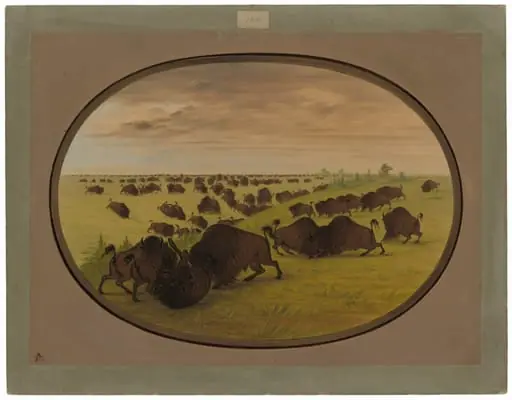 Bulls Fighting
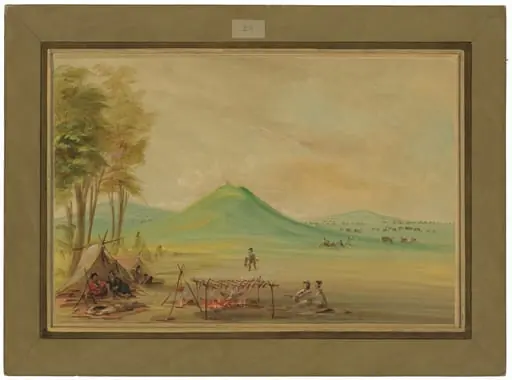 Expedition Encamped on a Texas Prairie. April 1686
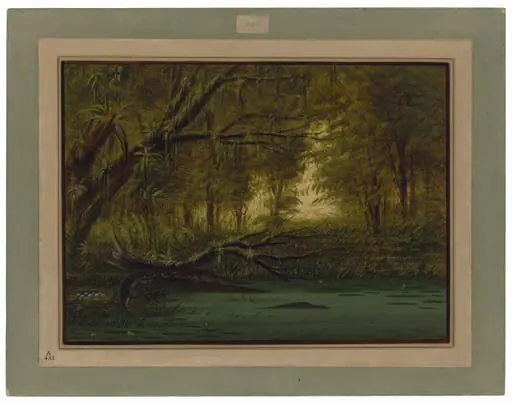 An Alligator's Nest
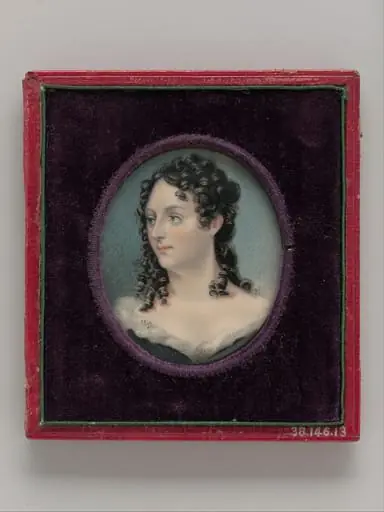 Mrs. George Catlin (Clara Bartlet Gregory)
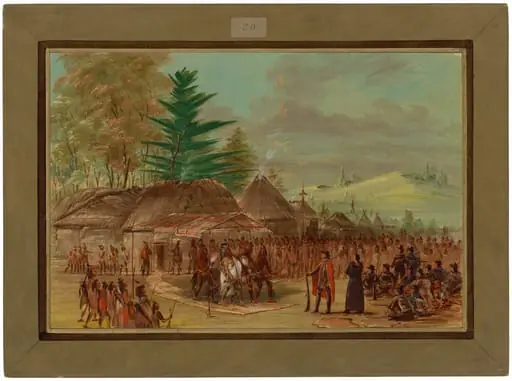 Chief of the Taensa Indians Receiving La Salle. March 20, 1682
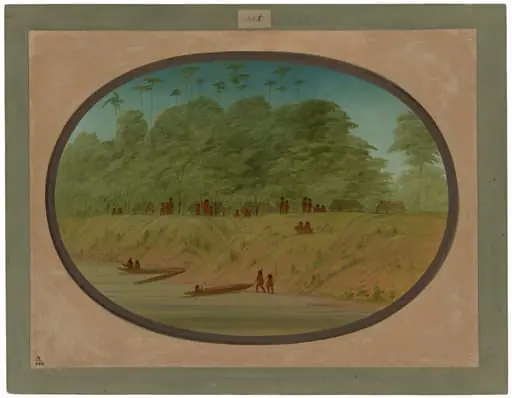 A Small Village - Payaguas Indians
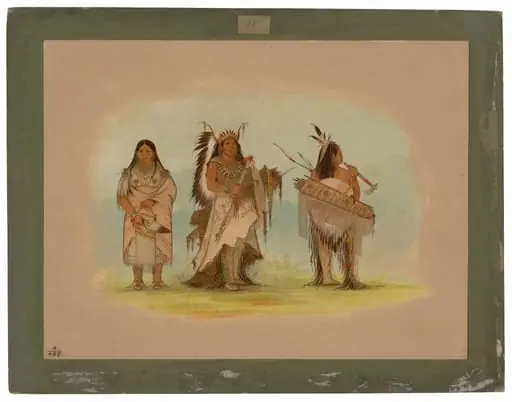 Omaha Chief, His Wife, and a Warrior
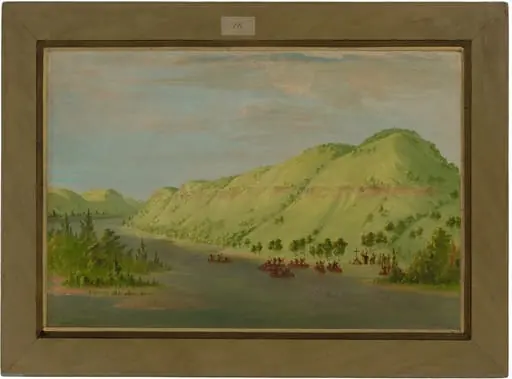 Father Hennepin Leaving the Mississippi to Join La Salle. May 8, 1680