Artwork
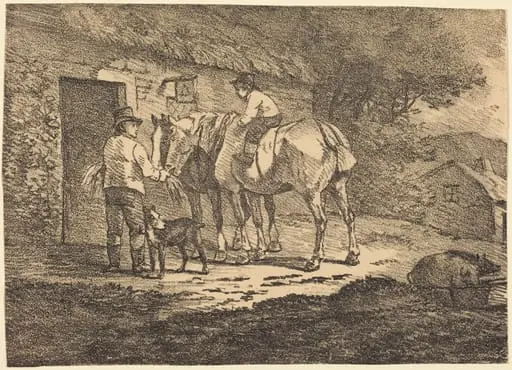
First Riding Lesson
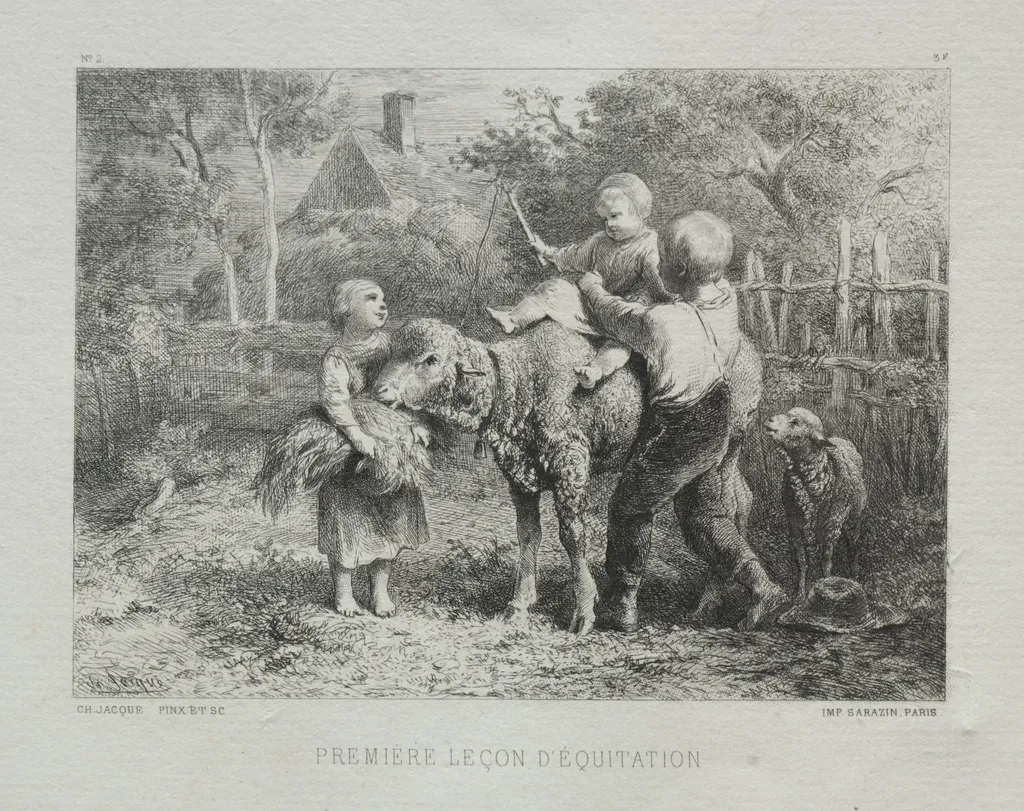
First Riding Lesson is a print by the Impressionist artist Charles-Émile Jacque. It dates from 1864 and is held in the collection of the Cleveland Museum of Art.
- Accession no.
- 1921.1476
- Credit line
- Gift of Leonard C. Hanna Jr.
About this work
Overview
Though trained in engraving through cartographic work during his army service, he turned to pastoral subjects after leaving military service.
Charles-Émile Jacque produced this print in 1864, drawing on his background as a military surveyor and his later focus on rural life. Though trained in engraving through cartographic work during his army service, he turned to pastoral subjects after leaving military service. This piece belongs to a body of work that reflects his deep engagement with the countryside and its quiet, everyday rituals.
Subject & Meaning
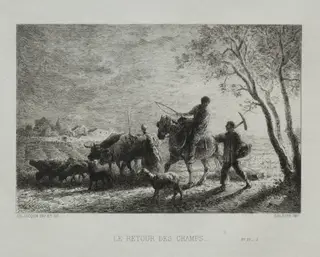
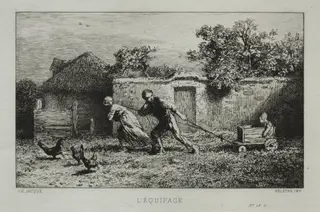
The scene shows a child on horseback, guided by an adult, in a gentle moment of learning. No grand spectacle or drama is present, only the quiet tension of a first attempt at horsemanship. The setting suggests a rural enclosure, reinforcing Jacque’s interest in ordinary rural experiences rather than idealized or theatrical narratives.
Technique & Style
Executed as an engraving, the work displays fine linear detail and controlled tonal gradations typical of Jacque’s hand. The composition is restrained, with attention to the textures of fabric, fur, and earth. Jacque avoids dramatic lighting or exaggerated motion, favoring a calm, observational approach that aligns with the Barbizon School’s emphasis on naturalism.
History & Provenance
Created during Jacque’s mature period, the print emerged from his sustained focus on agricultural and equestrian themes. It was likely produced for a broader audience interested in domesticated rural life, circulating among collectors and print enthusiasts in mid-19th-century France. No specific early ownership records are widely documented.
Context
Jacque worked alongside other Barbizon artists who rejected academic grandeur in favor of truthful depictions of peasant life and landscape. While his peers painted fields and forests, Jacque often turned to animals and rural labor. This print fits within a broader cultural interest in the moral and emotional value of simple, grounded experiences.
Legacy
Jacque’s prints, including this one, contributed to the recognition of engraving as a legitimate medium for serious artistic expression beyond reproduction. His focus on rural childhood and animal-human relationships influenced later generations of printmakers who sought intimacy over spectacle in their depictions of everyday life.
Own this work as a print
Artist & collection

Artist
Charles-Émile Jacque (23 May 1813 – 7 May 1894) was a French painter of Pastoralism and engraver who was, with Jean-François Millet, part of the Barbizon School. He first learned to engrave maps when he spent seven years in the French Army.