Artwork
The Crew
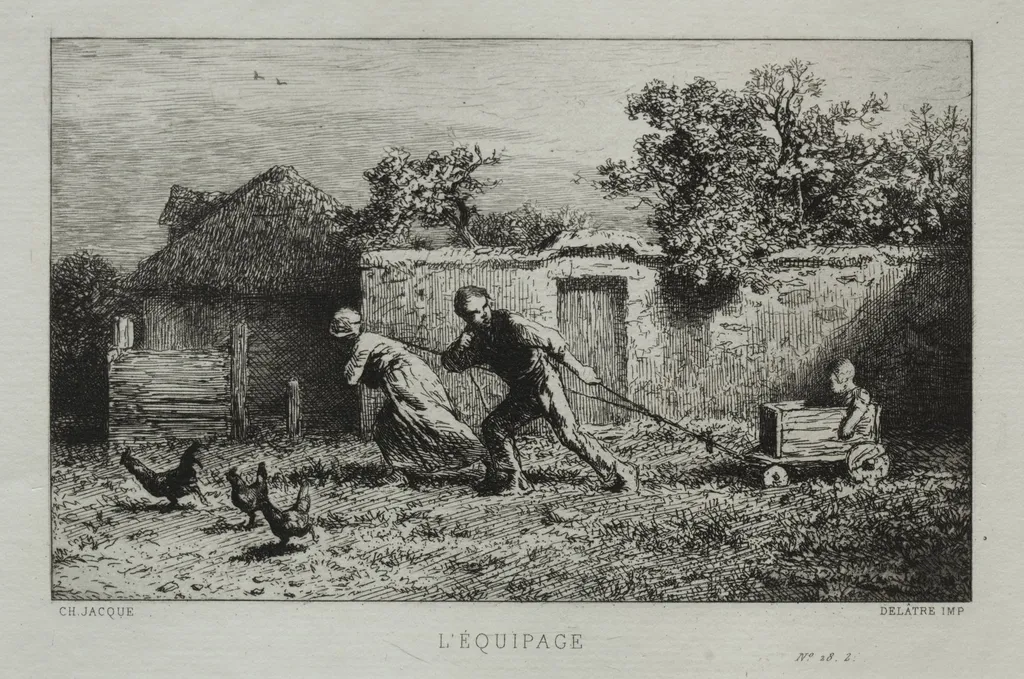
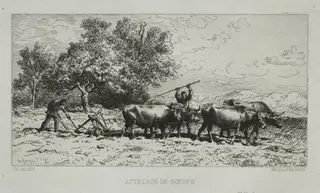
The Crew is a print by the Impressionist artist Charles-Émile Jacque. It dates from 1865 and is held in the collection of the Cleveland Museum of Art.
- Accession no.
- 1921.1447
- Credit line
- Gift of Leonard C. Hanna Jr.
About this work
Overview
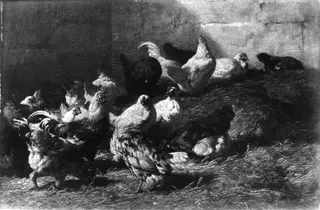
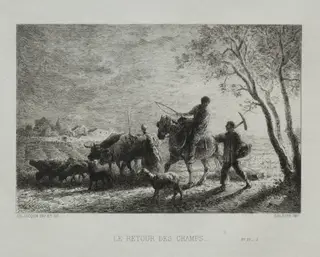
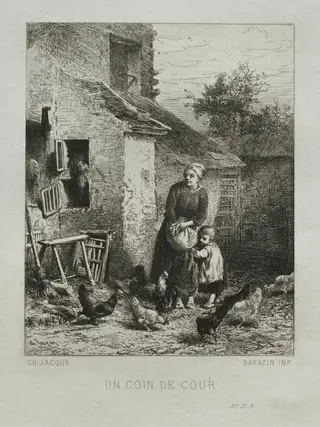
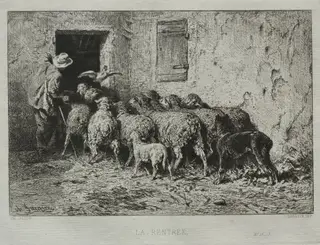
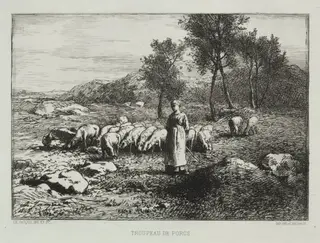
Created in 1865 by French artist Charles‑Émile Jacque, The Crew is a black‑and‑white print that captures a moment of rural labor. The composition centers on three figures engaged in physical work beside a modest wooden structure, with chickens and a solitary tree completing the scene.
Subject & Meaning
The image portrays everyday agricultural activity: one figure hoists a heavy load, another pushes a wheelbarrow, while a third observes from a seated position. The title, L’Équipage (The Crew), underscores the focus on collective, ordinary effort rather than heroic or mythological narratives.
Technique & Style
Jacque employs a restrained line drawing, using clear, economical strokes to convey movement and the weight of the tasks. The monochrome palette and emphasis on contour reflect his background in precise engraving, while the composition aligns with the Barbizon School’s preference for naturalistic, unembellished depictions of rural life.
History & Provenance
Before turning to fine art, Jacque spent seven years as a map engraver in the French army, a training that informed his meticulous approach to printmaking. By the mid‑nineteenth century he had joined the Barbizon circle, where The Crew was produced as part of his ongoing exploration of pastoral subjects.
Context
The work emerges from the Realist movement’s interest in portraying the lives of common people. In the 1860s, French artists increasingly turned away from academic idealization toward scenes that documented the labor and environment of the countryside, a trend that Jacque exemplifies through this straightforward, observational piece.
Own this work as a print
Artist & collection

Artist
Charles-Émile Jacque (23 May 1813 – 7 May 1894) was a French painter of Pastoralism and engraver who was, with Jean-François Millet, part of the Barbizon School. He first learned to engrave maps when he spent seven years in the French Army.