Artwork
Saint Florian
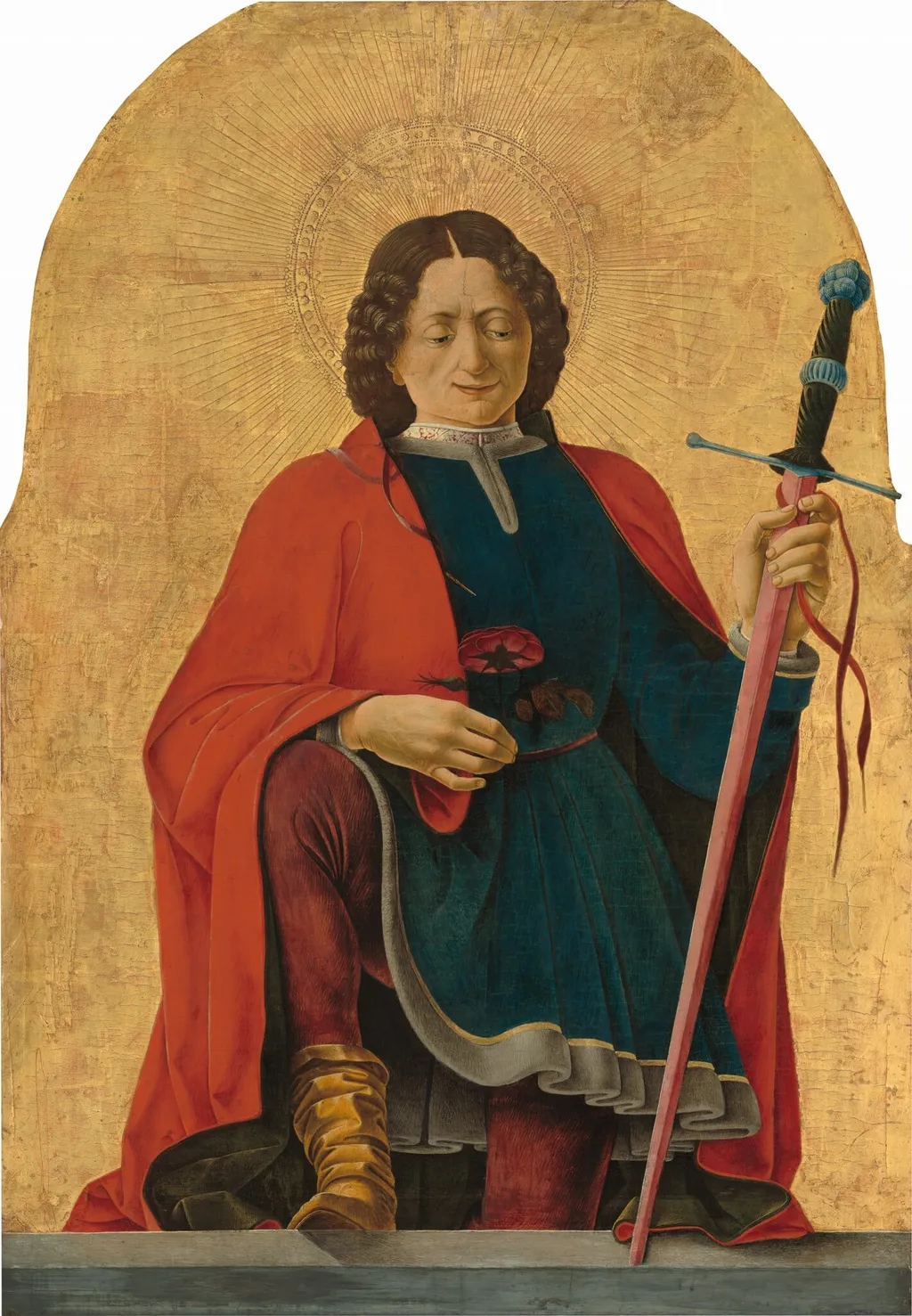
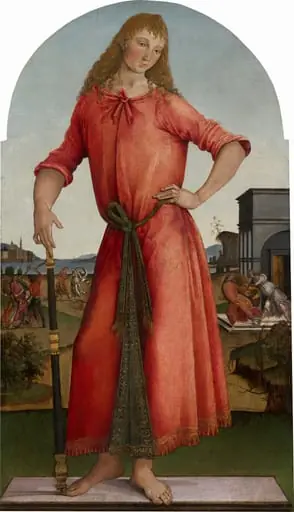
Saint Florian is an oil painting by the Early Renaissance artist Francesco del Cossa. It dates from 1474 and is held in the collection of the National Gallery of Art.
About this work
A saint stands in a spare landscape of a few trees and a low hill, dressed in armor and holding a flag. Francesco del Cossa lavishes detail on the armor and clothing. Tempera on poplar panel, 1474.
Subject & Meaning
The figure is rendered with naturalistic anatomical detail and soft gestures, reflecting the influence of Piero della Francesca.
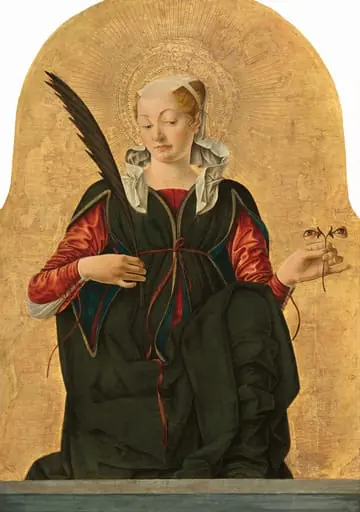
Francesco del Cossa's panel depicts Saint Florian standing in a solemn, regal pose, with one foot propped upon a stone parapet. The saint holds a sword in one hand and a red rose in the other, while a lace or cord hangs from his neck. These specific attributes carry distinct symbolic weight: the rope alludes to Florian's martyrdom, specifically his drowning while tied to a millstone, while the sword represents his military status.
The figure is rendered with naturalistic anatomical detail and soft gestures, reflecting the influence of Piero della Francesca. Although the gold background differs from the sky found in the lower panels of the original Griffoni Polyptych, it signifies that Florian and the opposing Saint Lucy occupy a paradisiacal loggia, looking down upon the central scene of Saint Vincent Ferrer.
Technique & Style
Created circa 1472–1473, this work is executed in tempera and gold on a poplar panel, measuring 79 × 55 cm. The support features a gold background, a distinct typology that initially raised questions regarding its inclusion in the Griffoni Polyptych compared to the sky backgrounds of lower panels. Stylistically, the figure of Saint Florian displays a solemn and regal presence, reflecting the influence of Piero della Francesca. The artist prioritizes anatomical and naturalistic rendering, evident in the soft gestures and detailed hands.
Formal composition relies on a striking stance, utilizing the oval shape of the red cape and the shortened circle of the petticoat's edge to define spatial depth. The saint stands with one foot propped on a stone parapet, holding a sword and a red rose, while a lace around his neck alludes to his martyrdom.
History & Provenance
Saint Florian was painted by Francesco del Cossa around 1472 as the upper left panel of the Griffoni Polyptych, commissioned by Floriano Griffoni for the family chapel dedicated to Saint Vincent Ferrer, the sixth off the north aisle of the Basilica of San Petronio in Bologna. The altarpiece was executed in collaboration with the Ferrarese master Ercole de' Roberti. Vasari recorded the work in his Lives, noting the chapel dedication and the tempera panel with its predella of small figures.
The polyptych remained in situ until 1725–1730, when it was disassembled and dispersed on the antiquarian market in separate lots. The Saint Florian and Saint Lucy panels eventually entered the collection of Count Ugo Beni in Gubbio by 1858. They were sold at the Beni sale in Gubbio in April 1882 and acquired by the dealer Joseph Spiridon in Paris.
After passing through Duveen Brothers, the panel was purchased in May 1936 by the Samuel H. Kress Foundation, which gifted it in 1939 to the National Gallery of Art in Washington.
The painting is held in the National Gallery of Art, Washington, D.C., as part of the Samuel H. Kress Collection (accession no. 1939.1.165). It was acquired in 1939 through the Samuel H. Kress Foundation’s gift to the museum. The work was previously in the collections of Count Ugo Beni, Gubbio, by 1858, then sold in 1882 to Joseph Spiridon, Paris.
It passed through Duveen Brothers before being purchased by the Kress Foundation in 1936. The painting was part of the Griffoni Polyptych in the Basilica of San Petronio, Bologna, until its dispersal in the early 18th century.
Context
Francesco del Cossa's Saint Florian (c. 1472) occupies a pivotal position within the Ferrarese school, exemplifying the synthesis of local style and the influence of Piero della Francesca. Art historical scholarship, notably Roberto Longhi's 1935 reconstruction in Officina ferrarese, established the panel's identity as the upper-left component of the dispersed Griffoni Polyptych, despite initial doubts caused by its gold background contrasting with the sky of lower panels. The work reflects Cossa's tenure in Bologna, where he collaborated with Ercole de' Roberti on a commission for the Griffoni family chapel in San Petronio.
Critics have long praised the figure's solemn, regal demeanor and the naturalistic rendering of anatomy and hands, marking a high point in Cossa's mature style. The panel's journey from its original 15th-century context to its 20th-century reunification in scholarly discourse underscores its significance in understanding the development of Renaissance religious painting in Emilia-Romagna.
Legacy
The legacy of Francesco del Cossa's Saint Florian is significantly tied to the scholarly reconstruction of the disassembled Griffoni Polyptych. Although the panel remained in its original chapel in Bologna until the 1720s, its subsequent dispersal into private collections, including that of Count Ugo Beni, obscured its context for over a century. The work's modern reputation was solidified in 1935 when art historian Roberto Longhi virtually reassembled the polyptych in his seminal study Officina ferrarese, correcting earlier misidentifications such as its classification as Saint Martin by Zoppo.
Longhi's analysis highlighted the panel's stylistic debt to Piero della Francesca, cementing its status as a key example of Ferrarese art. The painting's eventual acquisition by the Samuel H. Kress Foundation and donation to the National Gallery of Art in 1939 ensured its preservation and public visibility, allowing it to serve as a critical reference for understanding Cossa's mature style.
Overview
Saint Florian is a tempera painting on a poplar panel, created by Francesco del Cossa around 1472. This work, now housed at the National Gallery of Art in Washington, originally served as the upper left component of the extensive Griffoni Polyptych. It depicts a solitary figure, characteristic of devotional art from the period, rendered with meticulous attention to detail and a focused composition that highlights the saint.
Own this work as a print
Artist & collection
Artist
Francesco del Cossa (c. 1430 – c. 1477) was an Italian Renaissance painter of the School of Ferrara, who after 1470 worked in Bologna. Cossa is best known for his frescoes, especially his collaboration with Cosimo Tura…