Artwork
Bagpiper
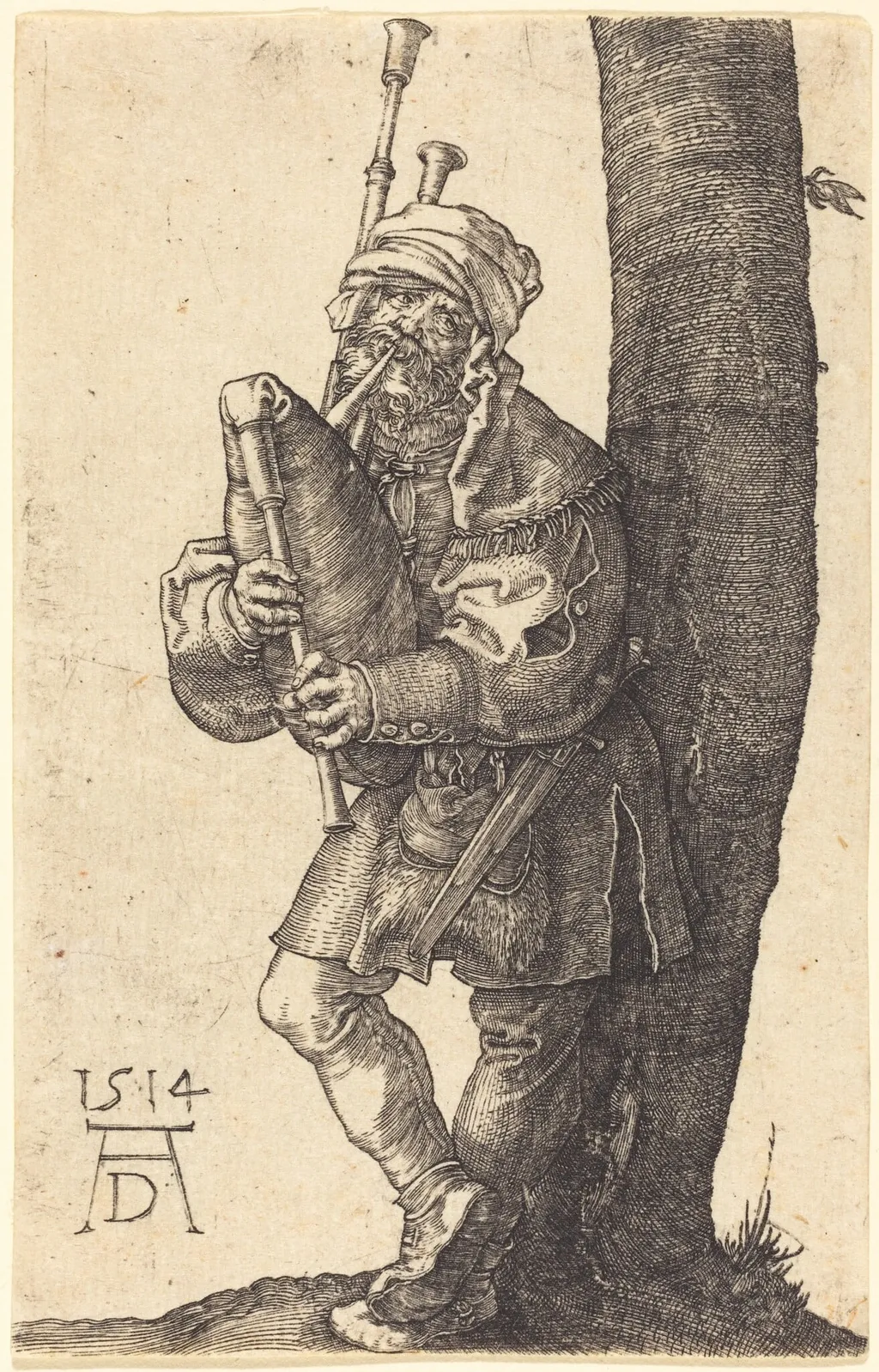
Bagpiper is an ink print by the Northern Renaissance artist Albrecht Dürer. It dates from 1514 and is held in the collection of the National Gallery of Art.
- Inscription
- Inscribed:in plate, lower left: 1514 / AD [artist's monogram]; verso, lower right, in graphite by a later hand: 1. [?]; verso, lower right, in graphite by a later hand: a[1?]; verso, lower left, in graphite by a later hand: 255
About this work
Overview
The engraving demonstrates Dürer's mastery of line and his ability to convey movement and character within a small, self-contained format.
Bagpiper is an engraving by the German Renaissance master Albrecht Dürer, executed in 1514. The work depicts a solitary male figure in profile, playing a bagpipe while walking. The composition is tightly framed, focusing entirely on the musician and his instrument against a blank background, a format typical of Dürer's independent prints from this period.
Dürer renders the figure with precise linear detail, capturing the folds of the clothing, the texture of the bag, and the mechanical components of the instrument. The date 1514 is inscribed within the image, marking it as a product of the artist's mature period in Nuremberg. This work belongs to a series of genre scenes and character studies Dürer produced around this time, reflecting a growing interest in everyday life and individual expression alongside his religious and allegorical subjects.
The engraving demonstrates Dürer's mastery of line and his ability to convey movement and character within a small, self-contained format. It stands as a significant example of Northern Renaissance printmaking, illustrating the artist's engagement with secular themes and his technical virtuosity in translating complex forms into the medium of engraving.
Technique & Style
Created through the intaglio process, the work employs a network of fine incised lines that build tonal variation across the paper’s textured surface. Dürer’s handling of hatching and cross‑hatching achieves subtle shading, while the crisp outlines emphasize the bagpipe’s form, illustrating his mastery of printmaking techniques that were advancing in early sixteenth‑century Germany.
History & Provenance
Since its production, the engraving has been part of several collections, ultimately entering the National Gallery of Art in Washington, D.C. The museum acquired the piece as part of its broader effort to assemble representative works by Dürer, ensuring public access to this example of his early print oeuvre.
Own this work as a print
Artist & collection
Artist
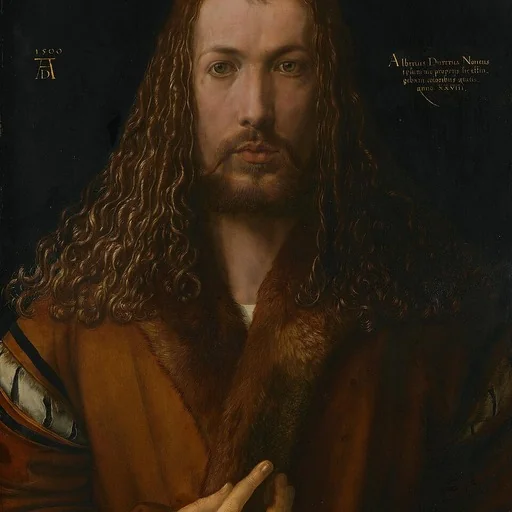
Albrecht Dürer spent his life in Nuremberg, a busy German city where artists traded prints like currency.

![Madonna and Child [obverse], by Albrecht Dürer](https://artifactworldgallery.com/img/albrecht-durer--madonna-and-child-obverse--d7b8ebf05d22ebe5-w320.webp)
![Lot and His Daughters [reverse], by Albrecht Dürer](https://artifactworldgallery.com/img/albrecht-durer--lot-and-his-daughters-reverse--b4ebf9b282faa17a-w320.webp)