Artwork
Doubting Thomas
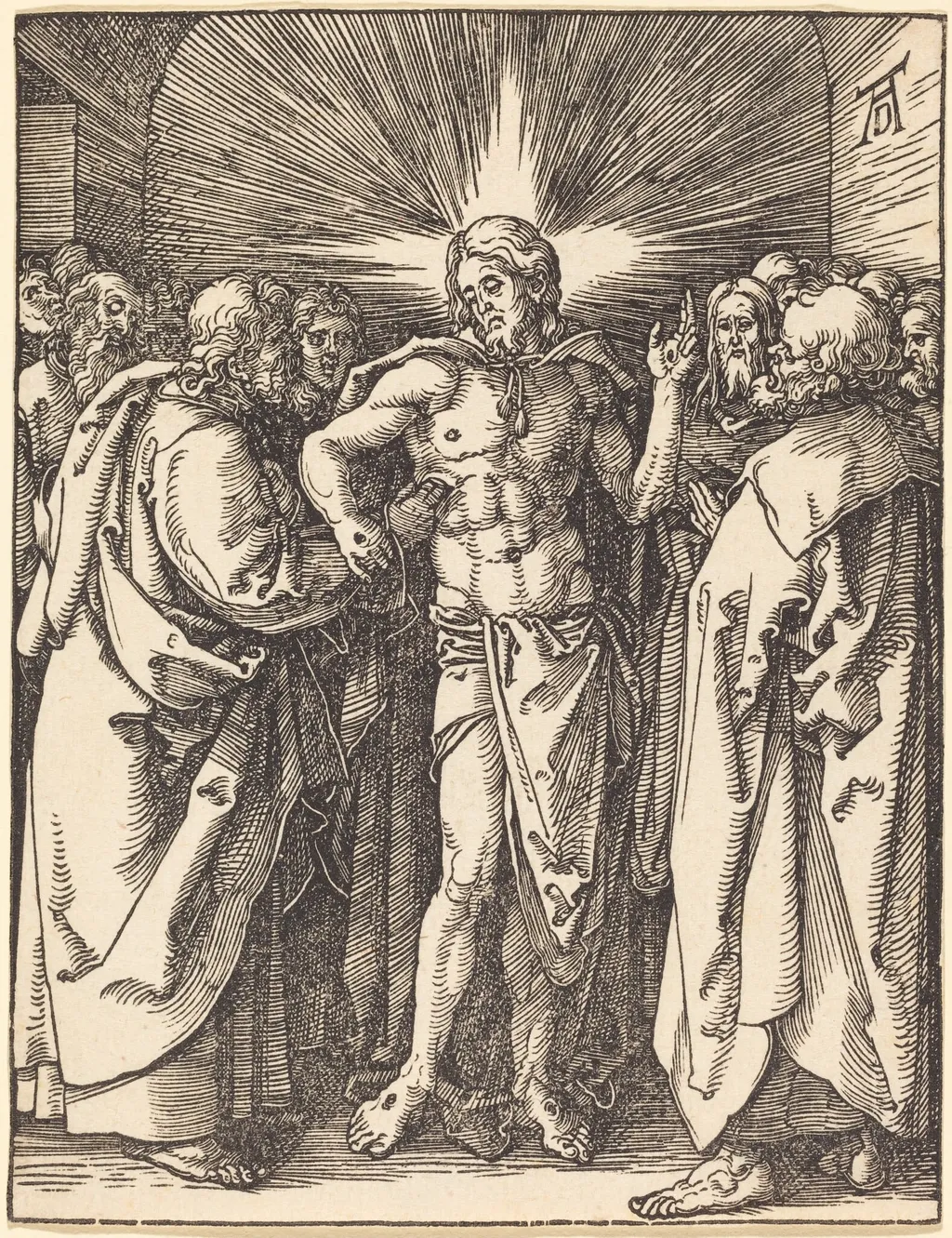
Doubting Thomas is an ink print by the Northern Renaissance artist Albrecht Dürer. It dates from 1510 and is held in the collection of the British Museum.
- Inscription
- Inscribed:in block, top right, on wall: AD [artist's monogram]; verso, lower center, in graphite by a later hand: 627; verso, bottom left, in graphite by a later hand: B 49; verso, bottom center, in graphite by a later hand: 34
About this work
Subject & Meaning
As part of the Little Passion series, the work visualizes the New Testament narrative in which Thomas demands physical proof of Christ's resurrection.
Albrecht Dürer's 1509 woodcut illustrates the biblical episode of Doubting Thomas, depicting the Apostle Thomas as the central figure. As part of the Little Passion series, the work visualizes the New Testament narrative in which Thomas demands physical proof of Christ's resurrection. The print serves as a religious devotional image, focusing on the moment of scrutiny and the subsequent affirmation of faith through tactile evidence.
By isolating this specific apostle, the composition emphasizes the human struggle with doubt and the theological significance of believing without seeing, a core theme in Christian iconography derived directly from scripture.
Technique & Style
Doubting Thomas is a woodcut printed on laid paper, classified as a print within the religious genre. Created as part of Albrecht Dürer's Little Passion series, it belongs to the German Renaissance movement and depicts the Apostle Thomas. The work measures 12.7 cm in height by 9.7 cm in width, consistent with the intimate scale typical of small-format devotional woodcuts.
Dürer's handling of the woodcut medium in this series is noted for its refined linear technique and expressive detail, achieved through carefully cut blocks printed on laid paper supports.
History & Provenance
Albrecht Dürer created the woodcut Doubting Thomas in 1509 as part of his Little Passion series. The work depicts the Apostle Thomas and is based on the New Testament narrative. The known ownership chain begins with Joseph Daniel Böhm of Vienna, followed by Robert Scholtz of Budapest.
The print later passed through the collection of William Schab in New York before being purchased by Lessing J. Rosenwald in Jenkintown, Pennsylvania, in 1940. Rosenwald subsequently gifted the work to the National Gallery of Art in Washington, D.C., in 1943, where it remains part of the Rosenwald Collection.
Albrecht Dürer's 1509 woodcut Doubting Thomas is held by the National Gallery of Art in Washington, D.C., as part of the Rosenwald Collection. The work entered the museum's holdings in 1943 as a gift from Lessing J. Rosenwald, who had purchased it in 1940. Prior to its arrival in the United States, the print passed through the collections of Joseph Daniel Böhm in Vienna and Robert Scholtz in Budapest.
While other institutions such as the Metropolitan Museum of Art and the British Museum also possess impressions from this series, the specific provenance documented for this impression traces its ownership exclusively to the Rosenwald gift.
Overview
Albrecht Dürer's 'Doubting Thomas' is a woodcut created in 1510, depicting the biblical moment from the Gospel of John where the Apostle Thomas verifies the resurrected Christ's wounds. The composition centers on Christ, who stands calmly while lifting his robe to expose his side, inviting Thomas to insert his finger into the spear wound. Thomas leans forward with intense focus, his hand guided by Christ's own, while two other apostles observe the interaction from the background, framing the central theological assertion of physical resurrection.
Executed on laid paper, the work demonstrates Dürer's mastery of the woodcut medium, utilizing precise hatching and cross-hatching to model volume and convey the texture of drapery and flesh. This piece belongs to a series of religious prints produced during Dürer's second Italian journey and subsequent return to Nuremberg, a period marked by his synthesis of Northern European detail with Italian Renaissance ideals of proportion and perspective. The image serves as a didactic tool for Catholic devotion, emphasizing the tangible reality of the Incarnation against contemporary skepticism.
It remains a significant example of Dürer's ability to translate complex theological narratives into accessible, visually rigorous graphic art that influenced subsequent generations of printmakers.
Context
Produced during the height of the Northern Renaissance, the print reflects contemporary interest in disseminating biblical stories to a broad audience. Woodcuts like this one allowed Dürer to circulate religious imagery beyond the confines of altarpieces and manuscripts, aligning with the period’s expanding print culture.
Own this work as a print
Artist & collection
Artist
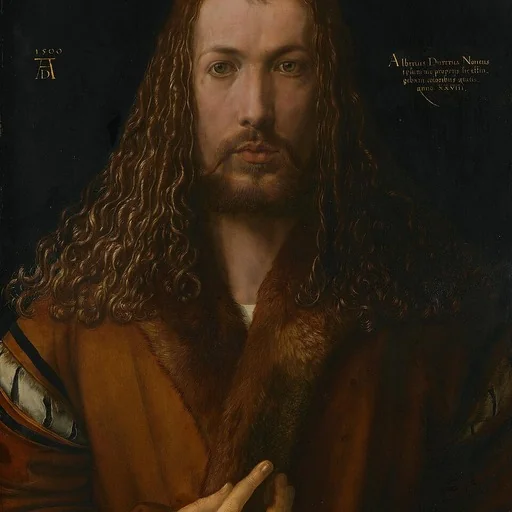
Albrecht Dürer spent his life in Nuremberg, a busy German city where artists traded prints like currency.

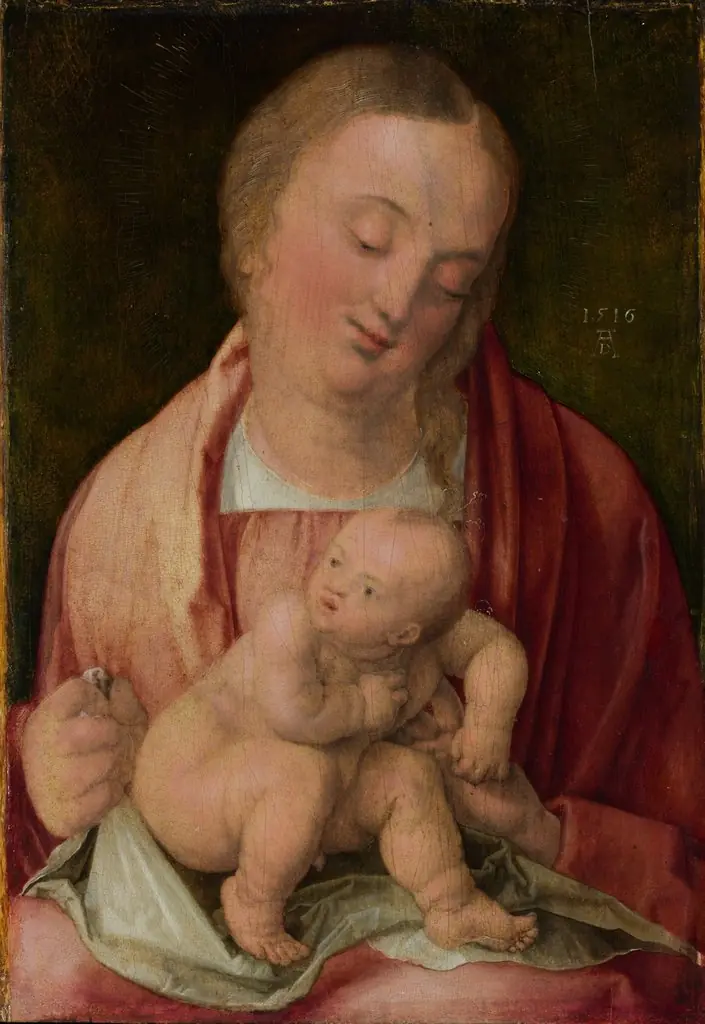
![Madonna and Child [obverse], by Albrecht Dürer](https://artifactworldgallery.com/img/albrecht-durer--madonna-and-child-obverse--d7b8ebf05d22ebe5-w320.webp)
![Lot and His Daughters [reverse], by Albrecht Dürer](https://artifactworldgallery.com/img/albrecht-durer--lot-and-his-daughters-reverse--b4ebf9b282faa17a-w320.webp)
- The Flagellation
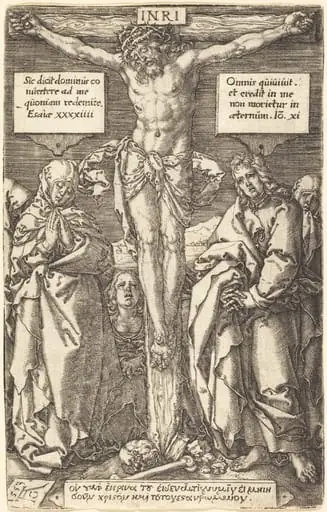 Christ on the Cross
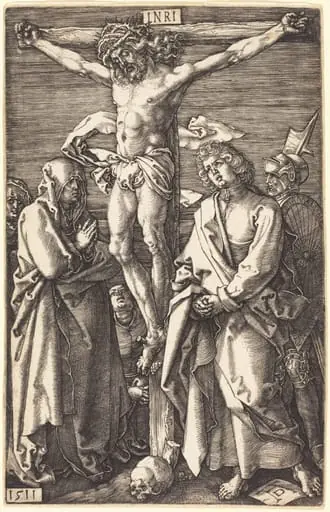 The Crucifixion
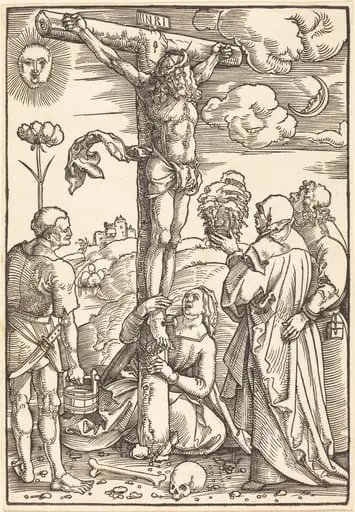 Christ on the Cross
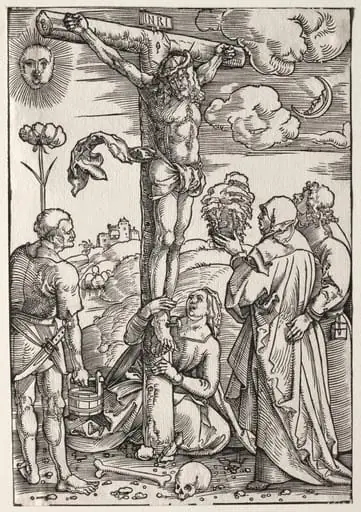 Christ on the Cross with Mary, St. John, Mary Magdalen and St. Stephen
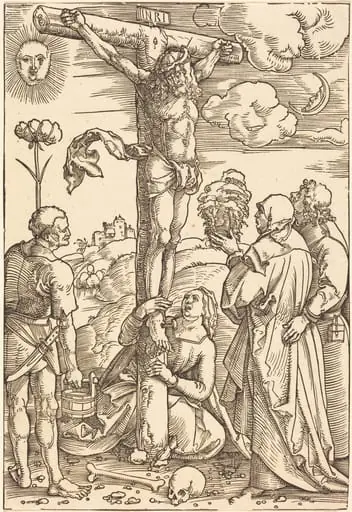 Christ on the Cross
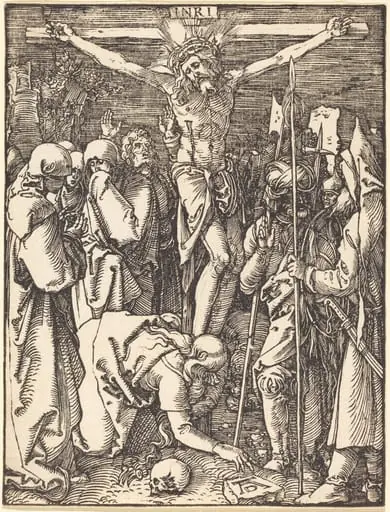 The Crucifixion
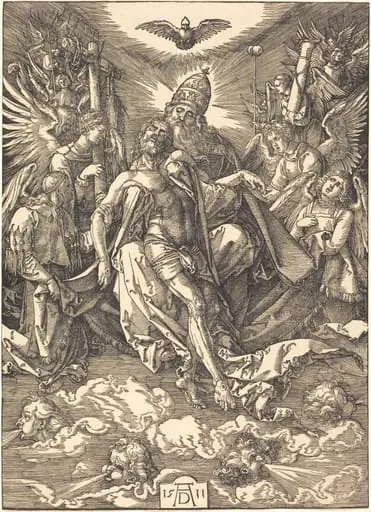 The Trinity
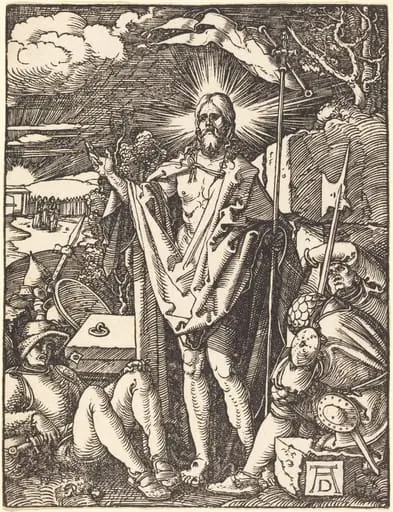 The Resurrection
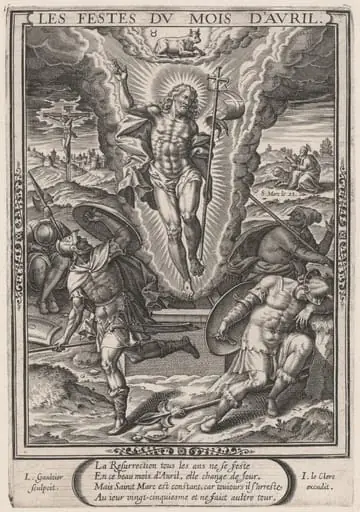 Les Festes du mois d'Avril (April: The Resurrection)
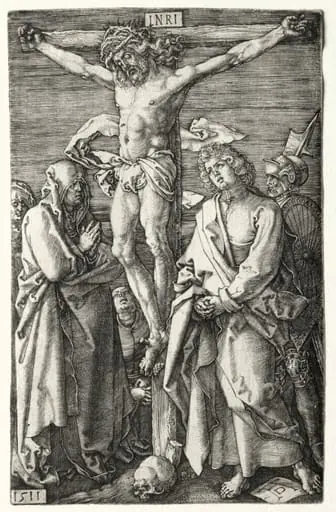 The Crucifixion
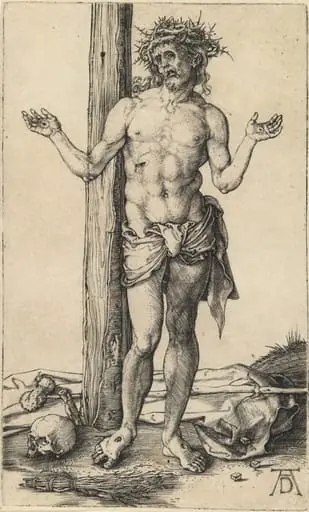 The Man of Sorrows with Arms Outstretched