Artwork
The Prodigal Son
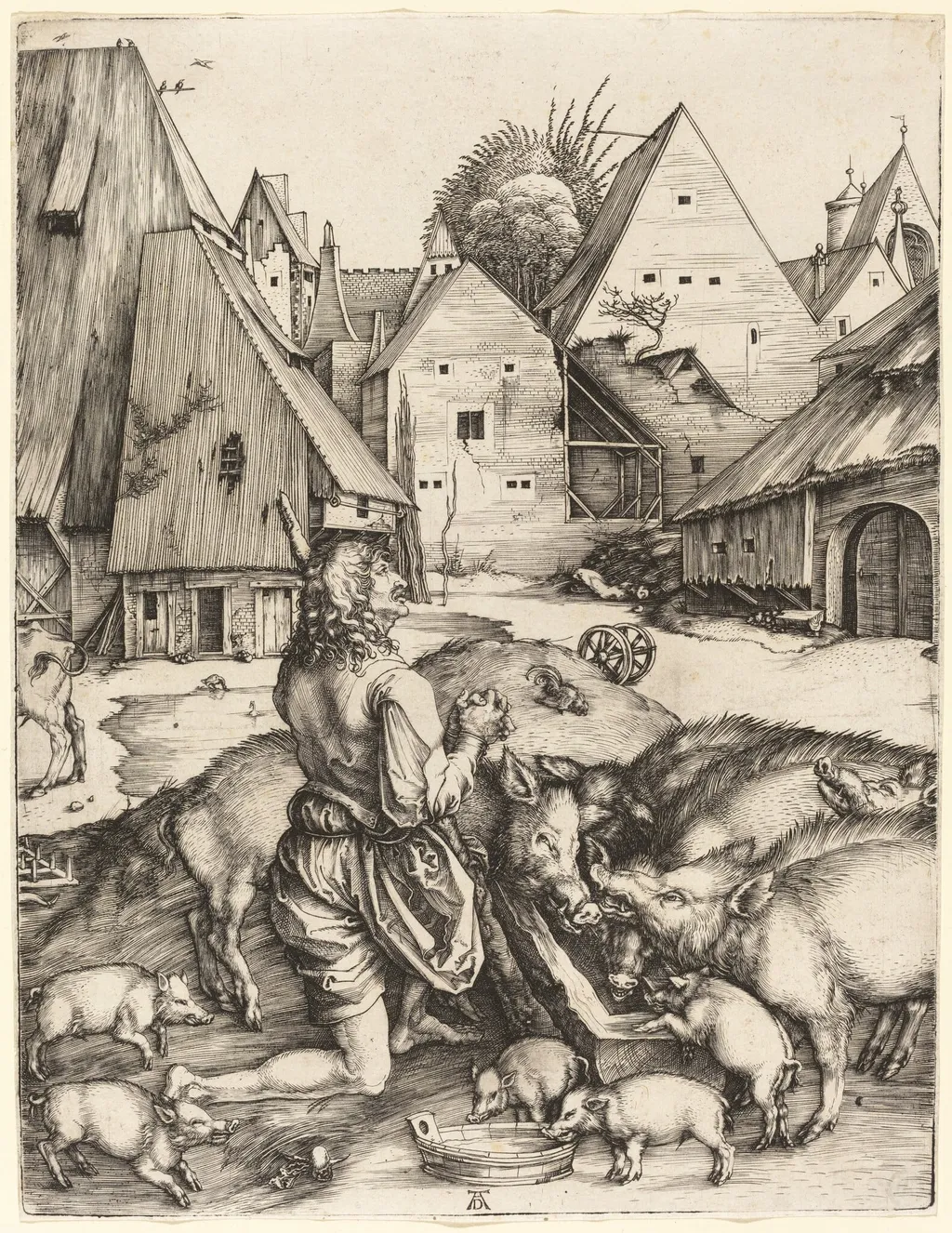
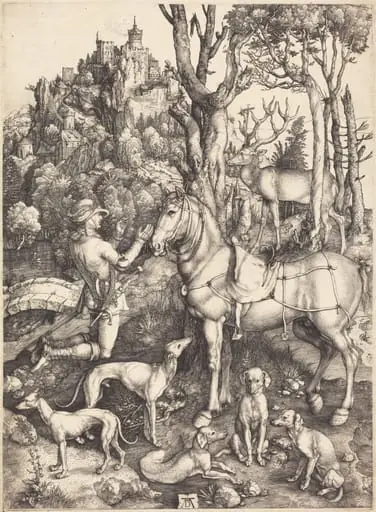
The Prodigal Son is an ink print by the Northern Renaissance artist Albrecht Dürer. It dates from 1496 and is held in the collection of the National Gallery of Art.
- Inscription
- Inscribed:bottom, in plate: AD [artist's monogram]; verso, upper left, in graphite by a later hand: 206; center, in brown ink by a later hand: 209; lower left center, in graphite by a later hand: B.28 D.10; lower left, in graphite by a later hand: J.4940 / K.906V; bottom left, in graphite by a later hand: B-6489 [upside down]
About this work
Overview
He is shown in a posture of humility and exhaustion, his head bowed as he tends to the animals, visually emphasizing his descent from wealth to poverty.
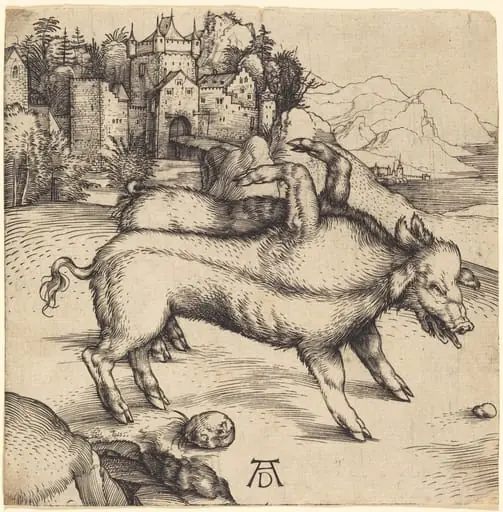
Albrecht Dürer's engraving The Prodigal Son, created in 1496, illustrates the biblical parable of the repentant son from the Gospel of Luke. The composition centers on the prodigal son, depicted as a gaunt figure in tattered, anachronistic clothing, kneeling in a muddy pen among swine. He is shown in a posture of humility and exhaustion, his head bowed as he tends to the animals, visually emphasizing his descent from wealth to poverty.
The scene is populated by numerous pigs rooting in the dirt, their forms rendered with Dürer's characteristic precision in texture and anatomy. In the background, simple structures with steep roofs and a distant boat on water provide a landscape context that anchors the narrative in a recognizable, albeit stylized, European setting. This work is a significant example of Dürer's early mastery of the engraving medium, demonstrating his ability to convey complex emotional states and narrative depth through intricate line work and tonal variation.
Created during the height of the German Renaissance, the piece reflects the artist's engagement with humanist themes and his skill in translating literary and religious subjects into the graphic arts, establishing his reputation as a leading printmaker of his era.
Subject & Meaning
The image depicts a weary man in antiquated attire kneeling beside a disordered herd of pigs, his head bowed in exhaustion. A small boat carrying an infant drifts nearby, while the animals root in the soil. The composition evokes the biblical parable of the prodigal son, suggesting themes of loss, repentance and the hardships of poverty.
Technique & Style
Dürer employed precise incised lines and cross‑hatching to model the textures of cloth, fur and architectural elements. The use of laid paper, with its visible ribbed pattern, adds subtle tonal variation. Sharp contours and careful shading create a sense of depth, allowing the figures and the surrounding structures to emerge distinctly within the black‑and‑white medium.
History & Provenance
Created in the late 15th century, the engraving entered the National Gallery of Art’s holdings through acquisition in the 20th century, though earlier ownership records are sparse. Its survival on laid paper attests to the durability of Dürer’s copper plates and the careful preservation of early modern prints.
Context
The work belongs to Dürer’s formative period, when he was exploring narrative subjects drawn from religious texts. Engravings such as this were widely circulated, serving both devotional and didactic purposes. The depiction of a humble, laboring figure reflects contemporary concerns about social order and moral instruction in late medieval Germany.
Own this work as a print
Artist & collection
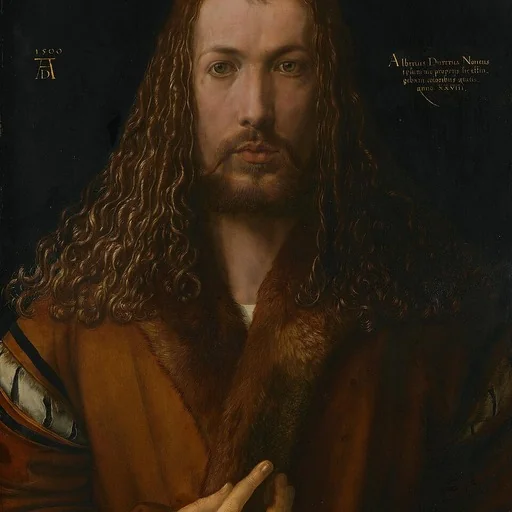
Artist
Albrecht Dürer spent his life in Nuremberg, a busy German city where artists traded prints like currency.

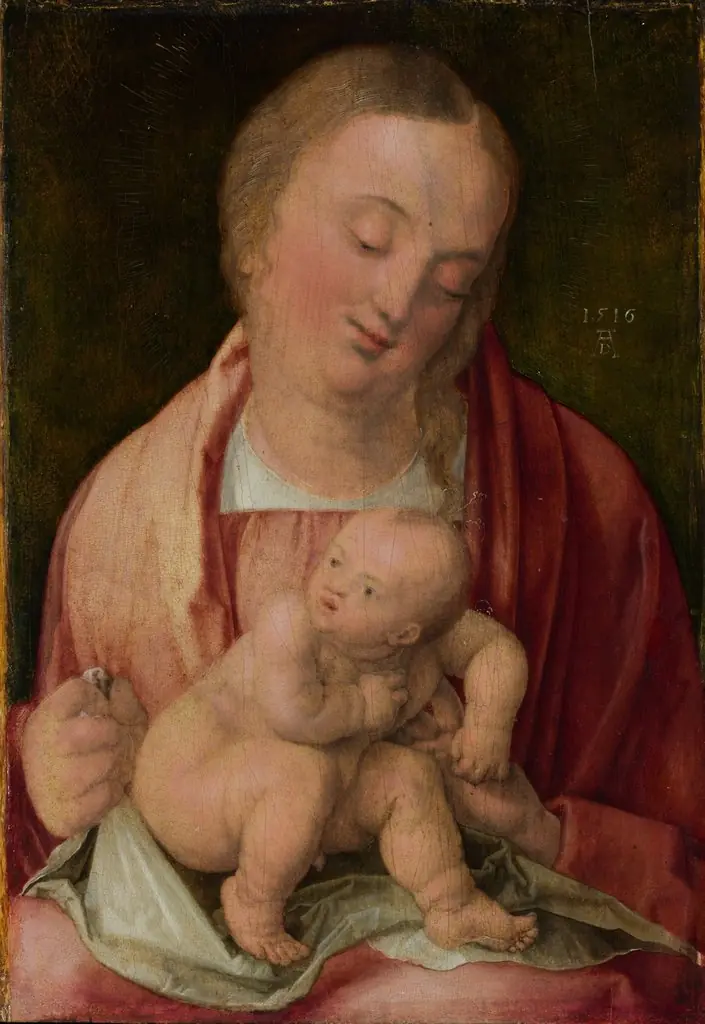
![Madonna and Child [obverse], by Albrecht Dürer](https://artifactworldgallery.com/img/albrecht-durer--madonna-and-child-obverse--d7b8ebf05d22ebe5-w320.webp)
![Lot and His Daughters [reverse], by Albrecht Dürer](https://artifactworldgallery.com/img/albrecht-durer--lot-and-his-daughters-reverse--b4ebf9b282faa17a-w320.webp)