Artwork
Saint Eustace
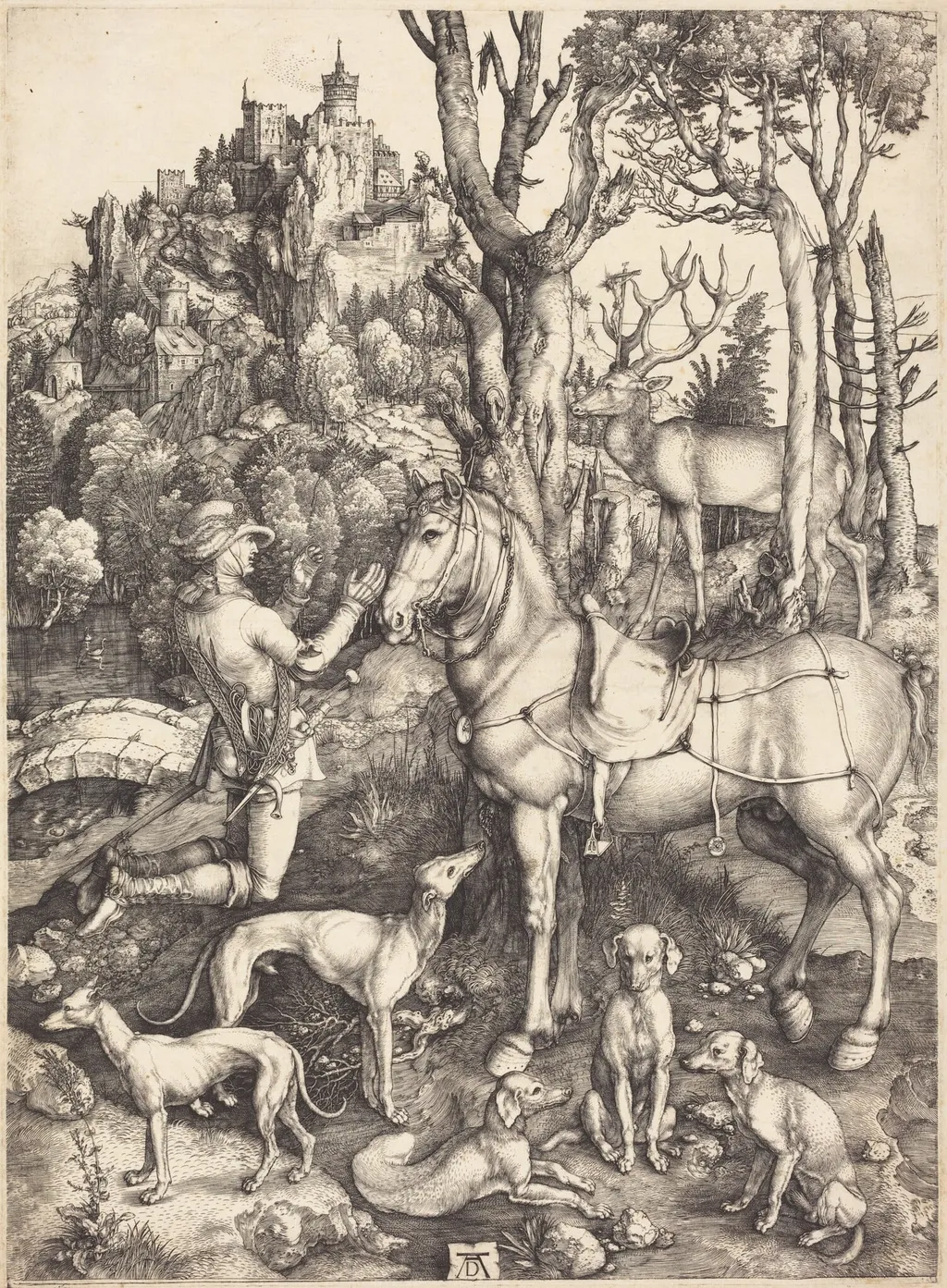
Saint Eustace is an ink print by the Northern Renaissance artist Albrecht Dürer. It dates from 1500 and is held in the collection of the Metropolitan Museum of Art.
- Inscription
- Inscribed:in plate, bottom center, in sheet: AD [artist's monogram]; verso, lower center, in graphite by a later hand: 57; verso, lower left, in graphite by a later hand: NR [?] 31509; verso, bottom left, in graphite by a later hand: B - 15222 [upside down]
- Markings
- Marked:verso, stamp in black ink on bottom left corner: JO [?]; R. Horace Gallatin-National Gallery stamp.
About this work
Subject & Meaning
The piece reflects Dürer's study of animal proportions and acknowledges the influence of Pisanello's earlier treatments of similar subjects and animal studies.
The engraving depicts the Roman general Placidus, later Saint Eustace, during a hunt when he experiences a divine vision of a crucifix appearing between the antlers of a stag. Dürer portrays the saint as a knight kneeling in awe in the middle ground, having momentarily abandoned his horse and greyhounds, which occupy the foreground. This compositional choice directs the viewer's eye through realistically rendered trees toward a castle on a rocky outcrop in the distance.
Likely inspired by the Golden Legend, the work serves as a glorification of Creation in all its diversity, showcasing detailed observations of nature alongside human-made elements like the saint's contemporary hunting attire and equipment. The piece reflects Dürer's study of animal proportions and acknowledges the influence of Pisanello's earlier treatments of similar subjects and animal studies.
Technique & Style
Saint Eustace is an engraving on copper, executed on laid paper around 1501. It is Dürer's largest copperplate and one of the prints that most strikingly testifies to his pictorial ambition, a quality sustained both by the format of the impression and by a remarkable command of the burin. Through this mastery he obtains a varied palette of greys that helps construct space and deepen the composition. The depiction of nature, in all its forms, is fully accomplished, with trees rendered realistically and a landscape that is simultaneously monumental and fairy-tale-like. The composition is extremely rich in details scattered across the scene, while Dürer also reserves particular care for the contemporary costume of Placidus and his hunting equipment. The horse that masterfully occupies the right side of the sheet, to the point of eclipsing the stag bearing the apparition of Christ, marks a decisive step in the artist's reflections on ideal animal proportions.
The only surviving preparatory study is a profile greyhound in the Royal Collection at Windsor, comparable to drawings by Pisanello, whose work on the same subject and animal studies Dürer demonstrably knew.
History & Provenance
Dated to 1501, Saint Eustace is an engraving by Albrecht Dürer produced in Nuremberg during the early German Renaissance. The composition likely drew on the Legenda Aurea, published in the city in 1488 by Dürer’s godfather Anton Koberger. The print was widely distributed by the artist during his 1520-1521 journey to the Low Countries and became a sought-after collectors’ item across the sixteenth century, praised by Giorgio Vasari for the “variety of some dogs inégalables.” The copper plate passed to Emperor Rudolf II by the century’s end, where it existed as a gilded impression or the original matrix, before multiple eighteenth-century impressions on silk were taken. In 1929, the London dealer Knoedler & Co. sold an impression to the New York collector R. Horace Gallatin, who in 1949 bequeathed it to the National Gallery of Art, Washington, D.C. The print is held by the National Gallery of Art, Washington, D.C., where it entered the collection as a gift from R. Horace Gallatin in 1949. Its accession record at the National Gallery of Art is not specified in the cited sources. The Fogg Art Museum, Harvard Art Museums, Cambridge, Massachusetts, also holds an impression that is described as one of the finest surviving copies.
Context
Saint Eustace is widely regarded as Dürer’s most ambitious engraving of his early maturity, praised for its technical mastery and ambitious composition. Early reception in Vasari’s Lives (1568) highlights the print’s celebrated dogs, singling out the variety and quality of the hounds as exemplary. The work’s layered space, achieved through subtle gradations of burin-work and atmospheric landscape, was seen as a summation of Dürer’s study of nature and human form.
In the sixteenth century the engraving circulated as a prized collector’s item, with Rudolf II acquiring a gilded impression or the matrix by century’s end. Seventeenth-century taste favored luxurious variants, including impressions on silk, underscoring the print’s status as both devotional image and luxury artifact. Later, Cranach’s adaptation of one of its hounds in the Judgment of Paris (1508) signals its formal influence across German art.
Own this work as a print
Artist & collection
Artist
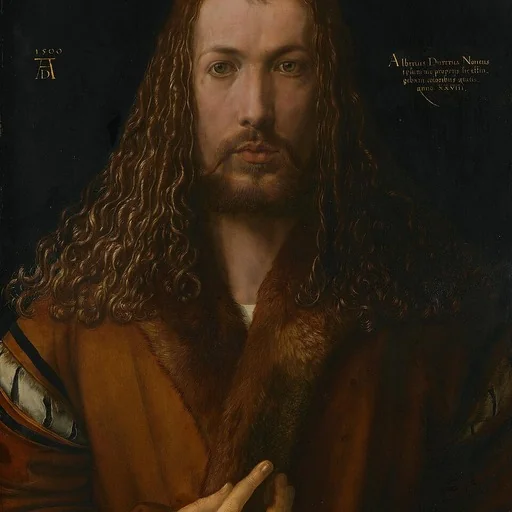
Albrecht Dürer spent his life in Nuremberg, a busy German city where artists traded prints like currency.

![Madonna and Child [obverse], by Albrecht Dürer](https://artifactworldgallery.com/img/albrecht-durer--madonna-and-child-obverse--d7b8ebf05d22ebe5-w320.webp)
![Lot and His Daughters [reverse], by Albrecht Dürer](https://artifactworldgallery.com/img/albrecht-durer--lot-and-his-daughters-reverse--b4ebf9b282faa17a-w320.webp)
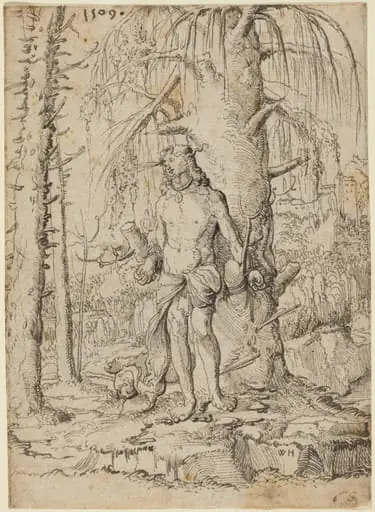 Saint Sebastian
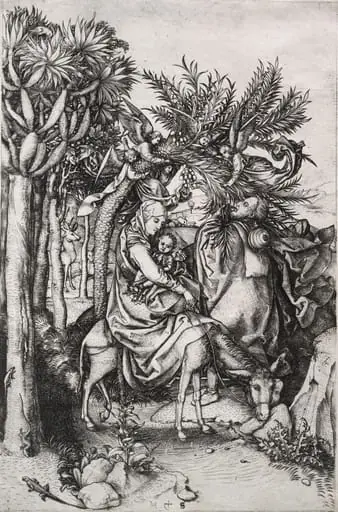 The Flight into Egypt
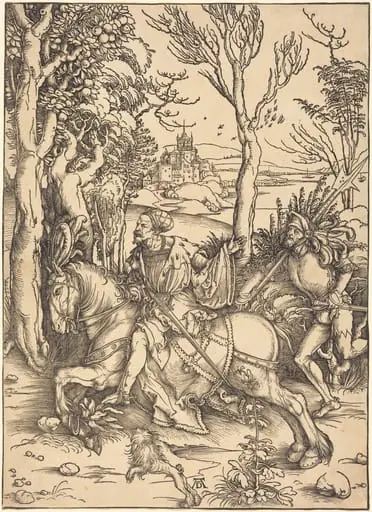 The Knight on Horseback and the Lansquenet
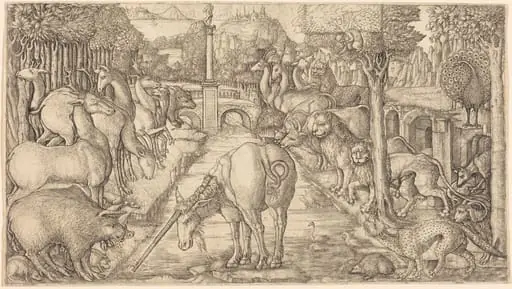 The Unicorn Purifies the Water with Its Horn
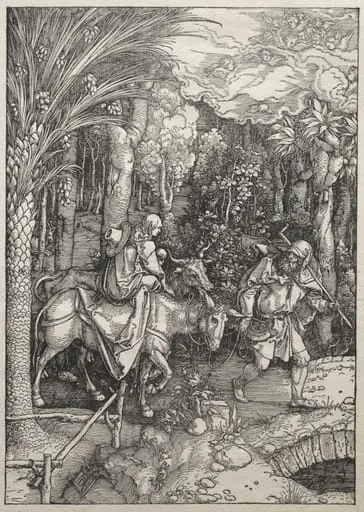 Life of the Virgin: Flight into Egypt
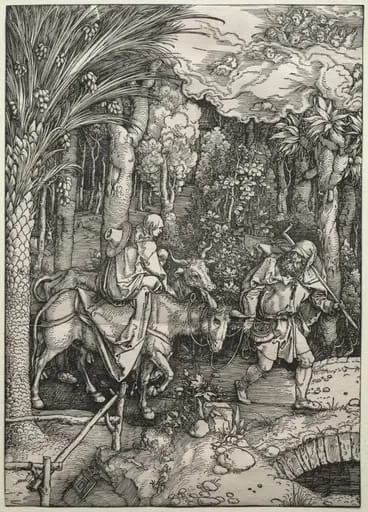 The Flight into Egypt
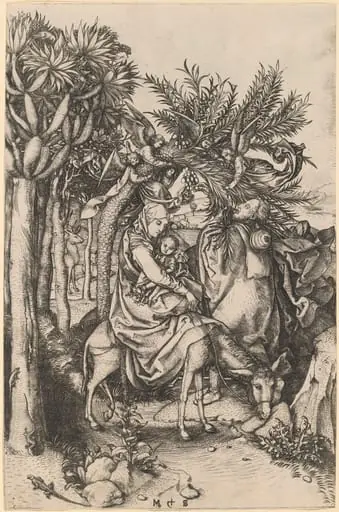 The Flight into Egypt
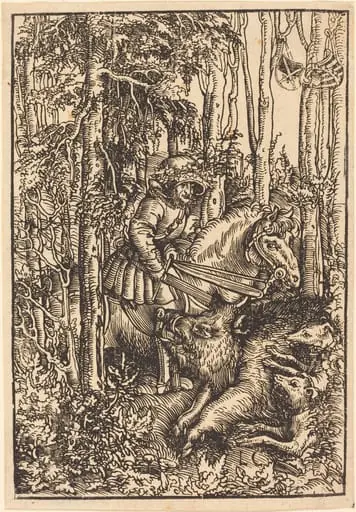 Hunter on Horseback Hunting a Wild Boar
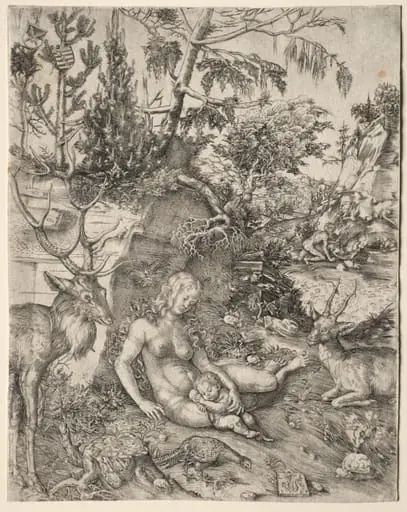 The Penance of St. John Chrysostom
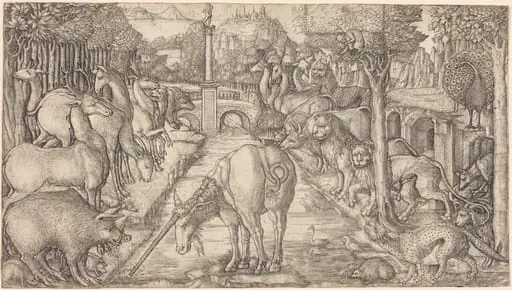 The Unicorn Purifies the Water with Its Horn
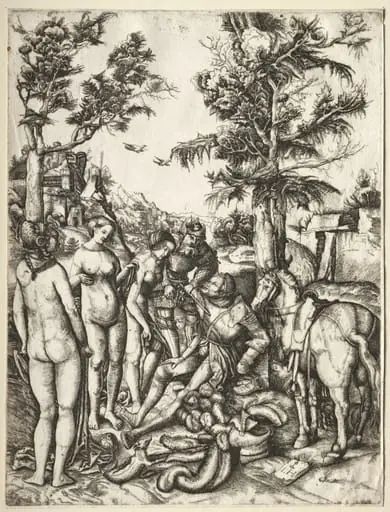 Judgment of Paris
- Saint Eustace