Artwork
L'or est une chimère
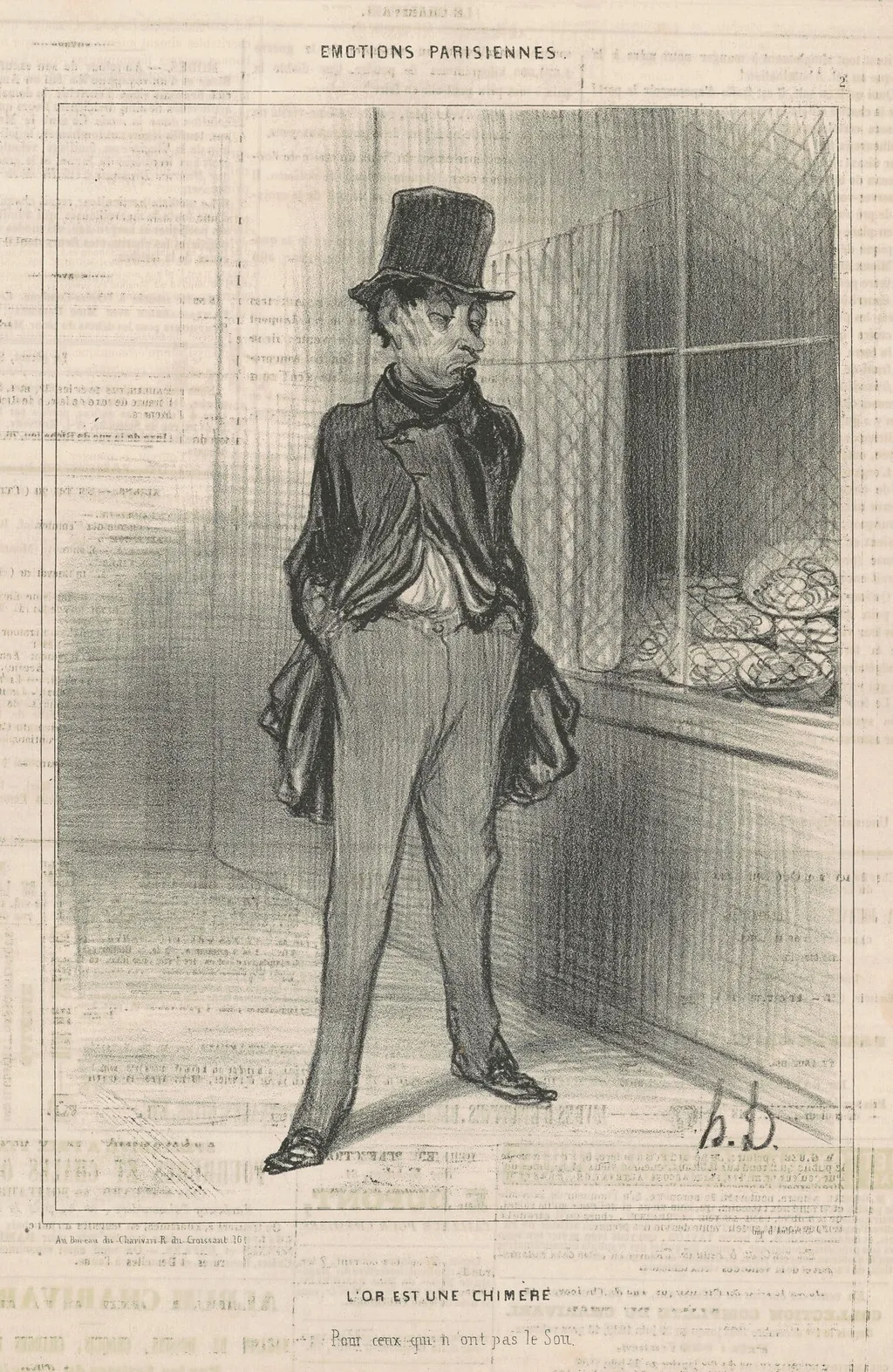
L'or est une chimère is an ink print by the Romanticist artist Honoré Daumier. It dates from 1839 and is held in the collection of the National Gallery of Art.
About this work
Overview
Created in 1839 by Honoré Daumier, L'or est une chimère is a lithograph that captures a solitary figure in urban attire, paused before a shop window. The print belongs to a series of social commentaries Daumier produced during the July Monarchy, using everyday scenes to reflect broader societal tensions. Its quiet composition belies a sharp critique of materialism and illusion.
Subject & Meaning
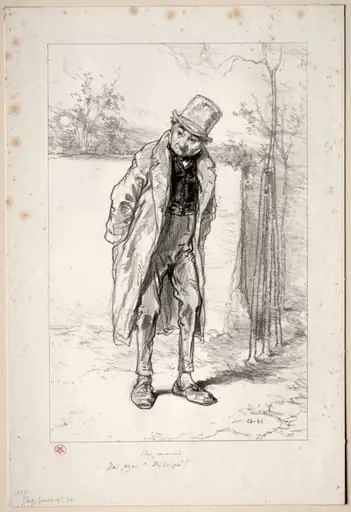
The central figure, clad in a top hat and overcoat, stares into a window filled with coiled objects, their form suggesting gold or currency. His expression conveys skepticism rather than desire, implying a disillusionment with the promise of wealth. The title, 'Gold is an Illusion,' reinforces the idea that material value is deceptive, reflecting Daumier’s skepticism toward bourgeois aspirations.
Technique & Style
The man is rendered with minimal detail, emphasizing his isolation, while the window’s contents are suggested rather than fully defined.
Daumier employed lithography to achieve sharp contrasts and fluid line work, using dense vertical strokes to frame the scene and suggest the architecture of the city. The man is rendered with minimal detail, emphasizing his isolation, while the window’s contents are suggested rather than fully defined. This economy of form heightens the psychological tension and aligns with the satirical tone of his work.
History & Provenance
The print was produced during Daumier’s most active period as a political caricaturist, published in the satirical journal Le Charivari. Though not widely exhibited in his lifetime, it was part of a broader body of work that circulated among Parisian intellectuals. Its survival in institutional collections reflects its recognition as a key example of 19th-century social commentary in print.
Context
In late 1830s Paris, economic instability and rising consumer culture fueled public debate over wealth and class. Daumier’s lithographs responded to these conditions, portraying the alienation of individuals amid commercial spectacle. L'or est une chimère fits within a tradition of urban observation, echoing the emerging realism of writers like Balzac and the visual critiques of contemporaries like Gavarni.
Legacy
The print influenced later artists interested in the psychological dimensions of modern life, including Degas and Toulouse-Lautrec. Its understated critique of consumerism remains relevant, and its technical precision helped establish lithography as a serious medium for social observation beyond mere caricature. Daumier’s ability to convey complex ideas through simple forms continues to inform visual commentary today.
Own this work as a print
Artist & collection
Artist
Honoré-Victorin Daumier (French: ; 26 February 1808 – 10 or 11 February 1879) was a French painter, sculptor, and printmaker, whose many works offer commentary on the social and political life in France, from the…