Artwork
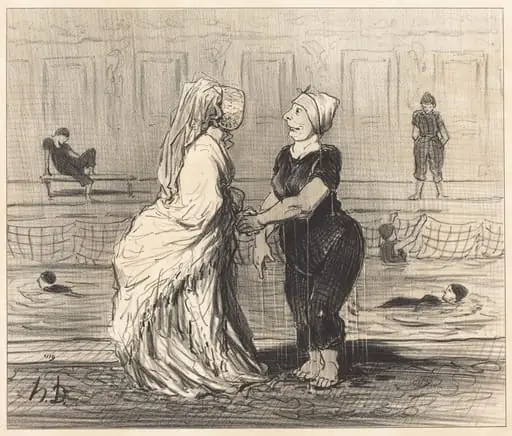
Madame Rabourdeau a sa première leçon
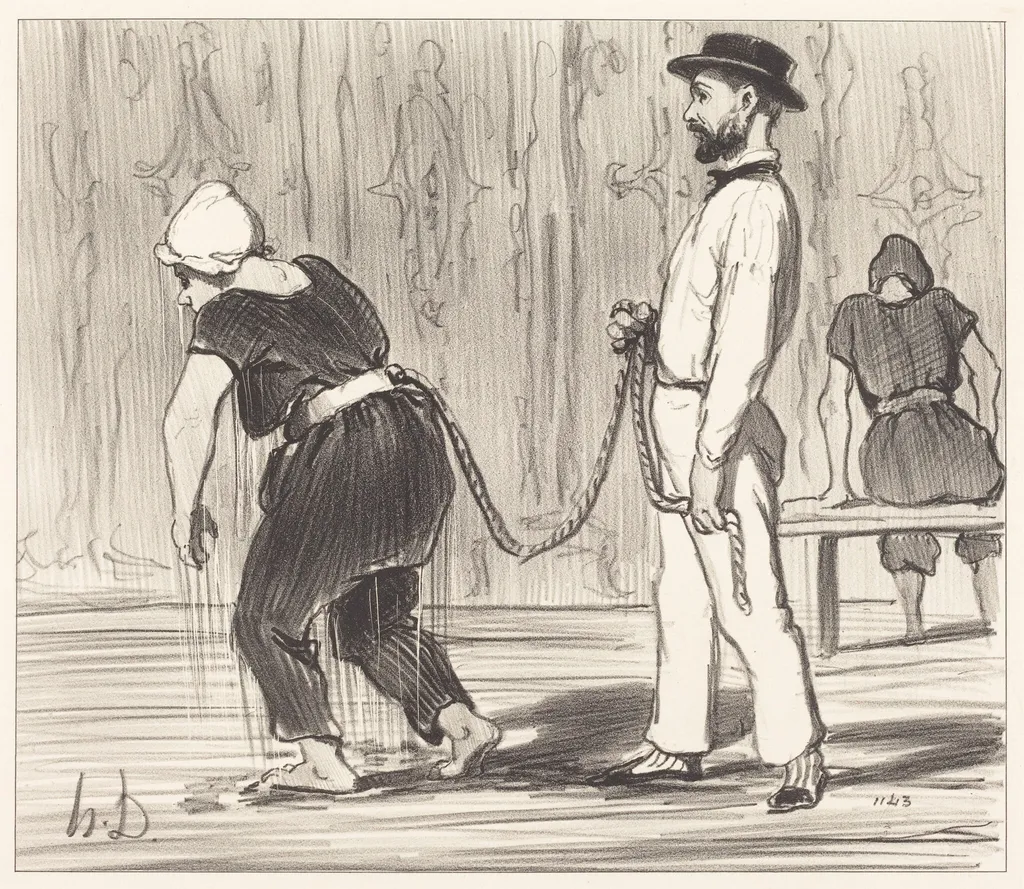
Madame Rabourdeau a sa première leçon is an ink print by the Romanticist artist Honoré Daumier. It dates from 1847 and is held in the collection of the National Gallery of Art.
About this work
Overview
As part of his prolific output for satirical journals, Daumier used the accessibility of printmaking to reach a broad audience.
Created in 1847, this lithograph by Honoré Daumier captures a quiet domestic moment with subtle social observation. As part of his prolific output for satirical journals, Daumier used the accessibility of printmaking to reach a broad audience. The work belongs to a series examining middle-class aspirations and the tensions of everyday life under the July Monarchy, rendered without overt exaggeration yet rich in implied critique.
Subject & Meaning
The scene portrays a woman assisting a child in learning to walk, while a man observes from the sidelines. The domestic setting suggests a moment of ordinary instruction, but the figures’ postures and the child’s precarious balance hint at broader themes: the struggle for upward mobility, the weight of social expectation, and the quiet labor of domestic life. Daumier avoids caricature here, instead inviting reflection on the unglamorous realities of aspiration.
Technique & Style
Daumier employed lithography to achieve a spontaneous, sketch-like quality. His fluid, economical lines convey motion and texture with minimal detail, rough walls, worn wood floors, and folded fabric are suggested rather than defined. The tonal contrasts and loose contours lend immediacy, as if capturing a fleeting glance. This technique aligned with the urgency of periodical illustration, prioritizing expressive clarity over polished finish.
History & Provenance
The print was originally published in Le Charivari, a widely circulated satirical weekly where Daumier contributed hundreds of images between the 1830s and 1860s. It was likely produced during a period of heightened political tension, following his imprisonment in 1832 for caricaturing King Louis-Philippe. Though less overtly political than earlier works, this image continues his practice of using everyday scenes to reflect societal undercurrents.
Context
In mid-19th century France, rising literacy and print culture enabled visual satire to reach the middle class. Daumier’s work responded to a public hungry for commentary on social mobility, education, and gender roles. While other artists idealized domestic life, he portrayed it with unvarnished realism, highlighting effort over elegance, and quiet endurance over spectacle.
Legacy
Daumier’s approach influenced later realist and modernist printmakers by demonstrating how ordinary moments could carry critical weight. His use of lithography as a vehicle for social observation helped redefine the medium’s potential beyond illustration. This image, though modest in scale, remains a quiet testament to his ability to reveal the emotional texture of daily life through understated observation.
Own this work as a print
Artist & collection
Artist
Honoré-Victorin Daumier (French: ; 26 February 1808 – 10 or 11 February 1879) was a French painter, sculptor, and printmaker, whose many works offer commentary on the social and political life in France, from the…









- A la buvette
 Fesant toutes partie de la plus belle moitié...
 Chère baronne, je vous félicite...
 The Cigarette
 Une profession de foi
 After the Visit (Après sa visite)
 Entre deux plongeons
 Impressions de voyage d'un grand poete
 Bal Gavarni Fan
 Les Baigneuses prudentes
 The Duel (Le duel)
 Allons, v'la encore le mouton qui a haussé