Artwork
On rend des comptes aux actionnaires
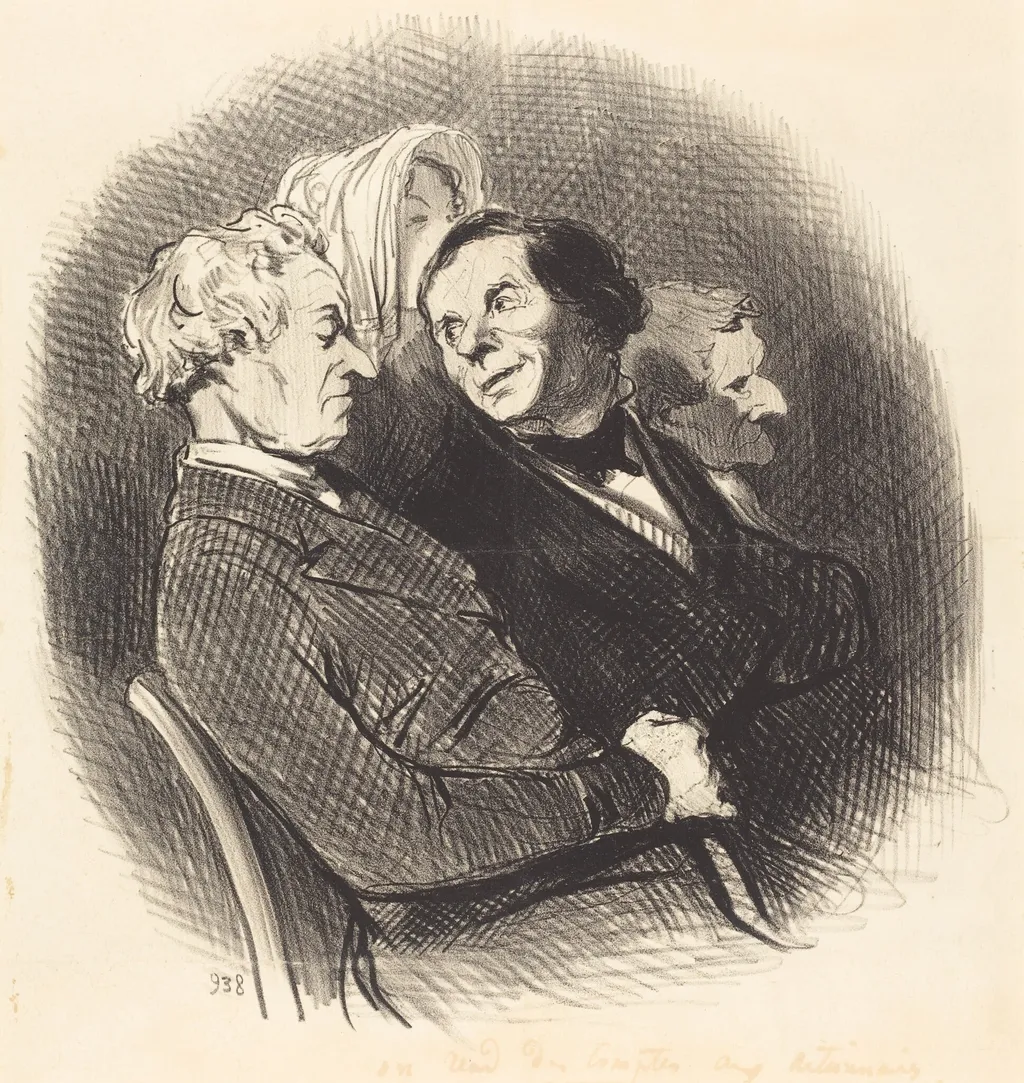
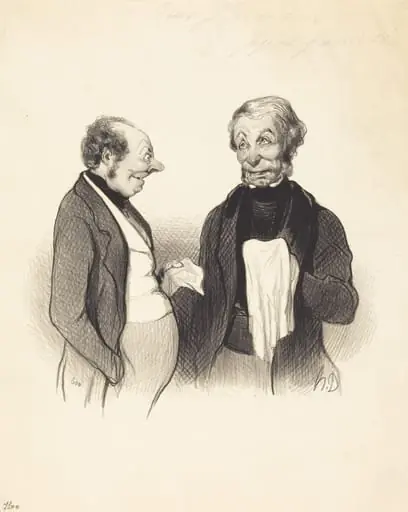
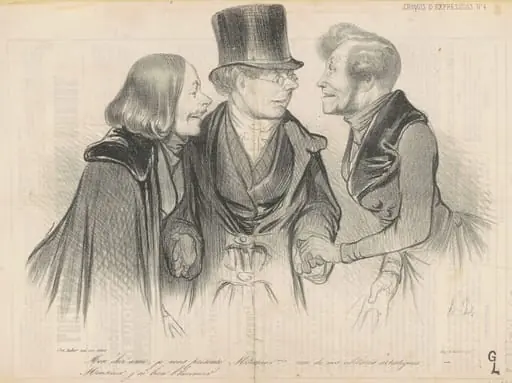
On rend des comptes aux actionnaires is an ink print by the Romanticist artist Honoré Daumier. It dates from 1846 and is held in the collection of the National Gallery of Art.
About this work
Overview
Created in 1846, this lithograph by Honoré Daumier captures a quiet moment of interpersonal exchange, stripped of overt political symbolism.
Created in 1846, this lithograph by Honoré Daumier captures a quiet moment of interpersonal exchange, stripped of overt political symbolism. Though titled to suggest corporate accountability, the image focuses instead on two elderly figures in intimate conversation. Daumier, known for biting social satire, here shifts tone to observe human behavior with subtle nuance, using the medium’s capacity for rapid, expressive line work to convey emotion without narrative exposition.
Subject & Meaning
The title references financial accountability, yet the scene depicts no boardroom or ledger, only two individuals, one solemn, the other smiling, engaged in quiet dialogue. The disconnect between title and imagery invites reflection on the gap between institutional rhetoric and personal reality. Daumier may be suggesting that true accountability occurs not in formal settings, but in the unguarded moments between people, revealing the human cost behind systems of power.
Technique & Style
Daumier employed lithography to achieve rapid, fluid lines and tonal gradations with minimal detail. The figures emerge from sparse, sketch-like strokes, their expressions shaped by subtle shading rather than defined features. Background elements are reduced to faint smudges, directing focus to the interplay of posture and facial nuance. The technique mirrors the immediacy of journalistic illustration, prioritizing emotional resonance over polished finish.
History & Provenance
Produced during Daumier’s prolific period contributing to French satirical journals, this print likely appeared in Le Charivari, where his work regularly critiqued bourgeois and financial elites. Though less overtly political than his courtroom or political caricatures, it aligns with his broader practice of observing social dynamics through intimate, unguarded moments. Its survival reflects its status as part of a larger body of work documenting mid-century French life.
Context
In 1846 France, financial speculation and public distrust in economic institutions were rising, preceding the 1848 revolution. Daumier’s work often targeted the hypocrisy of those in power, yet here he turns inward, focusing on ordinary individuals. The absence of grandeur or spectacle underscores a broader cultural fatigue with institutional performance, suggesting that meaning resides not in official accounts, but in the quiet exchanges of daily life.
Legacy
This lithograph exemplifies Daumier’s ability to convey complex social observation through understated imagery. Unlike overt political cartoons, its power lies in ambiguity and restraint, influencing later artists who favored psychological depth over direct satire. Its enduring relevance stems from its quiet humanism, offering a counterpoint to the noise of public life through the intimacy of two faces in conversation.
Own this work as a print
Artist & collection
Artist
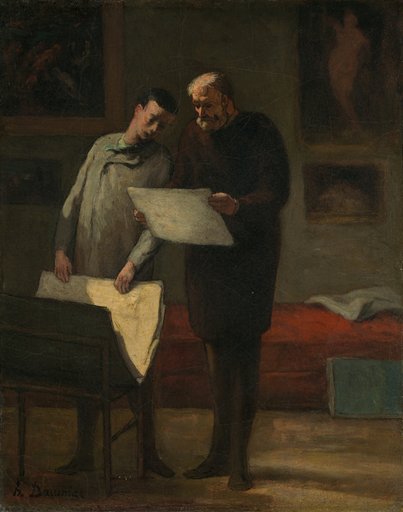
Honoré-Victorin Daumier (French: ; 26 February 1808 – 10 or 11 February 1879) was a French painter, sculptor, and printmaker, whose many works offer commentary on the social and political life in France, from the…