Artwork
Plaisanterie que se permettent ...
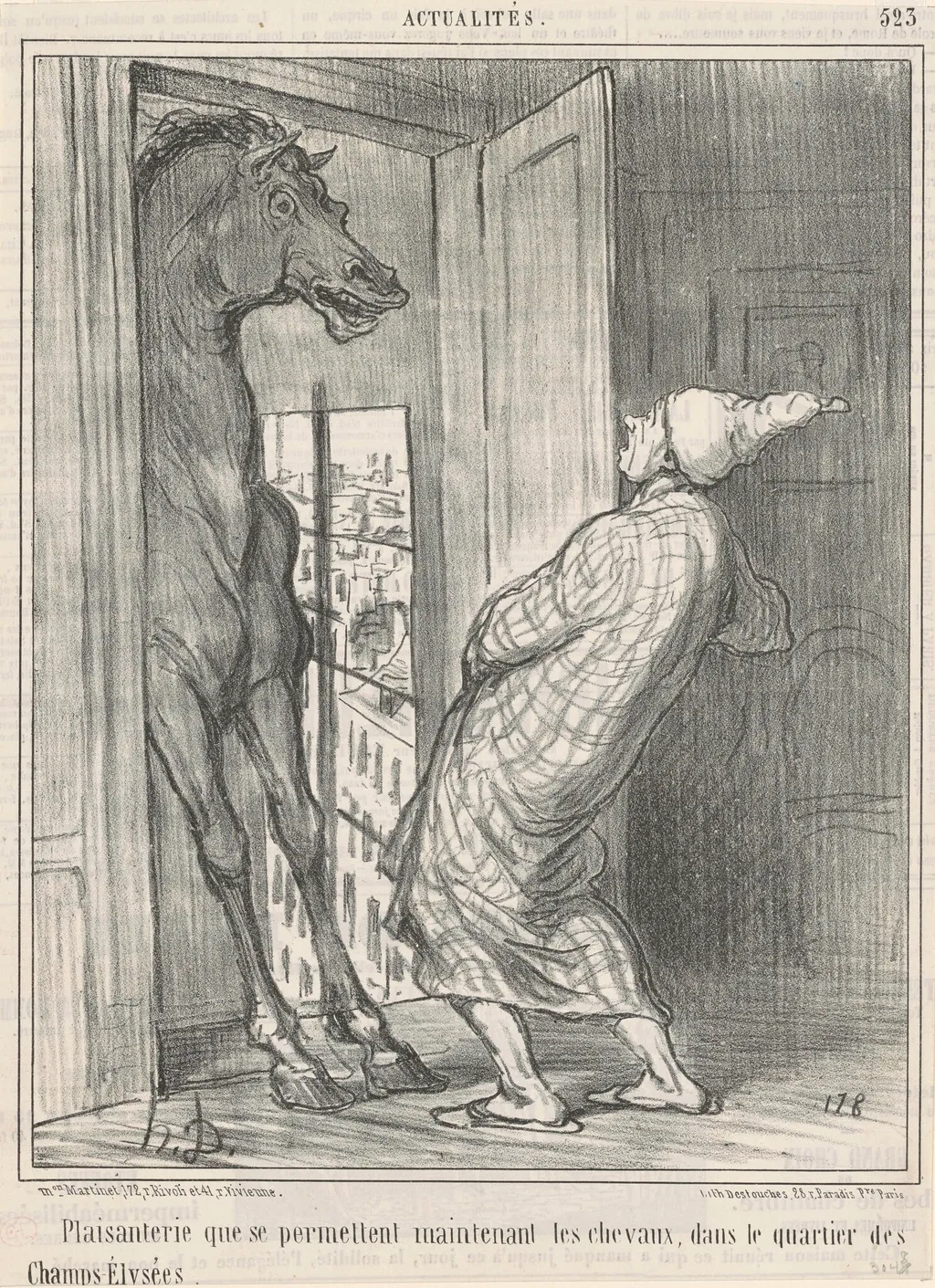
Plaisanterie que se permettent ... is an ink print by the Impressionist artist Honoré Daumier. It dates from 1858 and is held in the collection of the National Gallery of Art. Plaisanterie que se permettent.
About this work
This lithograph shows a horse standing on its back legs in a doorway. Its bulging eyes and wild mane look like it’s about to laugh. The artist filled the background with a busy city street, making the scene even funnier.
Daumier made this in 1858 as a print, not a painting. You can see how he used sharp lines to show every wrinkle in the horse’s face.
Look it up yourself, this is lithography.
Overview
Plaisanterie que se permettent... is an 1858 lithograph by Honoré Daumier, featuring a comical depiction of a horse standing upright in a doorway, characterized by exaggerated facial expressions.
Subject & Meaning
The lithograph humorously contrasts the horse's antics with its surroundings, emphasizing the disparity between the interior space and the bustling cityscape visible through the window.
Technique & Style
Daumier employed meticulous line work, typical of 19th-century printed illustrations, with sharp lines capturing the horse's detailed, comedic facial features, such as bulging eyes and a wild mane.
History & Provenance
Created in 1858 as a print, this work showcases Daumier's use of lithography, a medium distinct from painting, highlighting his skill in the technique.
Own this work as a print
Artist & collection
Artist
Honoré-Victorin Daumier (French: ; 26 February 1808 – 10 or 11 February 1879) was a French painter, sculptor, and printmaker, whose many works offer commentary on the social and political life in France, from the…