Artwork
Un Surveillant obligé de fermer l'oeil...
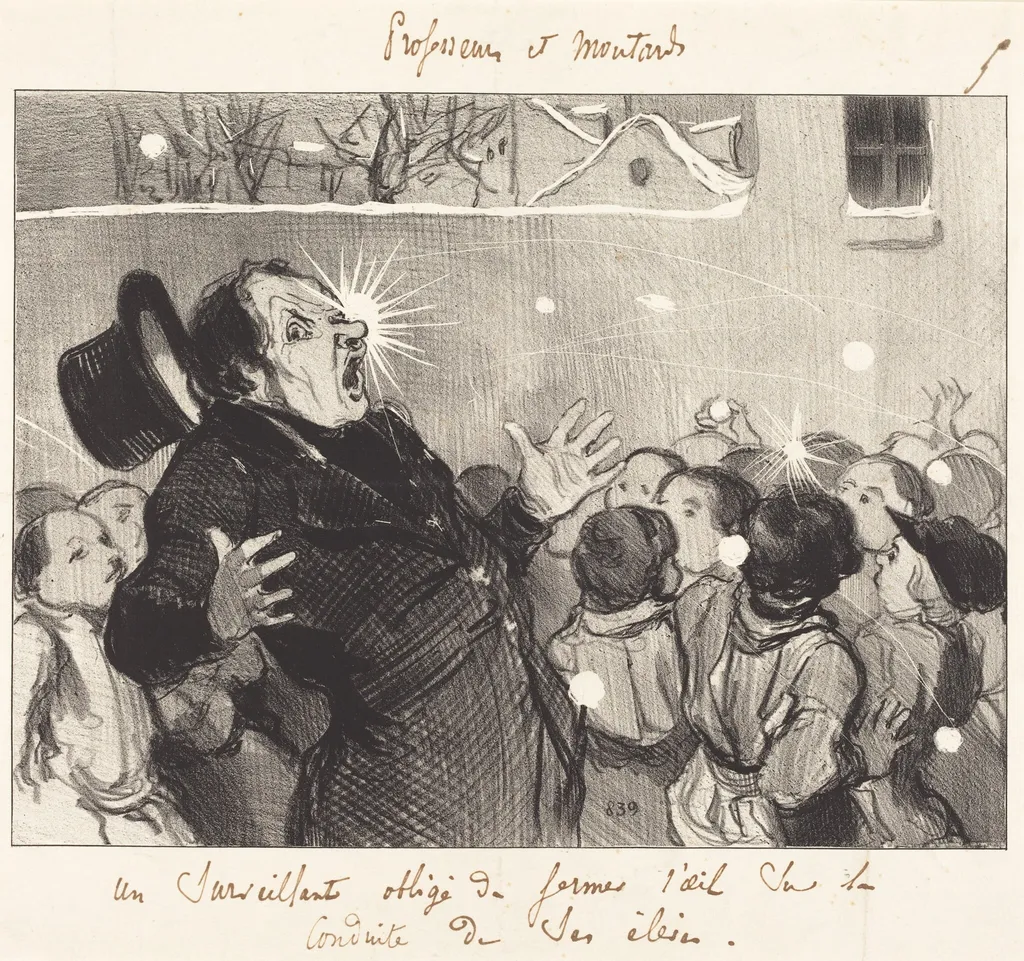
Un Surveillant obligé de fermer l'oeil... is an ink print by the Romanticist artist Honoré Daumier. It dates from 1845 and is held in the collection of the National Gallery of Art.
About this work
Overview
Created in 1845, this lithograph by Honoré Daumier is one of many political satires produced during France’s July Monarchy.
Created in 1845, this lithograph by Honoré Daumier is one of many political satires produced during France’s July Monarchy. Executed in the medium of lithography, it was likely intended for mass circulation in periodicals like Le Charivari. Daumier used printmaking to critique social and political figures, often with biting irony. The work captures a moment of public confrontation, emphasizing the tension between authority and the populace.
Subject & Meaning
The image portrays a uniformed official, possibly a police supervisor or municipal enforcer, gesturing forcefully before a silent crowd. His open mouth and raised hands suggest an outburst of authority, yet the crowd’s stillness implies indifference or suppressed resistance. The title, translating to 'A Supervisor Forced to Close His Eye...', hints at institutional hypocrisy, officials turning a blind eye to disorder while performing displays of control.
Technique & Style
Daumier employed bold, fluid lithographic lines to convey movement and emotion. The figure is rendered with exaggerated features, distorted facial muscles, elongated limbs, heightening the sense of absurdity. The background is deliberately sparse, eliminating distractions and focusing attention on the psychological dynamic between the official and the unseen crowd. Shading is minimal, relying on contrast and gesture to communicate tension.
History & Provenance
The print emerged during a period of strict censorship in France, when Daumier had already been imprisoned for caricaturing King Louis-Philippe. Though Un Surveillant obligé de fermer l'oeil... avoids direct portraiture, its critique of state surveillance and performative authority aligned with republican sentiments. It was likely published in Le Charivari, where Daumier’s work reached a broad urban readership seeking subversive commentary.
Context
In mid-1840s France, the July Monarchy faced growing unrest over political exclusion and police overreach. Daumier’s prints responded to daily tensions between state power and civil liberties. While other artists idealized history or nature, Daumier turned to the street, documenting the absurdities of bureaucracy and the quiet defiance of ordinary citizens. His work offered a visual counter-narrative to official propaganda.
Legacy
Daumier’s lithographs influenced later generations of social realists and satirical illustrators, from Honoré de Balzac to 20th-century cartoonists. His ability to distill complex political dynamics into single, expressive images established a model for visual critique. Though largely overlooked in his lifetime by the fine art establishment, his prints are now recognized as vital documents of 19th-century French civic life.
Own this work as a print
Artist & collection
Artist
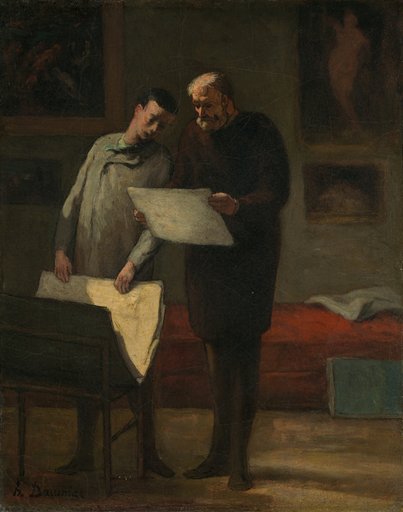
Honoré-Victorin Daumier (French: ; 26 February 1808 – 10 or 11 February 1879) was a French painter, sculptor, and printmaker, whose many works offer commentary on the social and political life in France, from the…









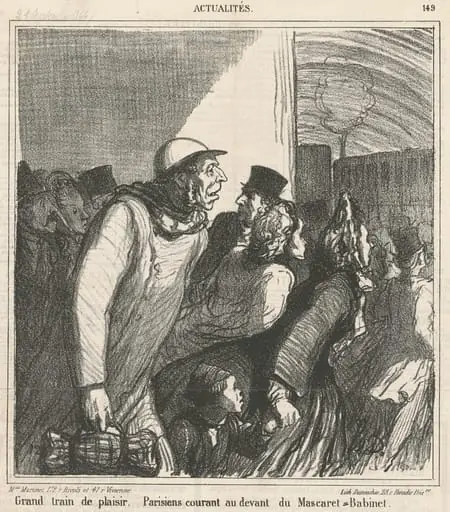 Grand train de plaisir
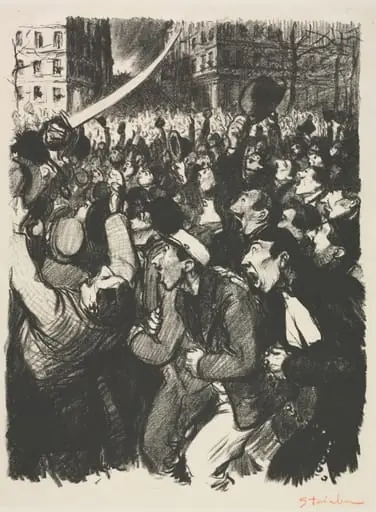 Sheep
Sheep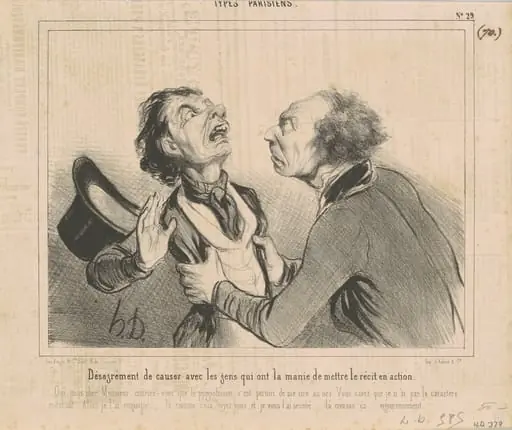 Désagrément de causer avec les gens...
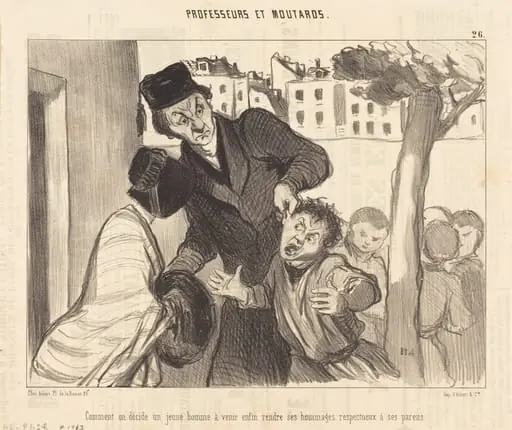 Comment on décide un jeune homme a venir...
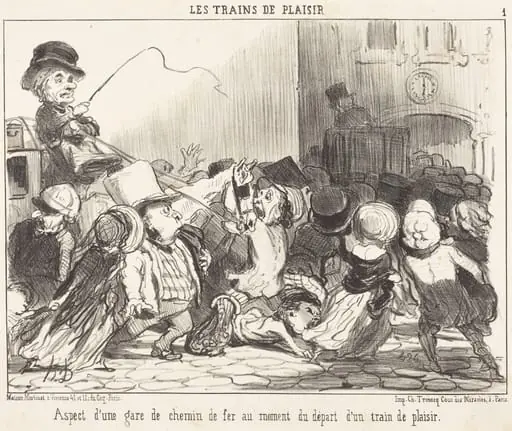 Aspect d'une gare de chemin de fer...
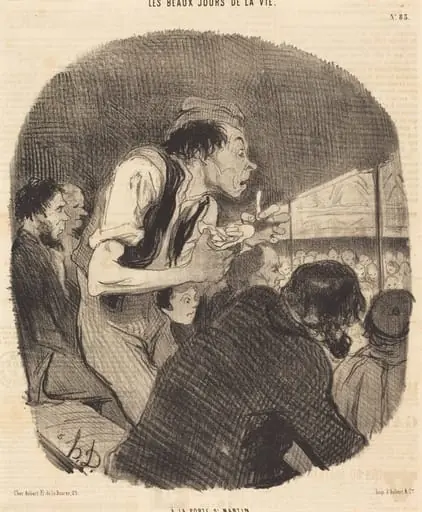 A la porte Saint-Martin
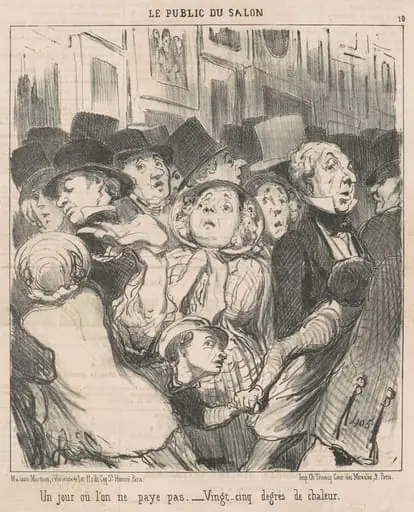 Un jour ou l'on ne paye pas
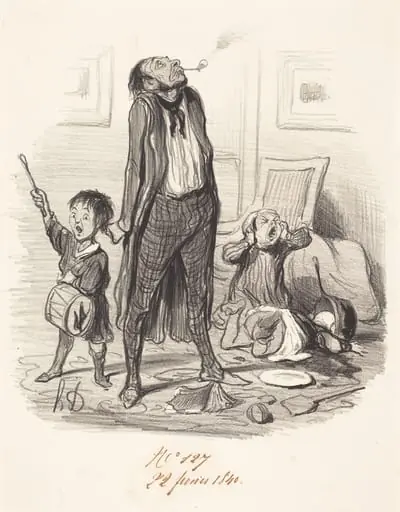 Poète classique composant une églogue...
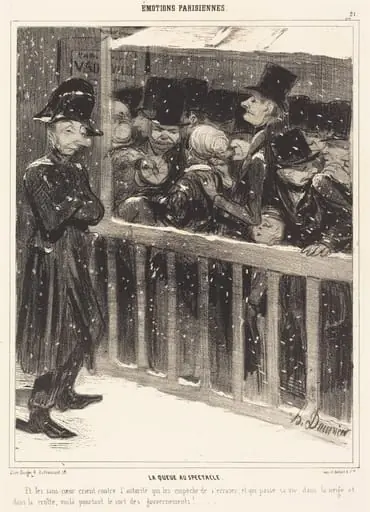
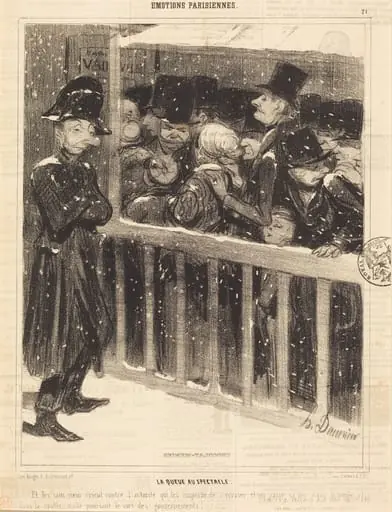 La Queue au spectacle
 La Queue au Spectacle
 Black Cat (Le chat noir)
- Attends... j'te vas en donner... du maitre d'école