Artwork
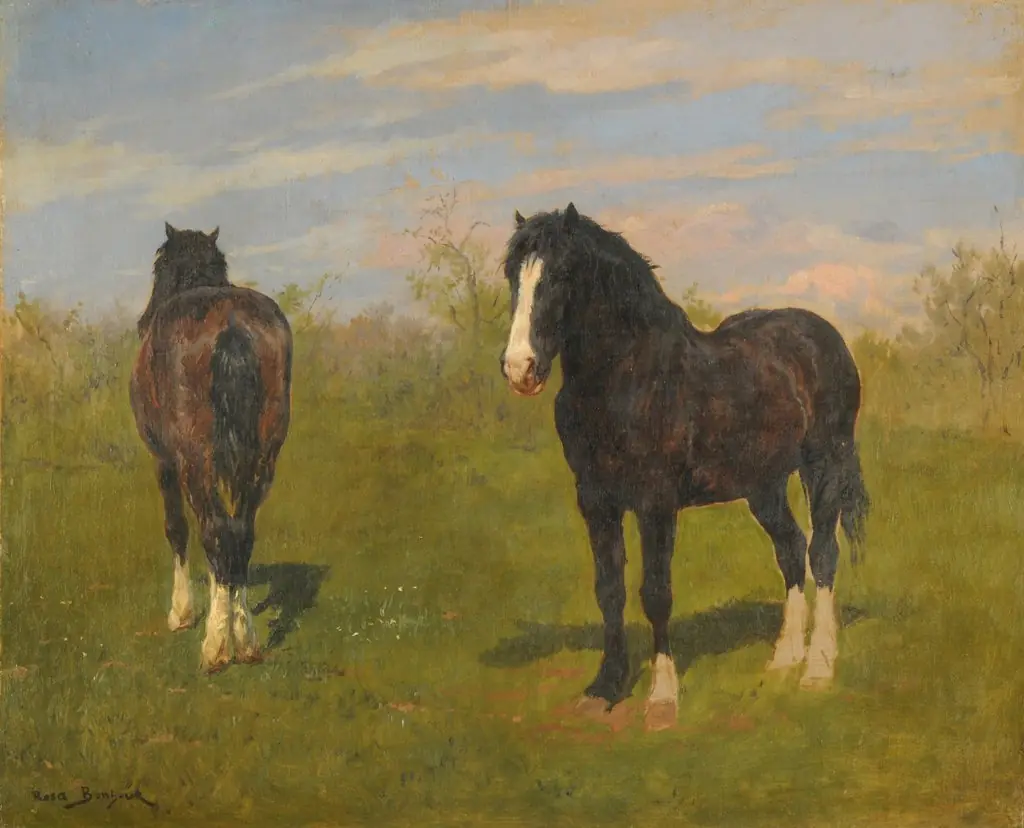
Horses in a Meadow
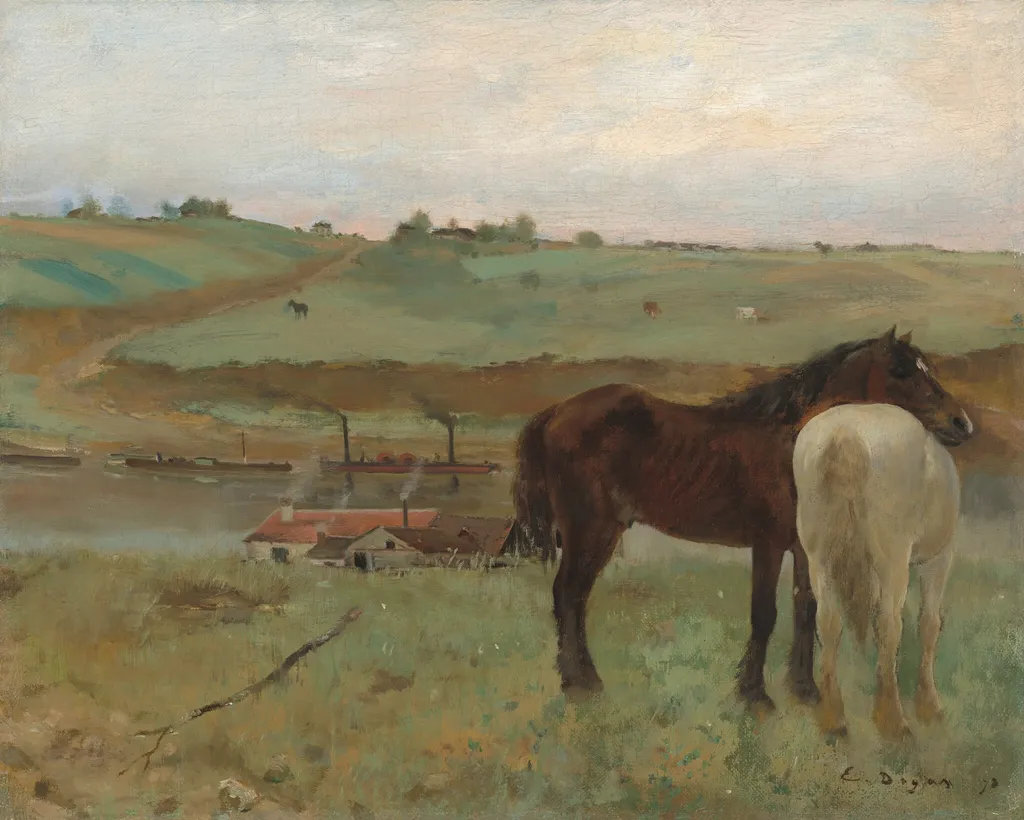
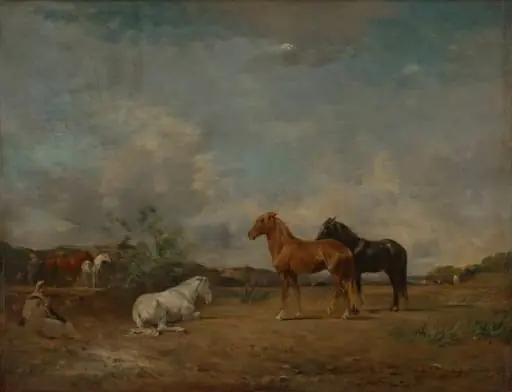
Horses in a Meadow is an oil painting by the Impressionist artist Edgar Degas. It dates from 1871 and is held in the collection of the National Gallery of Art. Created in 1871, this oil on canvas portrays two horses standing in a meadow.
- Inscription
- Inscribed:lower right: E. Degas 71
About this work
Technique & Style
The support consists of a woven canvas substrate prepared for oil medium, consistent with 19th-century French easel practices.
The work is an oil painting executed on canvas, reflecting Degas's characteristic handling of loose brushwork and compositional cropping within a naturalistic landscape. The surface demonstrates careful application of oil paint to achieve subtle tonal modulation across the meadow scene. The support consists of a woven canvas substrate prepared for oil medium, consistent with 19th-century French easel practices.
The painting's formal qualities include flattened spatial depth and an asymmetrical arrangement of grasses and distant horizon, emphasizing the artist's interest in momentary visual impressions.
History & Provenance
Edgar Degas completed this oil on canvas in 1871. The dealer Durand-Ruel purchased the work directly from the artist in Paris on April 26, 1872, subsequently transferring it to their London branch later that year. On March 5, 1874, the gallery sold the painting to the French baritone Jean-Baptiste Faure.
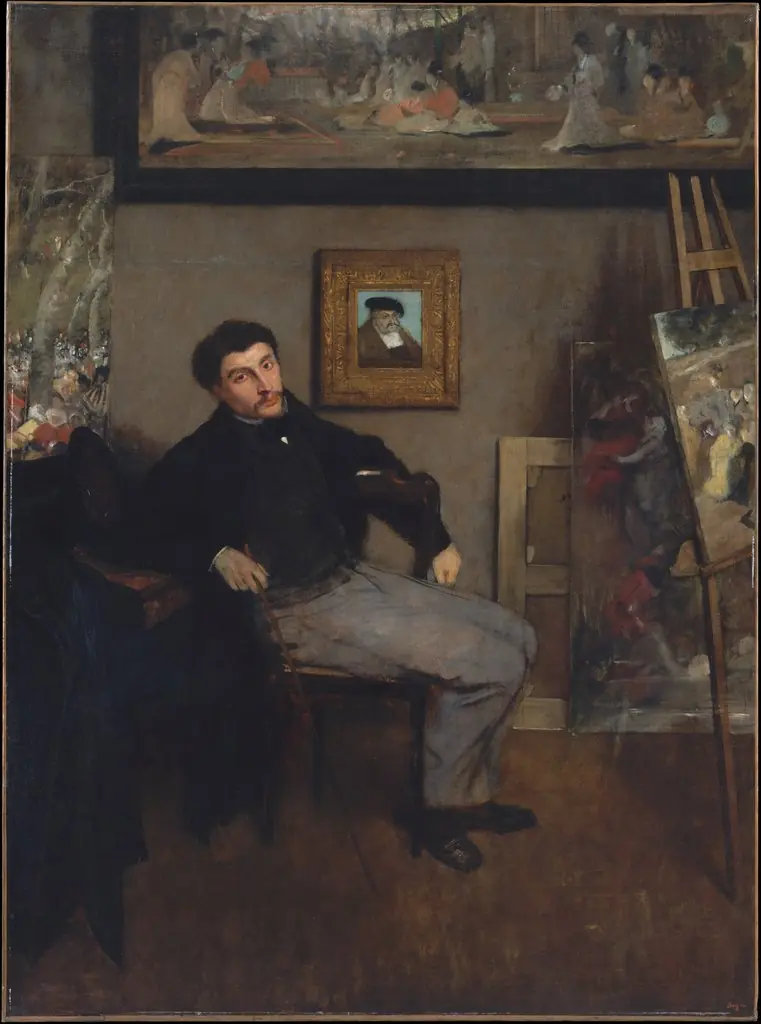
Faure later returned the piece to Degas at the artist's specific request, after which Degas gifted it to the painter James Tissot in Paris.
Durand-Ruel repurchased the work from Tissot on March 11, 1890, initially recording it under Joseph Durand-Ruel before Paul Durand-Ruel acquired it for his private collection the following August. Following Paul Durand-Ruel's death, his estate managed the painting until it was sent to the New York gallery branch in 1925. It remained with the Durand-Ruel family, specifically Mr. and Mrs. Jean D'Alayer, from 1951 until at least 1960.
After appearing at a Sotheby's auction in London in 1992 where it failed to sell, the National Gallery of Art in Washington, D.C., acquired the painting in March 1995.
Horses in a Meadow was acquired by the National Gallery of Art in Washington, D.C., in March 1995 after its purchase at Sotheby's London on 30 June 1992. The work's documented provenance includes its 1872 purchase from Degas by Galerie Durand-Ruel in Paris, subsequent sales to Jean-Baptiste Faure, Paul Durand-Ruel, and later to Joseph Durand-Ruel and Paul Durand-Ruel's private collection. It entered the collection of the National Gallery of Art through the intermediation of the Durand-Ruel Gallery in New York and a 1992 Sotheby's sale.
Overview
Created in 1871, this oil on canvas portrays two horses standing in a meadow. The composition places a brown horse turned to the left and a white horse turned to the right in the foreground, set against a gently rolling green landscape that recedes toward distant trees and modest structures under a light‑blue sky.
Subject & Meaning
The work centers on the animals, rendered with careful observation of their forms and coats. By isolating the horses against a relatively simple natural backdrop, the painting emphasizes the physical presence and quiet interaction of the creatures within an open, pastoral setting.
Context
The piece belongs to the landscape genre, yet it retains Degas’s focus on figure and movement. While not painted outdoors, it captures a moment of stillness in a rural environment, aligning with the era’s fascination with everyday subjects and the effects of natural light on form.
Own this work as a print
Artist & collection
Artist
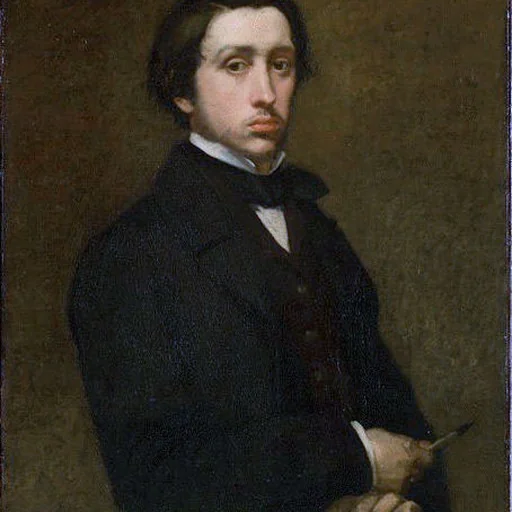
Born Hilaire-Germain-Edgar De Gas on 19 July 1834 in Paris, Edgar Degas came from an affluent banking family with aristocratic roots and spent his childhood among the cultivated circles of the French capital.