Artwork
Study for "The Dancing Lesson": The Banjo Player
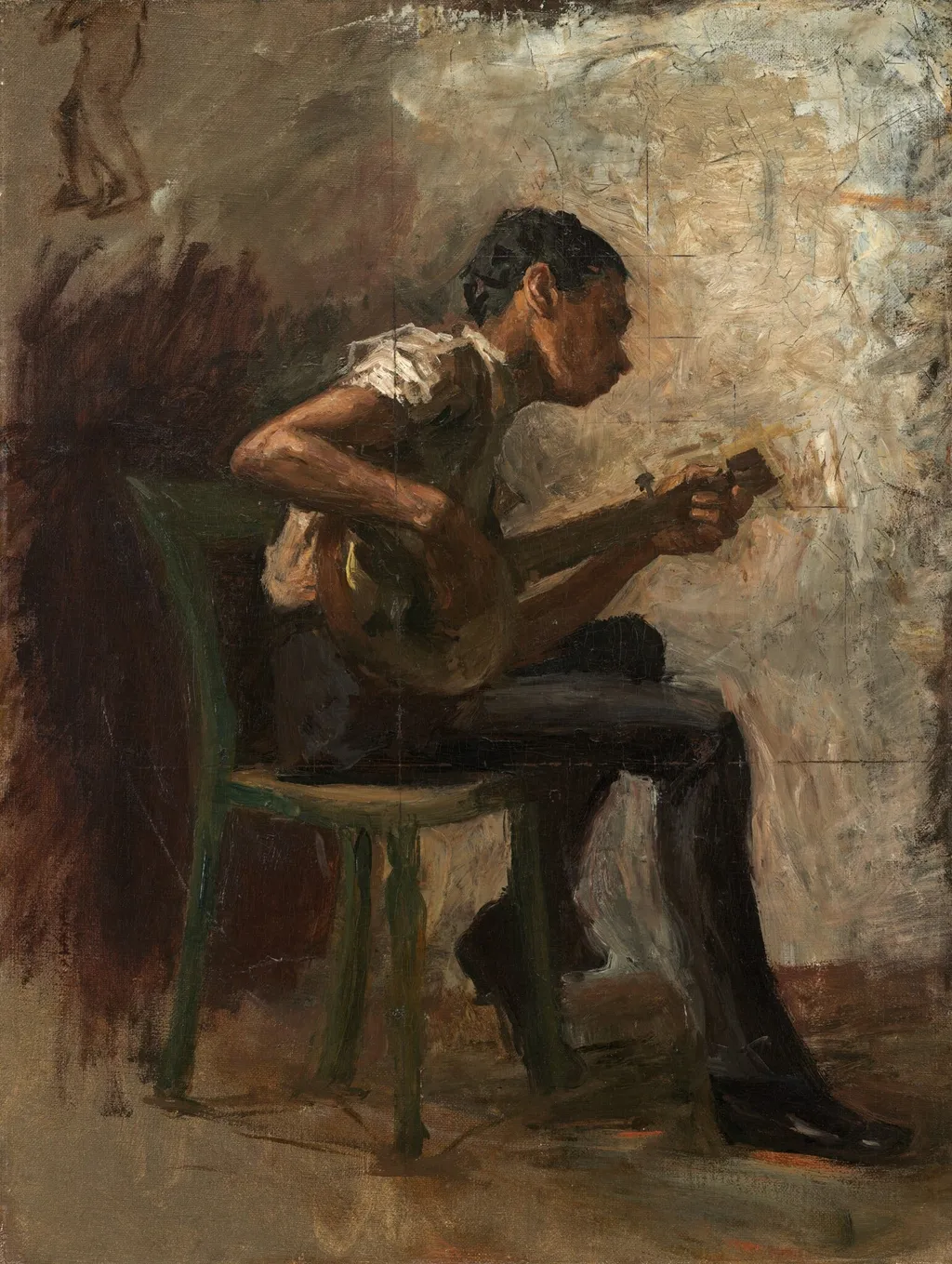
Study for "The Dancing Lesson": The Banjo Player is an oil painting by the American Impressionist artist Thomas Eakins. It dates from 1877 and is held in the collection of the National Gallery of Art.
About this work
Subject & Meaning
As a study, the painting isolates the figure to focus on the specific action of playing the instrument, capturing the sitter's engagement with the music.
The work depicts a young Black man seated on a stool while playing a banjo. This study serves as a preparatory piece for the larger composition known as "The Dancing Lesson." The subject matter reflects Thomas Eakins's interest in portraying African American life and musical culture within the domestic sphere.
As a study, the painting isolates the figure to focus on the specific action of playing the instrument, capturing the sitter's engagement with the music.
Technique & Style
This study is executed in oil paint on a canvas support that has been mounted onto cardboard. The work measures 49.5 cm in height and 37.9 cm in width. Visually, the composition depicts a young African American man seated on a stool while playing a banjo. The piece represents a preparatory effort for the larger composition titled "The Dancing Lesson."
History & Provenance
Study for "The Dancing Lesson": The Banjo Player" is an oil on canvas on cardboard painted by Thomas Eakins around 1877. The work entered the artist’s family shortly after its creation; it was owned by George Frank Stephens, Eakins’s brother‑in‑law, and later passed to Stephens’s nephew Roger Stephens by 20 December 1944. From there it was sold to E. & A. Milch, Inc. in New York, then to M. Knoedler & Co. in 1960, and was purchased on 10 January 1961 by Mr. and Mrs. Paul Mellon of Upperville, Virginia.
In 1985 the painting was gifted to the National Gallery of Art in Washington, D.C., where it remains in the museum’s collection.
The work entered the collection of the National Gallery of Art in Washington, D.C., in 1985 as a gift from Mr. and Mrs. Paul Mellon. Prior to this acquisition, the painting passed through the hands of dealers E. & A. Milch, Inc. and M. Knoedler & Co. in New York before being sold to the Mellons in January 1961. Earlier ownership included Roger Stephens, the artist's nephew, who held the piece by late 1944, and George Frank Stephens, the artist's brother-in-law.
While some historical records mistakenly inserted the names of Charles B. Eddy and his wife into the lineage between the two Stephens owners, this interruption is considered an error given the familial relationship between the confirmed owners.
No specific exhibition history or inventory accession number is provided in the available sources.
Legacy
The Banjo Player emerged as a significant study within Eakins' oeuvre, influencing approaches to figure studies and contributing to his reputation as a realist painter. Its inclusion in major collections like the National Gallery of Art cemented its standing in art history. The work's provenance reflects complex ownership transitions, eventually finding a permanent home through the Mellon family's gift in 1985.
Scholars have examined its compositional innovations in depicting musical subjects and its role in Eakins' exploration of anatomy and movement. The painting's technical execution on canvas over cardboard demonstrates his experimental approach to medium and support.
The work's legacy is underscored by its presence in the National Gallery of Art's collection, where it remains part of their permanent holdings as documented in institutional records and scholarly literature. Its study for a larger composition highlights Eakins' preparatory processes and artistic development.
The painting's attribution and provenance have been subject to scholarly analysis, particularly regarding the complexities of its ownership history involving multiple family connections and dealers.
The Banjo Player continues to be referenced in discussions of Eakins' artistic legacy and his influence on American realism, with its study status providing insight into his creative methodology.
Overview
Thomas Eakins produced this oil study around 1877 as a preparatory work for his larger composition, "The Dancing Lesson." Executed on cardboard, the piece depicts a solitary figure seated on a green chair, absorbed in playing a banjo. The setting is interior, hinted at by a plain wall behind the sitter, and the palette is dominated by muted earth tones.
Own this work as a print
Artist & collection
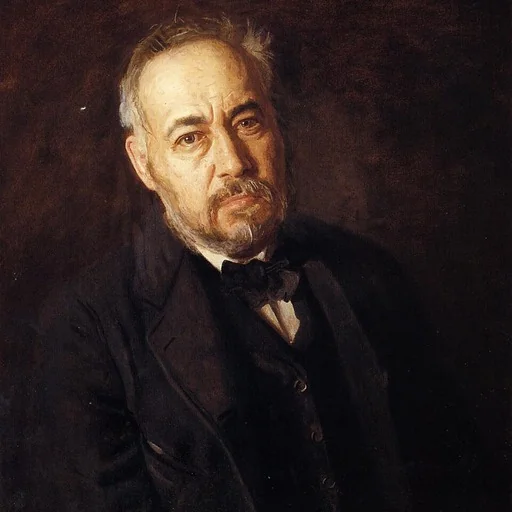
Artist
Thomas Cowperthwait Eakins (; July 25, 1844 – June 25, 1916) was an American realist painter, photographer, sculptor, and fine arts educator.