Artwork
Saint Andrew
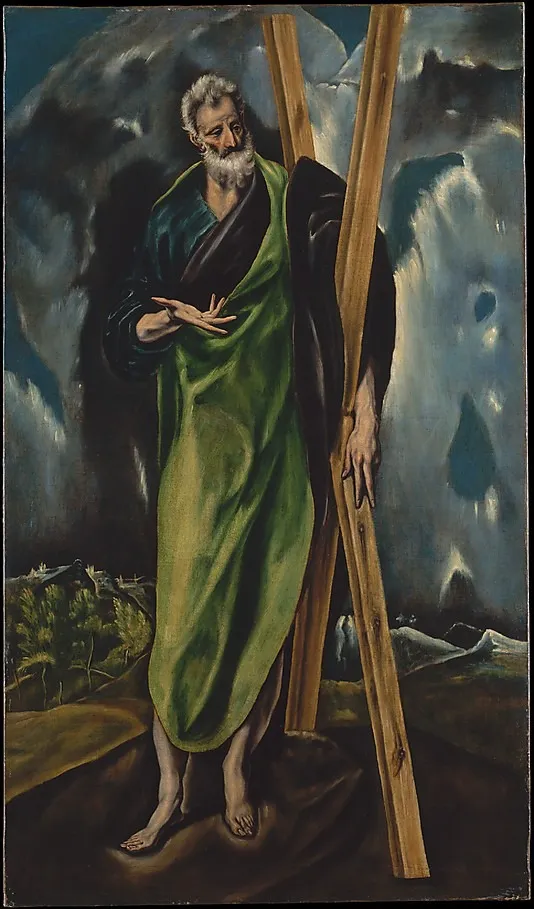
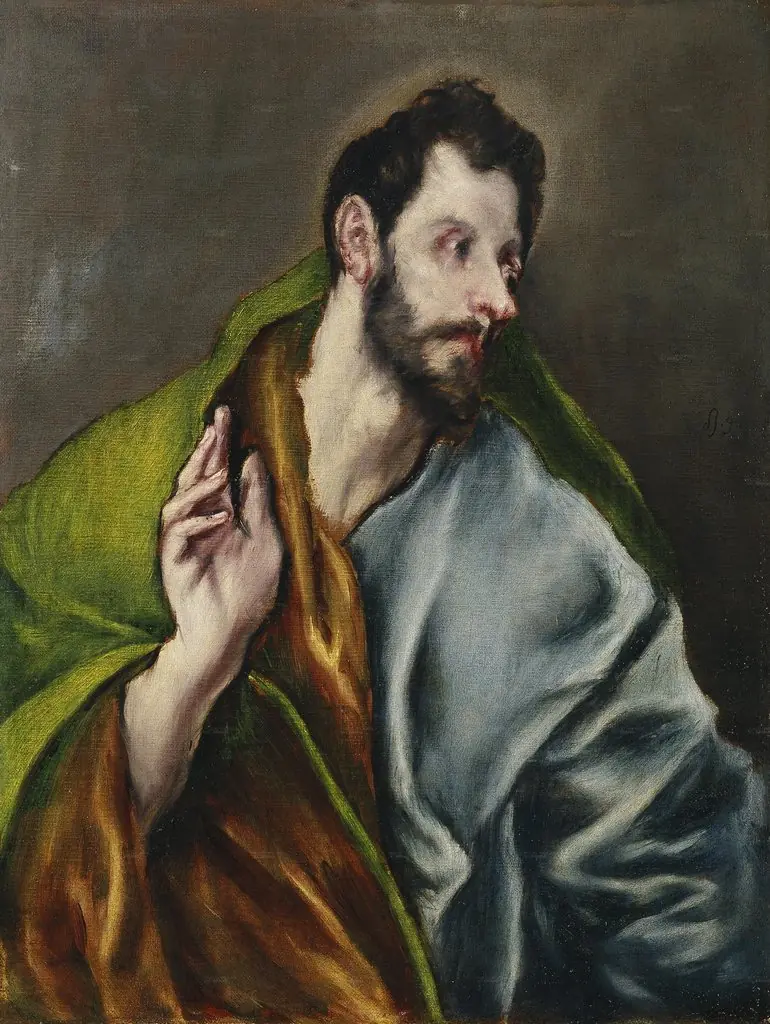
Saint Andrew is an oil painting by the Mannerist artist El Greco. It dates from 1610 and is held in the collection of the Metropolitan Museum of Art.
About this work
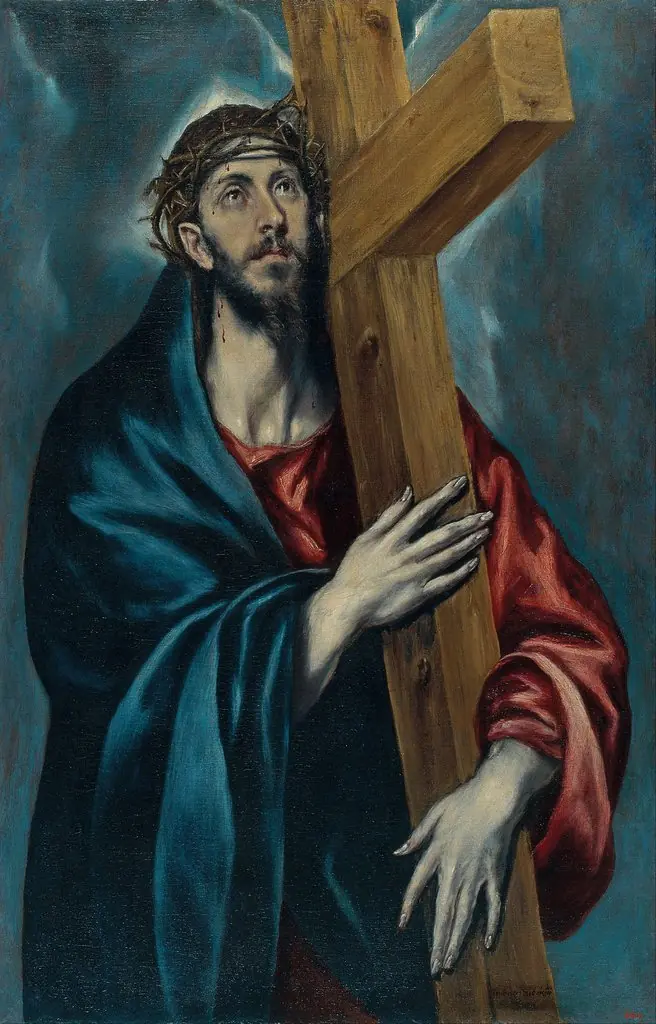
An old man with a long white beard stands barefoot on a rocky shore in a green robe over a dark tunic. His right hand rests on a tall wooden cross, his left gestures outward, and a stormy sky glows faintly behind him. El Greco let the light catch his face and robe against the dark in 1610.
Subject & Meaning
He is shown as a bearded man accompanied by the distinctive X-shaped cross on which, according to tradition, he was martyred.
The painting portrays Andrew the Apostle, identified as its main subject. He is shown as a bearded man accompanied by the distinctive X-shaped cross on which, according to tradition, he was martyred. The figure is set against a landscape background, a compositional device that situates the saint within a naturalistic environment rather than an architectural or abstract setting.
As a work of religious art, the painting functions as a devotional image, presenting the apostle with the instrument of his martyrdom as the central attribute enabling viewers to identify him and reflect on his role within Christian tradition. The X-cross, known as Saint Andrew's Cross or the saltire, carries specific symbolic weight, distinguishing Andrew from other apostles and emphasizing his status as the first-called disciple. The combination of portrait-like figure, martyrdom attribute, and landscape setting reflects standard early seventeenth-century Spanish devotional conventions for individual apostle portraits.
Technique & Style
Saint Andrew is executed in oil paint on canvas, a standard support for El Greco's late workshop production. The work measures 109.9 cm in height by 64.1 cm in width, giving it a tall, narrow vertical format suited to its devotional function. The painting belongs to the religious genre and is classified as a painting, with Andrew the Apostle as its main subject, accompanied by Saint Andrew's true Cross, a landscape, and a male figure.
Attributed to the Workshop of El Greco and dated to 1610, the work reflects the late mannerist style associated with the artist's studio, in which elongated figures and spiritualized color palettes were produced collaboratively. No specific condition report or detailed handling analysis is documented in the available sources.
History & Provenance
The Saint Andrew attributed to El Greco (Domenikos Theotokopoulos) was painted circa 1610, late in the artist’s career. The work is documented as part of the collection of the Metropolitan Museum of Art, where it entered through a bequest from Stephen Carlton Clark in 1960. Prior to this, the painting was held by Pinakos Inc., Emmy Margit von Opel, and Kurt Leimer, indicating a private ownership chain in the mid-20th century.
The commission and early provenance remain undocumented, but the stylistic dating aligns with El Greco’s late works, particularly those depicting apostles in elongated, expressive forms. The painting’s subject, Saint Andrew, is rendered with austerity against a dark landscape, consistent with the artist’s mature religious iconography.
Context
El Greco created Saint Andrew in 1610, an oil-on-canvas religious painting that portrays the apostle with his traditional cross amid a landscape. The work, attributed to the Workshop of El Greco, measures 109.9 × 64.1 cm and was later owned by Pinakos Inc, Stephen Carlton Clark, Emmy Margit von Opel, and Kurt Leimer before entering the Metropolitan Museum of Art’s collection. Its subject matter, scale, and medium align with El Greco’s late‑period devotional paintings, situating it within the evolution of Counter‑Reformation art and reflecting scholarly interest in the artist’s workshop practices and the diffusion of his imagery across European collections.
Overview
This oil painting depicts Saint Andrew, an elderly man characterized by a long white beard and gray hair. He stands barefoot on a rocky coastline, clad in a green robe over a dark tunic. The dramatic composition features a tall wooden cross, a symbol of his martyrdom, which he supports with his right hand.
A stormy sky looms behind him, with a faint light breaking through on the distant horizon, adding to the somber atmosphere.
Artist & collection
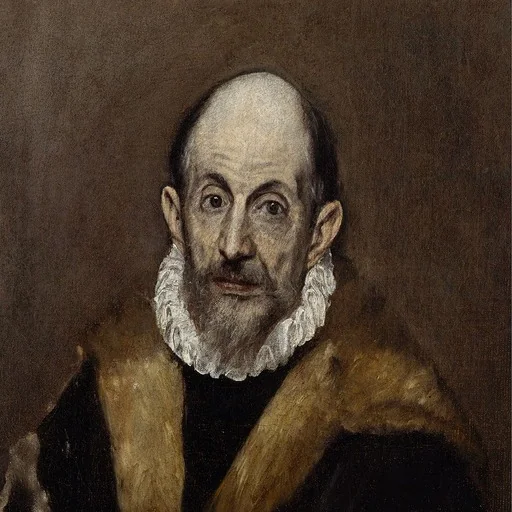
Artist
Doménikos Theotokópoulos was born in 1541 in Candia (modern Heraklion), the capital of Venetian-ruled Crete, where he was trained in the post-Byzantine tradition of icon painting.