Artwork
The Baptism of Christ
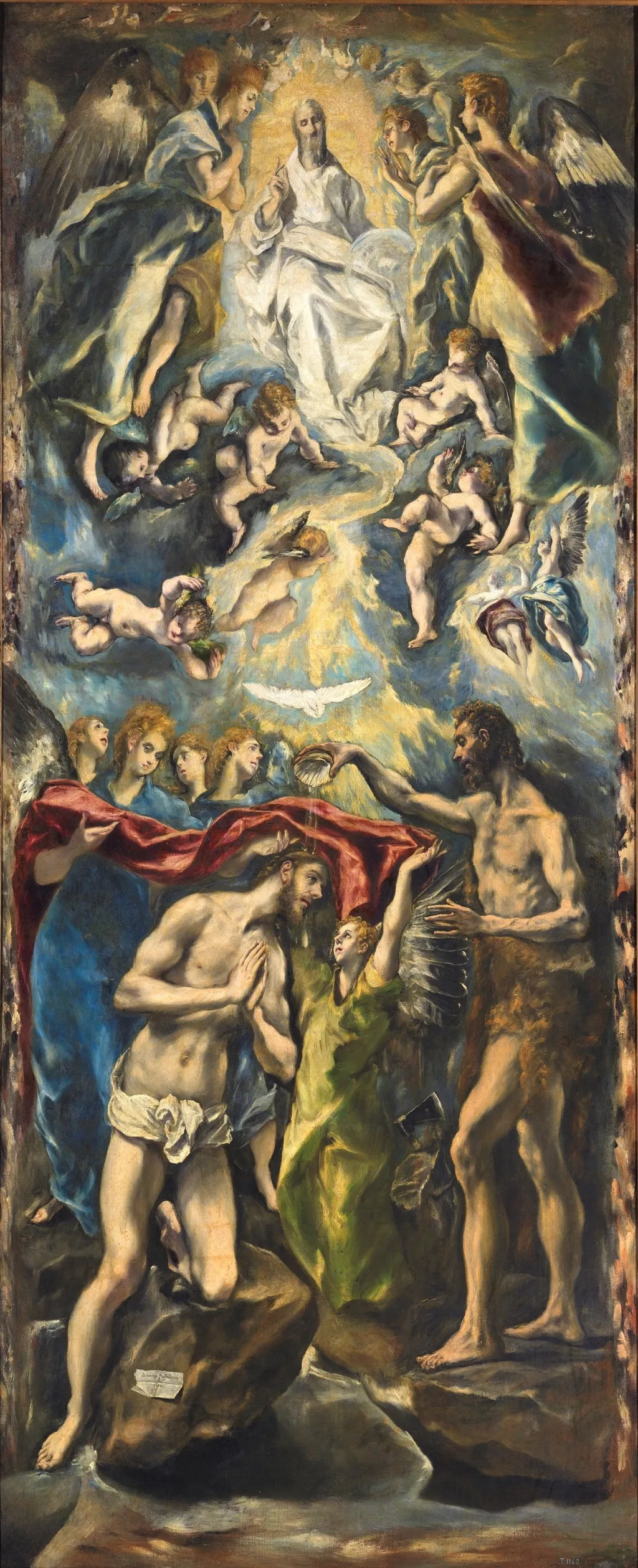
The Baptism of Christ is an oil painting by the Mannerist artist El Greco. It dates from 1600 and is held in the collection of the Museo del Prado.
About this work
Subject & Meaning
El Greco's The Baptism of Christ depicts the biblical moment of Jesus' baptism by John the Baptist, framed within a dual compositional plane.
El Greco's The Baptism of Christ depicts the biblical moment of Jesus' baptism by John the Baptist, framed within a dual compositional plane. The lower, earthly plane shows John pouring water from a shell onto Christ's head while angels support a red mantle above Him, reflecting traditional iconography of the event. Above, a celestial plane presents God the Father surrounded by angels and the Holy Spirit in the form of a dove, symbolizing divine approval.
The work integrates Mannerist stylization with references to Michelangelo's muscular figures, though El Greco's figures exhibit elongated proportions and distinctive hand gestures, such as the joining of the ring and little fingers. The painting was created between 1596 and 1600 for the altarpiece of the Augustinian Sisters' College in Madrid, later moved to the Museo del Prado, where it remains. Its meaning centers on the spiritual significance of baptism and divine revelation, conveyed through dynamic movement and symbolic light.
Technique & Style
Executed in oil on canvas between 1596 and 1600, this large-scale work measures 350 by 144 cm. The artist signed the piece in Greek cursive on a rock at the left. Stylistically, the composition is divided into terrestrial and celestial registers linked by a luminous central axis and the Holy Spirit depicted as a dove. The scene is set at night with minimal landscape details, focusing attention on the elongated, monumental figures of Christ and John the Baptist.
While the muscular anatomy reveals Michelangelo's influence, the figures display the characteristic stylization of the artist's Mannerist approach, though Christ retains more traditional proportions than later works. Dynamic, centrifugal movement among the angels contrasts with an overall atmosphere of stillness, enhanced by sparkling lights and abrupt spatial shifts.
History & Provenance
El Greco executed The Baptism of Christ between 1596 and 1600 as a component of the high altarpiece for the church of the College of Doña María de Aragón in Madrid. The artist formally committed to this commission with the Council of Castile in 1596. Although the original architectural context was later repurposed as the seat of the Spanish Senate, the painting entered the collection of the Museo de la Trinidad in Madrid, where it was assigned inventory number T1140.
It currently resides in the Museo del Prado, cataloged as P000821. The work bears the artist's signature in Greek cursive script on a paper element situated on a rock to the left.
The Baptism of Christ is held in the Museo del Prado in Madrid, Spain, where it is cataloged under accession number P000821. Originally created between 1596 and 1600 for the high altarpiece of the Colegio de Doña María de Aragón in Madrid, the painting was transferred to the Museo de la Trinidad in Madrid, where it was registered as number T1140 before entering the Prado's collection. The building that housed the original college now serves as the seat of the Spanish Senate.
While the painting's location and inventory numbers are well-documented, the provided sources do not list specific exhibition history or dates of public display.
Context
Executed between 1596 and 1600 for the high altar of the College of Doña María de Aragón in Madrid, this work is identified by scholars such as Harold Wethey as a definitive component of that dismantled retable. The painting exemplifies El Greco's Mannerist style, retaining Michelangelo's influence in its muscular anatomy while introducing the artist's characteristic elongation and stylization. Art historical analysis notes that the monumental figure of Christ adheres to traditional proportions, distinguishing it from the extreme stylization found in the painter's later oeuvre.
The composition eliminates conventional landscape references in favor of a nocturnal setting with compressed space, focusing attention on the theological significance of the event through a serpentine rhythm of figures and luminous contrasts.
Overview
El Greco’s oil painting entitled The Baptism of Christ, executed around the year 1600, portrays the biblical moment when John the Baptist immerses Jesus in the Jordan. The composition is populated by a multitude of figures, including celestial beings, and is currently displayed in Madrid’s Museo del Prado.
Artist & collection
Artist
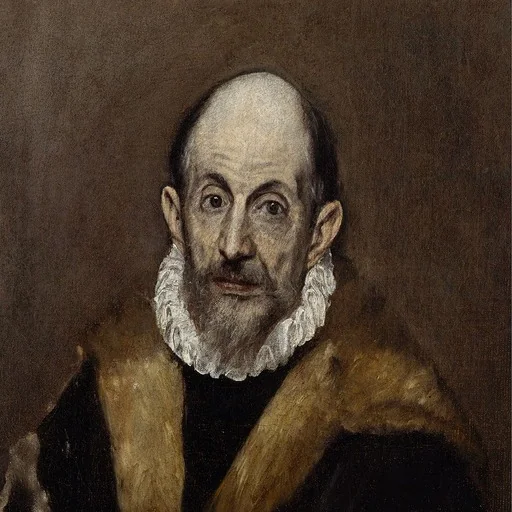
Doménikos Theotokópoulos was born in 1541 in Candia (modern Heraklion), the capital of Venetian-ruled Crete, where he was trained in the post-Byzantine tradition of icon painting.