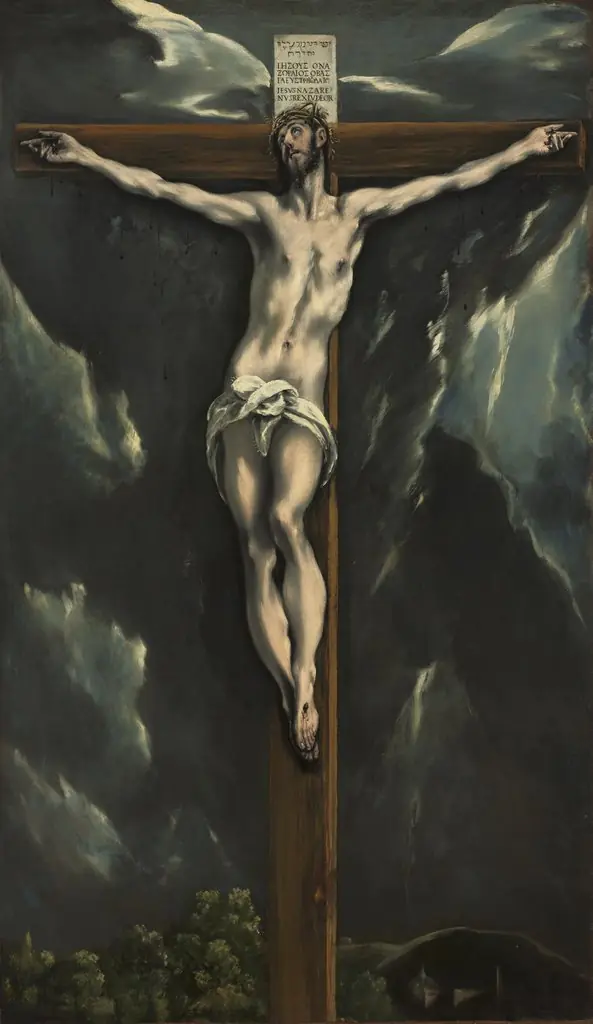
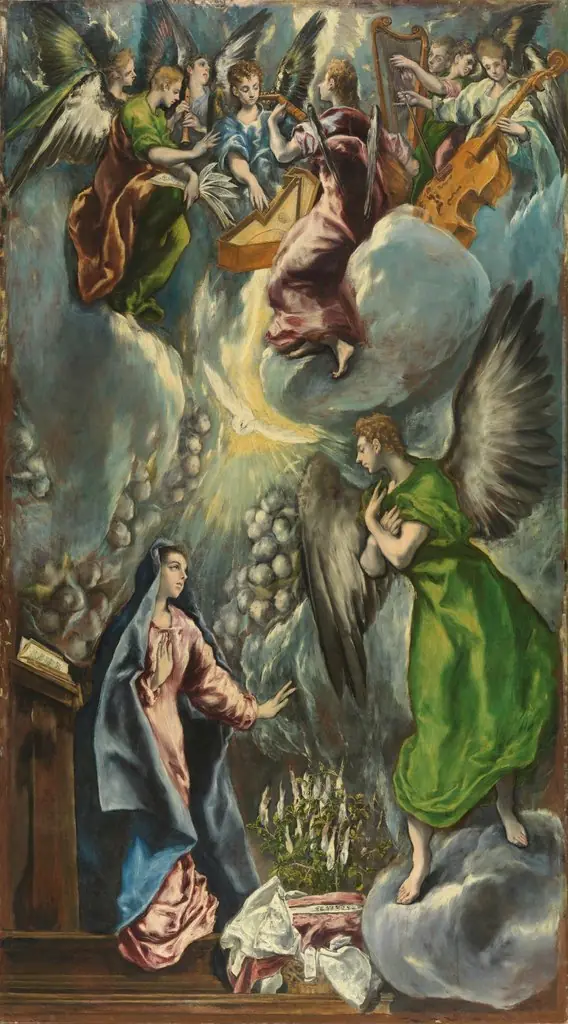
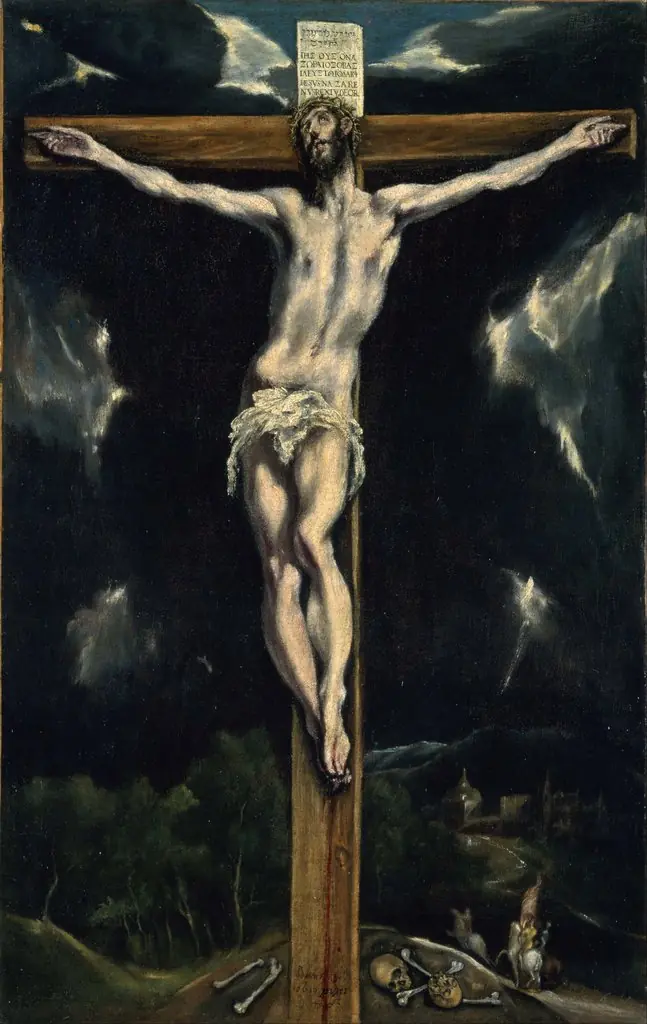
Artwork
The Crucifixion
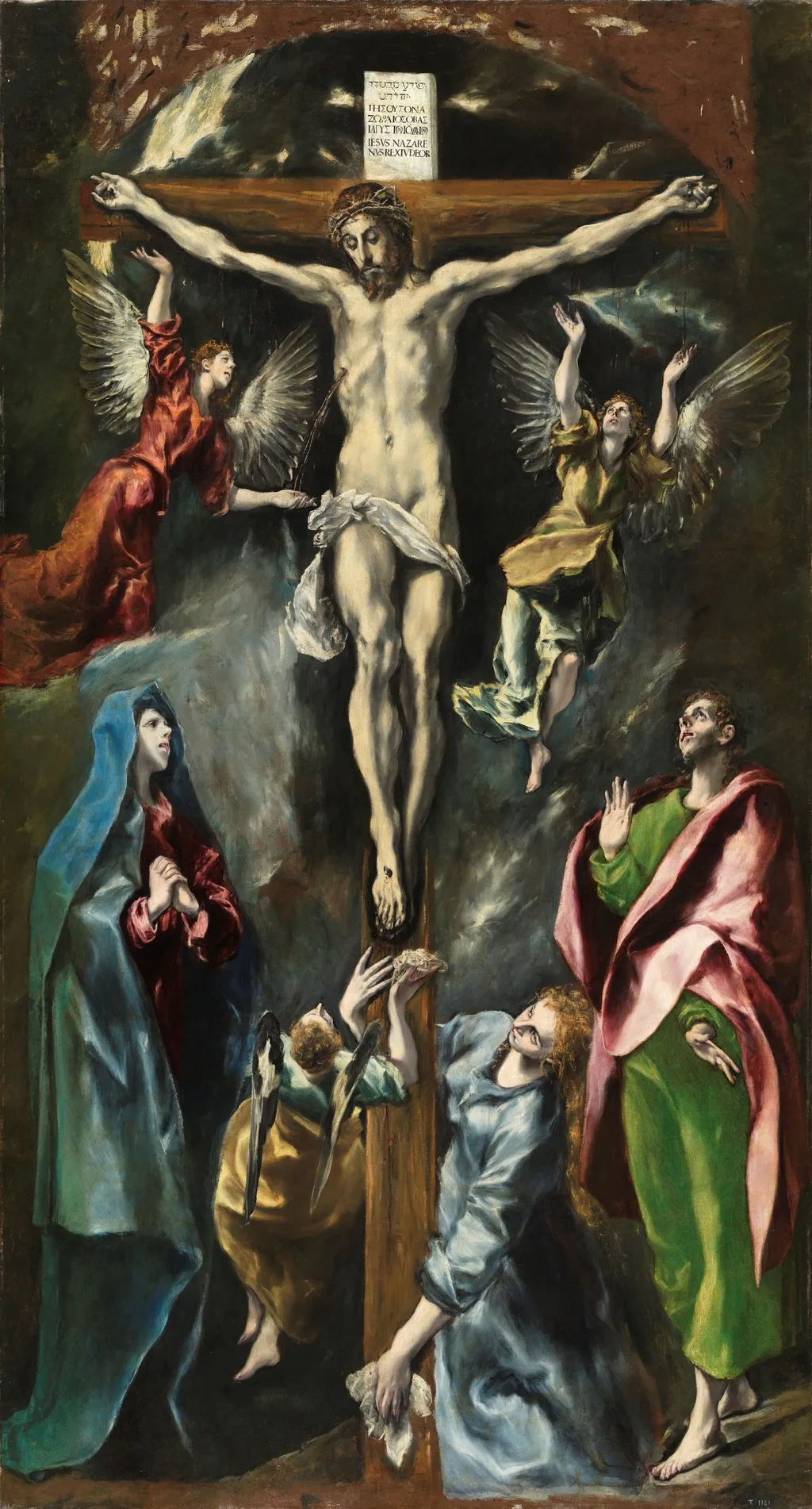
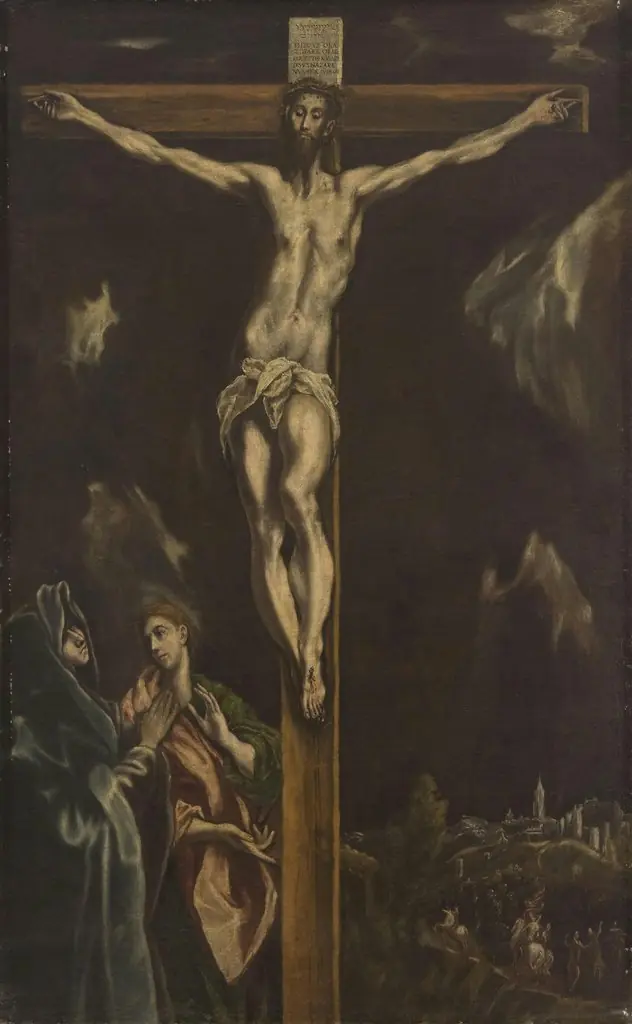
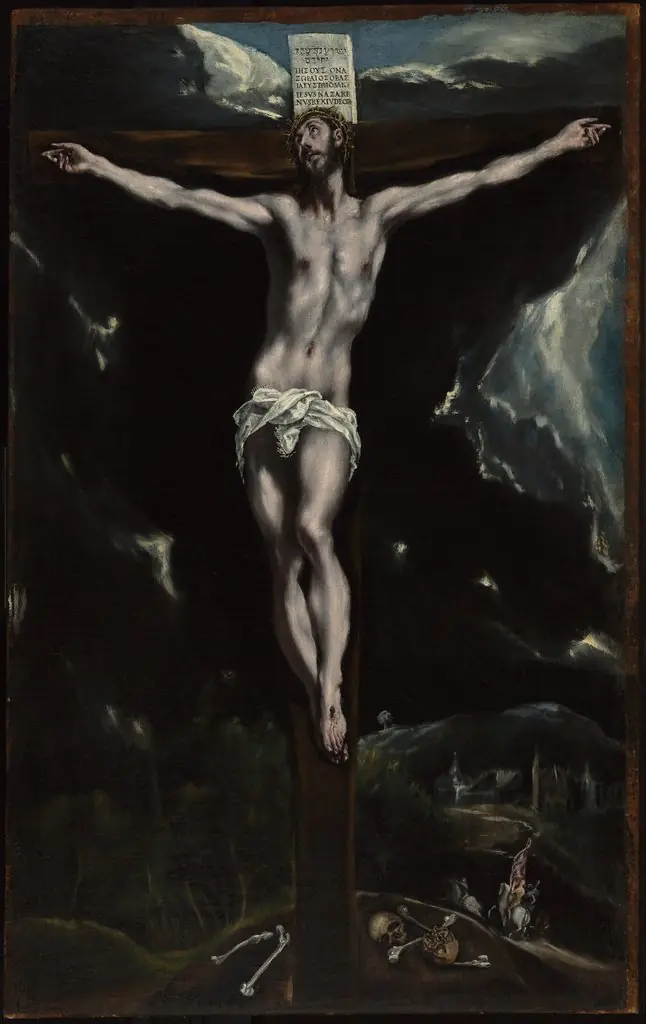
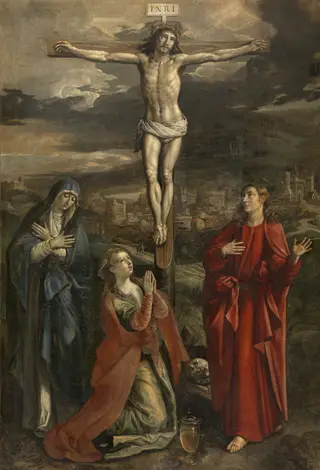
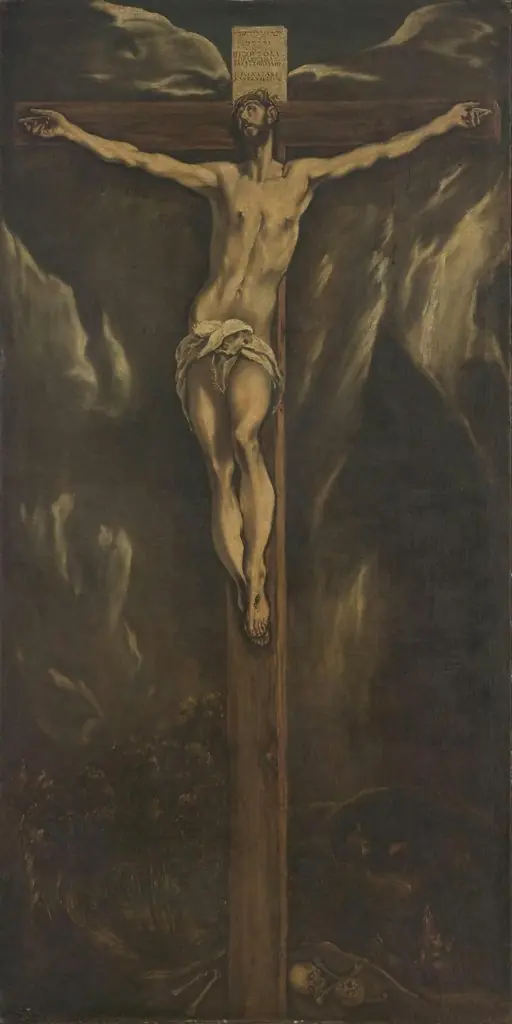
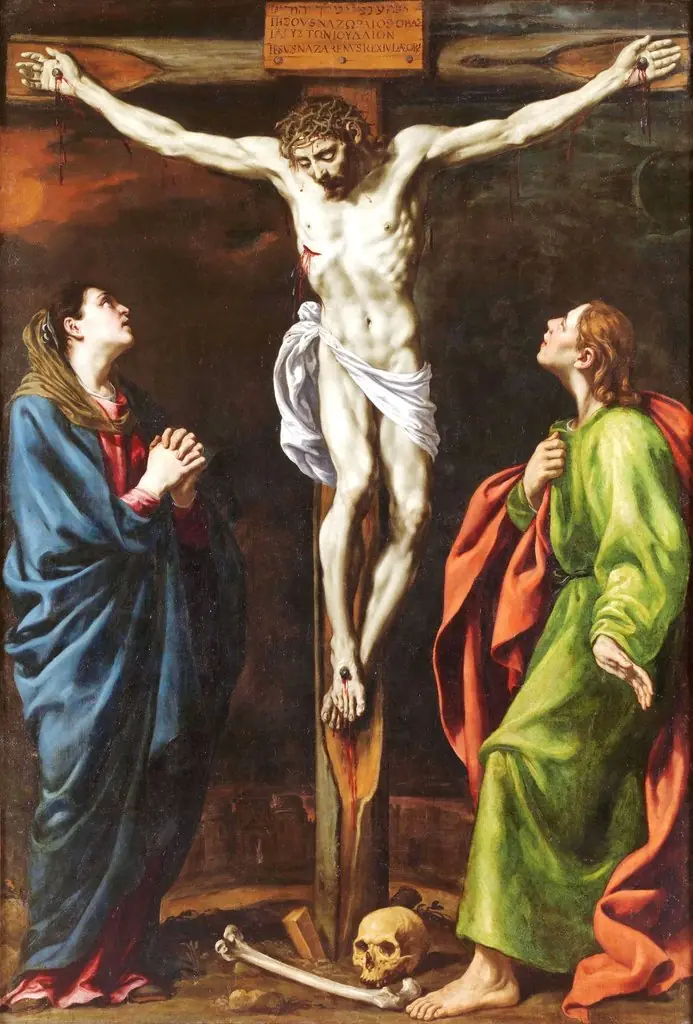
The Crucifixion is an oil painting by the Mannerist artist El Greco. It dates from 1600 and is held in the collection of the Museo del Prado.
About this work
Subject & Meaning
The composition is structured around two triangles, creating a dramatic, nocturnal atmosphere intensified by stark contrasts of light and color.
The Crucifixion depicts the crucifixion of Jesus Christ, showing him on the cross as the central figure with a vertical axis of symmetry. Flanking him are the Virgin Mary on the right and Saint John the Evangelist on the left, while three angels gather the blood flowing from Christ's wounds and Saint Mary Magdalene is also present. The composition is structured around two triangles, creating a dramatic, nocturnal atmosphere intensified by stark contrasts of light and color. El Greco employs his characteristic elongated forms and a distinctive palette, greens and dark reds for the Virgin, lighter reds and greens for Saint John, neutral blues and yellows for Magdalene, and reds and yellows for the angels, highlighting the livid quality of Christ's body. The work reflects Mannerist style with influences from Venetian coloration and Roman training, and its iconography emphasizes both the suffering of Christ and the devotional gathering of sacred blood.
Technique & Style
The Crucifixion is an oil painting on canvas created by El Greco between 1597 and 1600 during his final period in Toledo. The work measures 312 by 169 centimeters and depicts the crucifixion of Jesus Christ, including the Virgin Mary, Saint John the Evangelist, Mary Magdalene, and three angels collecting Christ’s blood. El Greco employs a distinctive compositional structure based on two interlocking triangles, with Christ on the cross serving as the central axis of symmetry. The figures are elongated and stylized, reflecting Mannerist characteristics, and the color palette combines traditional hues with influences from the Venetian school and his Roman period. The painting’s dramatic chiaroscuro and nocturnal landscape of Calvary heighten its emotional intensity, while the spatial arrangement emphasizes upward movement through the cross and flanking figures. The brushwork and formal qualities demonstrate El Greco’s departure from earlier, more serene depictions of the crucifixion, adopting a more austere and vertically oriented composition that aligns with Counter-Reformation iconography.
History & Provenance
The Crucifixion was painted by El Greco between 1597 and 1600 during his final years in Toledo, though Harold Wethey dated it later, to 1600-1605. According to the Museo del Prado, the canvas measures 312 × 169 cm and bears a faint Greek cursive signature at the base of the Cross. The work is generally believed to have occupied the central space of the altarpiece commissioned in 1596 for the church of the Colegio de doña María de Aragón, an Augustinian seminary. The commission was funded by the patron doña María de Aragón and, after her death, was taken over by the Council of Castile, which contracted El Greco to complete the ensemble within three years. Documents record that the altarpiece was valued at slightly more than 63,000 Spanish reales, the highest fee El Greco received in his lifetime. Wethey and Gudiol, however, disputed the painting's inclusion in the altarpiece, with Wethey proposing it was executed roughly five years after the other panels. According to the Prado's provenance records, the painting remained at the Colegio de la Encarnación (the Colegio de doña María de Aragón) in Madrid from 1600 to 1813. It then moved to the Church of San Felipe el Real and the Casa de la Inquisición (1813-1835), followed by the Real Academia de Bellas Artes de San Fernando (1835-1838) and the Museo de la Trinidad (1838-1872), before entering the Museo del Prado. Wethey instead traced an earlier origin to the Church of San Ildefonso in Toledo before its transfer to the Museo de la Trinidad. The Crucifixion is currently held by the Museo Nacional del Prado in Madrid, Spain, where it bears the accession number P000823. The painting's provenance traces back to the College of the Incarnation (College of Doña María de Aragón) in Madrid, where it remained from approximately 1600 until 1813. Following this, the work was transferred to the Church of San Felipe el Real and the House of the Inquisition between 1813 and 1835. It subsequently entered the Real Academy of Fine Arts of San Fernando from 1835 to 1838 before moving to the Museo de la Trinidad, where it was kept from 1838 until 1872, at which point it was transferred to its current location in the Prado. While some scholars debate its original inclusion in the Doña María de Aragón altarpiece, historical records confirm its long-standing presence in Madrid's major religious and institutional collections.
Context
The Crucifixion, painted by El Greco in 1598, was created as part of the altarpiece commissioned for the Colegio de doña María de Aragón in Toledo. The work, now housed in the Museo del Prado, exemplifies the artist’s late Mannerist style and his synthesis of Venetian colour with Roman mannerist influences. Its composition features a central triangular arrangement with Christ on the cross as the axis of symmetry, flanked by the Virgin Mary and Saint John, while three angels collect his blood and Saint Mary Magdalene is positioned at the foot of the cross. Scholars note the dramatic nocturnal lighting, elongated forms, and distinctive colour scheme that emphasizes the corporeal presence of Christ. The painting’s provenance includes the Colegio de doña María de Aragón, the Church of San Felipe el Real, the Real Academia de Bellas Artes de San Fernando, and the Museo de la Trinidad before its acquisition by the Prado. It is catalogued as P000823 and documented in the Wethey catalogue raisonné as work number 75.
Legacy
The Crucifixion (c. 1600) became a pivotal reference for later artists who adopted El Greco’s dramatic composition and heightened spirituality, influencing Baroque painters such as Zurbarán and later Expressionists. Its depiction of the crucified Christ surrounded by angels collecting blood was repeatedly cited in art historical studies as a model of emotive religious imagery, shaping devotional practices in Counter-Reformation Spain and later European art markets.
The work’s provenance, documented in the Museo del Prado’s records, traces its movement from the Colegio de doña María de Aragón to the Real Academia de Bellas Artes de San Fernando before its acquisition by the Prado in 1838, reinforcing its status as a cornerstone of Spanish Golden Age painting.
Scholars have debated its place within the larger altarpiece, with Wethey arguing for a later date (1600‑1605) and Gudiol assigning it to the 1597‑1600 period, yet both agree on its significance as a mature expression of Mannerist theology. This consensus has cemented its reputation as a canonical piece in El Greco’s oeuvre, frequently reproduced in exhibitions and academic curricula.
Artist & collection
Artist
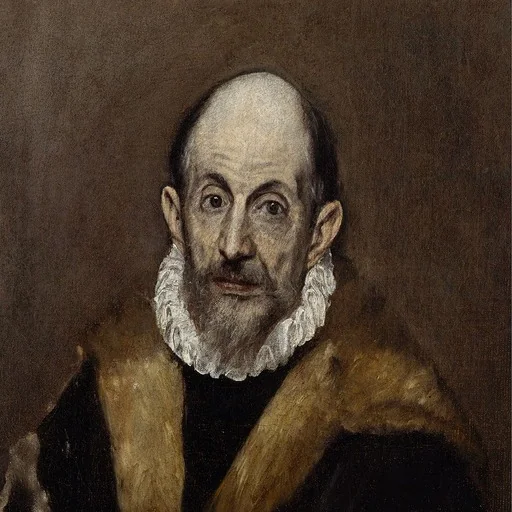
Doménikos Theotokópoulos was born in 1541 in Candia (modern Heraklion), the capital of Venetian-ruled Crete, where he was trained in the post-Byzantine tradition of icon painting.