Artwork
The Fable
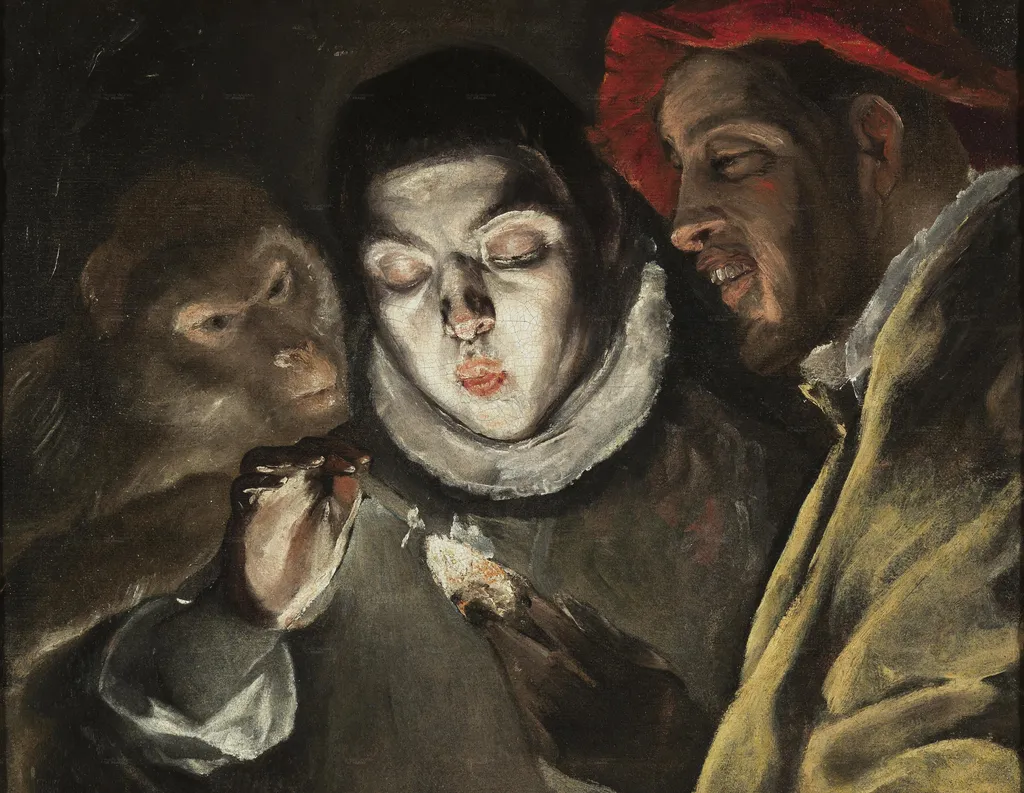
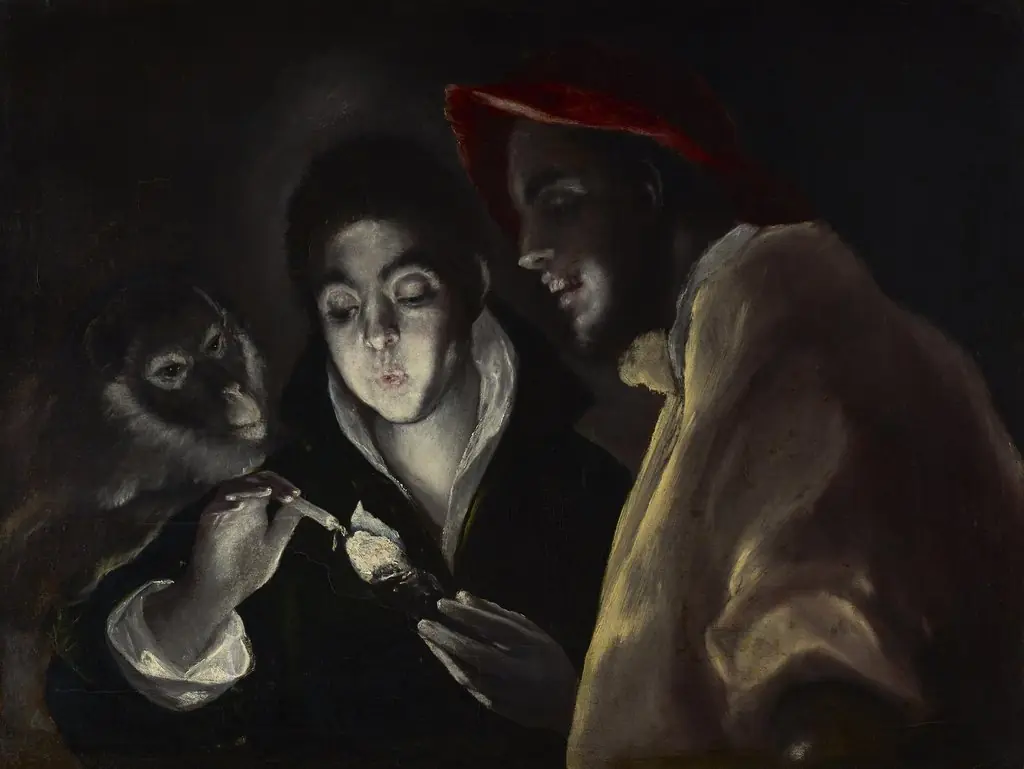
The Fable is an oil painting by the Mannerist artist El Greco. It dates from 1590 and is held in the collection of the Museo del Prado.
About this work
Subject & Meaning
The ember's flame signifies sexual arousal, while the monkey and buffoon represent vice and folly, making the work an allegory warning against lust.
The painting depicts a boy blowing on an ember, accompanied by a monkey and a rogue, elements drawn from Pliny the Elder's Naturalis Historia and used as moral symbols. The ember's flame signifies sexual arousal, while the monkey and buffoon represent vice and folly, making the work an allegory warning against lust. The central figure, dressed in a blue jacket with a white cuff and a white scarf, appears in other versions of the composition, reflecting variations in detail such as the monkey's chain and the presence of a white collar on the boy.
These symbolic elements align with the allegorical genre typical of El Greco's Toledan period, as documented in the Museo del Prado's catalog and scholarly analyses.
Technique & Style
El Greco painted The Fable in oil on canvas, measuring 50.5 × 63.6 cm. The work belongs to the artist's early Toledan period and exemplifies Mannerist tendencies. The handling reveals particular attention to light effects: a whitish glow from the ember illuminates the faces, hands, and garments of the figures, a technique that demonstrates the influence of Jacopo Bassano, whom El Greco had encountered in Italy. The composition is built around a tripartite arrangement of a boy blowing on an ember at center, flanked by a monkey and a rogue.
The canvas was trimmed, especially on the right side, diminishing the figure of the man. Color contrasts structure the scene: the neutral brown of the monkey opposes the red hat and yellow doublet of the right-hand figure, while the central boy wears a blue jacket with white cuffs and a white scarf.
The Prado version is considered the earliest and most "Venetian" of the three known versions of this theme.
History & Provenance
The Fable is an allegorical oil painting by El Greco, dated to circa 1580, marking the artist's early period in Toledo. The work is currently held in the collection of the Museo del Prado in Madrid. Scholars identify this canvas as the oldest of three known versions of the subject, characterized by a Venetian style and evidence that the right side was cropped, diminishing the figure of the man.
While the Prado version is assigned to around 1580, two other iterations exist: one in a private collection signed in Greek and dated between 1587 and 1597, and another at the National Gallery of Scotland in Edinburgh, attributed to the period between 1587 and 1597, though the Edinburgh museum suggests a slightly earlier range of 1580 to 1585.
The Fable is held by the Museo del Prado in Madrid.
Its inventory number at the Museo del Prado is P000605. The painting entered the museum’s collection as part of its permanent holdings and is recorded in the gallery’s online collection with dimensions of 50.5 cm in height and 63.6 cm in width.
Context
Scholarly readings of The Fable locate it within El Greco’s early Toledan period and interpret its allegorical scene as a moralizing reflection on vice and folly. The composition’s central motif, a youth blowing on an ember, derives from a story in Pliny the Elder’s Naturalis Historia, a source the artist had explored earlier in El Soplón. Critics note the influence of Jacopo Bassano in the painting’s light effects and palette, a Venetian inflection absorbed during El Greco’s Italian sojourn.
Spanish art historians such as Cossío have debated the central figure’s gender, proposing either erotic or picaresque connotations linked to contemporary proverbs, while later technical studies (Wethey, Gudiol, Frati) catalogue multiple versions of the theme executed between circa 1570 and the 1590s, situating The Fable as part of a sustained, evolving inquiry into human frailty.
Legacy
The painting is recognized as a significant early work from El Greco's Toledan period, reflecting the Venetian influence of Jacopo Bassano through its specific use of light and color. It belongs to a recurring subject in the artist's oeuvre, with the central figure appearing in other versions such as El Soplón and three distinct treatments of the theme created between 1570 and 1597. The Prado version, dated around 1580, is considered the oldest of these three surviving iterations and retains a "Venetian" stylistic character despite later cropping.
Interpretations of the work have evolved to view it as a moralizing allegory, potentially warning against lust and folly through the symbolism of the ember, monkey, and rogue. While some scholars like Cossío suggested the central figure was female with erotic connotations, the visual evidence of the boy's features and attire complicates this reading. The composition draws upon a narrative from Pliny the Elder's Naturalis Historia, cementing its status as a complex allegorical piece within Mannerist art.
Overview
Created in 1580, The Fable (La Fábula) is an oil painting by the artist known as El Greco. Executed during his early years in Toledo, the work now belongs to the collection of the Museo del Prado in Madrid. It presents a small narrative scene populated by a boy, a monkey and a clown‑like figure, arranged around a glowing ember.
Own this work as a print
Artist & collection
Artist
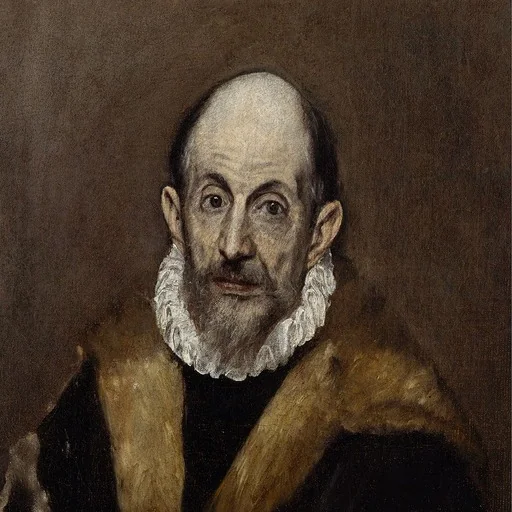
Doménikos Theotokópoulos was born in 1541 in Candia (modern Heraklion), the capital of Venetian-ruled Crete, where he was trained in the post-Byzantine tradition of icon painting.