Artwork
The Holy Trinity
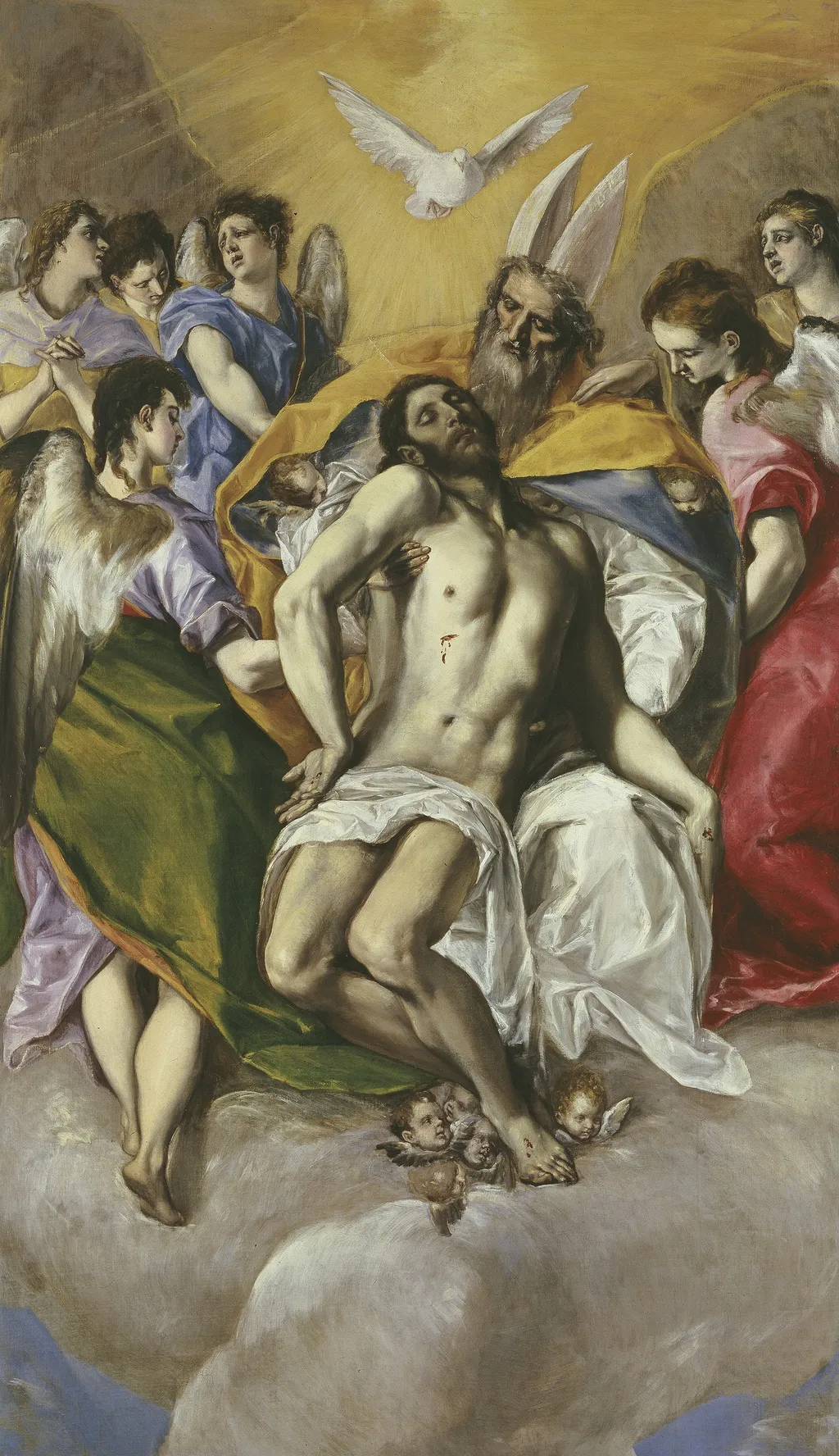
The Holy Trinity is an oil painting by the Mannerist artist El Greco. It dates from 1589 and is held in the collection of the Museo del Prado.
About this work
Subject & Meaning
Surrounding the Trinity are angels in various poses, their faces showing dramatic, almost irreverent expressions that reflect Mannerist innovation.
The painting depicts the Holy Trinity through the iconography of the Thronum Gratiae (Throne of Grace), a late-medieval formula that emphasizes Christ's dual nature. God the Father, represented as an enthroned, bearded elder, holds the dead body of Jesus Christ; above them, the Holy Spirit appears as a dove. This arrangement underscores the acceptance of Christ's sacrifice by the Father, with reference to Hebrews 4:16.
The composition forms a heart shape enclosing the action, with only the dove of the Holy Spirit positioned outside it. Surrounding the Trinity are angels in various poses, their faces showing dramatic, almost irreverent expressions that reflect Mannerist innovation. The serpentine line connecting Christ's body to God the Father further exemplifies this spirit.
Christ's monumental body dominates the center, rendered with traditional proportions rather than the stylization of El Greco's later works. The artist adapted a woodcut by Albrecht Dürer (1511), simplifying and concentrating its compositional lines while eliminating the Passion symbols and spatial depth.
Technique & Style
The Holy Trinity is an oil on canvas painting created by El Greco around 1577–1579. It measures 300 cm in height and 177–179 cm in width, confirming its large-scale format and rectangular support. The work depicts God the Father holding the dead body of Christ, with the Holy Spirit symbolized by a dove above them; angels surround the trio, their faces showing dramatic expression.
The composition forms a heart-shaped arrangement centered on Christ’s monumental, traditionally proportioned body, distinct from his later stylized figures. The painting’s cold palette of mauve, blue, and green, punctuated by isolated warm tones, contributes to its emotional intensity. Stylistically, it reflects El Greco’s synthesis of influences: Michelangelo’s anatomical modeling, Tintoretto’s chromaticism, and Dürer’s compositional structure, rendered in a distinctly Mannerist idiom.
The work was painted for the Convent of Santo Domingo el Antiguo in Toledo and entered the Spanish royal collection in 1832 after being acquired from sculptor Valeriano Salvatierra, eventually becoming part of the Museo del Prado’s collection.
History & Provenance
El Greco painted The Holy Trinity around 1577–1579, one of nine canvases he produced for the Convent of Santo Domingo el Antiguo in Toledo, where it occupied the attic of the main altarpiece.
In 1832, King Ferdinand VII of Spain acquired the painting from the sculptor Valeriano Salvatierra, who had owned it since at least 1827. Following this royal purchase, the work was transferred to the Museo del Prado in Madrid, where it remains.
The Holy Trinity is currently held in the Museo del Prado in Madrid, where it is cataloged under accession number P000824. The work originally formed part of the altarpiece at the Monastery of Santo Domingo el Antiguo in Toledo. It was acquired by King Ferdinand VII of Spain in 1832 from the sculptor Valeriano Salvatierra, who had possessed the piece since at least 1827.
Following this royal purchase, the painting was transferred to the Prado Museum, where it has remained in the collection since 1832. The sources do not provide a specific list of exhibition dates or temporary loan histories beyond its permanent installation.
Context
The Holy Trinity is widely regarded as a pivotal work in El Greco’s mature period and a significant expression of Counter-Reformation spirituality. Art historians note its innovative composition, featuring a heart-shaped arrangement that centers on the monumental figure of Christ, while the depiction of God the Father holding the dead Christ reflects a unique theological narrative. The painting’s stylistic synthesis, Michelangelo’s anatomical influence, Venetian chromaticism, and Dürer-derived structure, underscores its role at the intersection of High Renaissance ideals and Mannerist experimentation.
Its reception has been shaped by both scholarly analysis and institutional stewardship, particularly through its acquisition by Ferdinand VII and long-term placement in the Prado Museum, where it remains a focal point for studies on religious art and Spanish Renaissance painting.
Overview
El Greco’s oil on canvas, dated between 1577 and 1579, presents a dramatic vision of the Holy Trinity. The central scene depicts a bearded God the Father cradling the crucified Christ, while the Holy Spirit is symbolised by a dove above them. The composition is set against a turbulent sky populated by angels and cherubs, creating a dynamic spiritual tableau.
Artist & collection
Artist
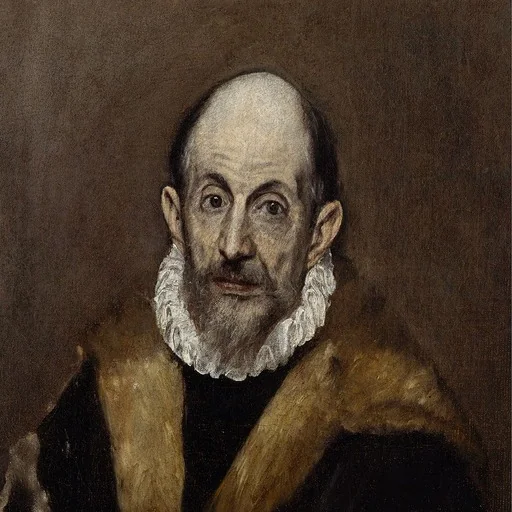
Doménikos Theotokópoulos was born in 1541 in Candia (modern Heraklion), the capital of Venetian-ruled Crete, where he was trained in the post-Byzantine tradition of icon painting.