Artwork
The lamentation over the dead Christ
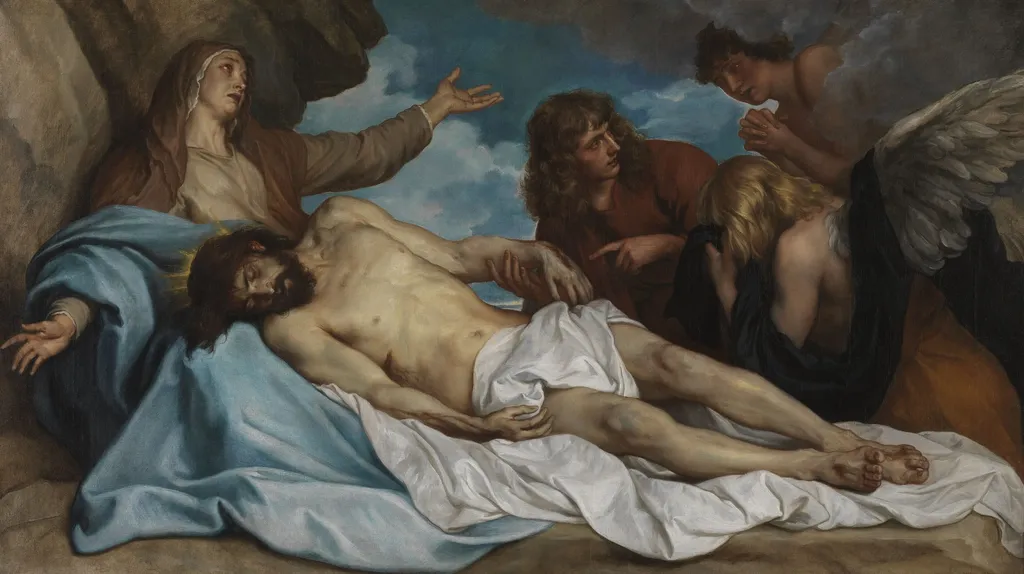
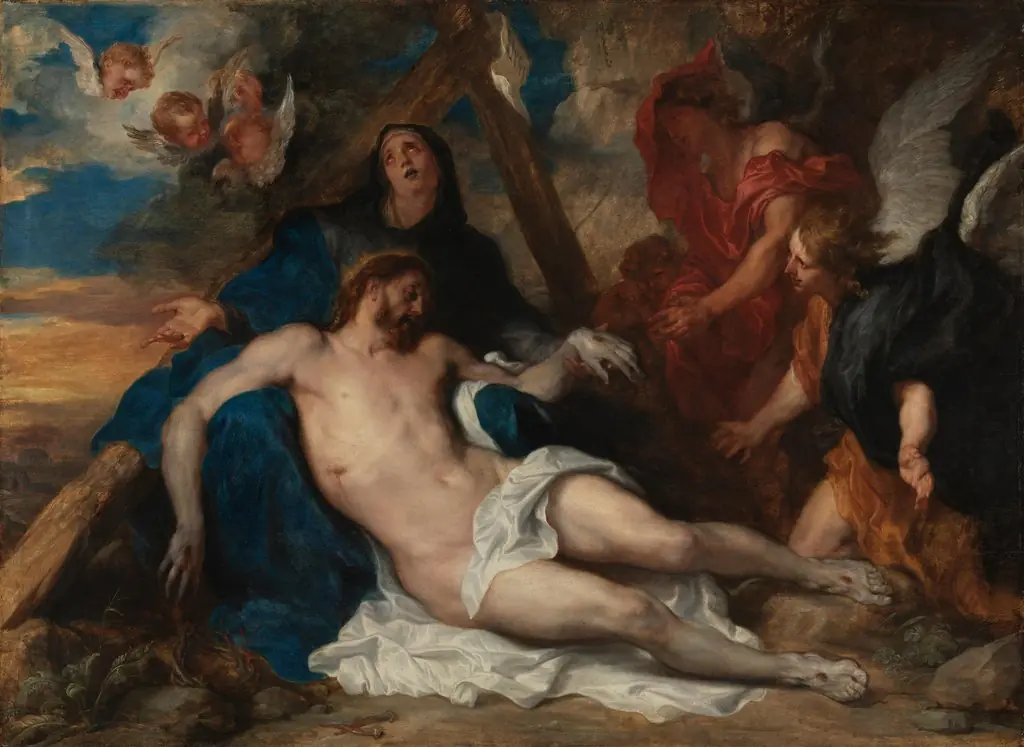
The lamentation over the dead Christ is an oil painting by the Flemish Baroque painting artist Anthony van Dyck. It dates from 1635 and is held in the collection of the Royal Museum of Fine Arts Antwerp.
About this work
Subject & Meaning
The work depicts the Lamentation of Christ, a devotional scene not narrated in the New Testament but drawn from the apocryphal Gospel of Nicodemus, in which Christ’s body is mourned between Crucifixion and Entombment. Van Dyck presents a compact, emotionally charged gathering centered on the prone, lifeless Christ, whose body is arranged parallel to the picture plane on a flat balsam-stone that doubles as an altar-like slab. The Virgin Mary kneels at his head, her arms outstretched in a gesture of maternal grief, while John the Evangelist supports the upper body and two angels hover above, their grey wings echoing the cold rock ledges. The composition’s sobriety and restrained palette intensify the mood of sorrow, with cool blues on the shroud and sky contrasting warmer hues on the figures’ drapery. The intimate scale and limited cast emphasize private mourning over public spectacle, aligning with the intended placement above a patron’s tomb and the chapel’s dedication to the Seven Sorrows of the Virgin.
Technique & Style
The composition is characterized by a sober, cold color palette dominated by blues, which are repeated in the clouds and the cloth beneath Christ's body.
Created between 1635 and 1640, this work is executed in oil paint on canvas. The support measures approximately 115.5 cm in height and 207.5 cm in width, a format that accommodates the extended, horizontal arrangement of the figures. Stylistically, the painting reflects a distinct Bolognese influence, marking a departure from Van Dyck's earlier treatments of the subject. The composition is characterized by a sober, cold color palette dominated by blues, which are repeated in the clouds and the cloth beneath Christ's body. Warm tonalities are reserved for the headscarf of Mary and the garments of John and the angels, creating subtle contrasts. The figures occupy nearly the entire surface, minimizing background detail and focusing on an intimate, emotionally charged scene set against a rocky tomb rather than a traditional crucifixion site.
History & Provenance
Commissioned by the Italian diplomat and abbot Cesare Alessandro Scaglia, this painting was intended for his tomb in the Recollects Convent (Our Lady of Seven Sorrows) in Antwerp. While older literature dated the work to 1634-1635 during Van Dyck's time in Brussels, modern stylistic analysis places its creation closer to 1640, potentially when the artist visited Antwerp in October of that year. Scaglia, who spent his final years at the convent, possessed several other works by the painter and was frequently portrayed by him. Although the chapel was consecrated in 1637, the altar holding the painting was not constructed until after Scaglia's death in 1641. The work, measuring approximately 115 by 208 cm, remains in the collection of the Royal Museum of Fine Arts Antwerp. The lamentation over the dead Christ is held in the collection of the Royal Museum of Fine Arts Antwerp, where it is listed under inventory number 404. The work was commissioned by Cesare Alessandro Scaglia and originally intended for placement above his tomb in the Recollects Convent in Antwerp. It has been exhibited as part of the museum’s permanent display of Flemish paintings and has been included in scholarly surveys of van Dyck’s religious output.
Context
The lamentation over the dead Christ by Anthony van Dyck was created in 1635 during his return from Italy and England, marking one of his final treatments of the subject and his last large-scale surviving painting. Van Dyck, like Rubens and Jordaens, was a leading 17th-century Flemish master, trained under Rubens and known for his influential portraiture across European aristocracy. The work was commissioned by Cesare Alessandro Scaglia, an Italian diplomat and art collector, who intended it for placement above his tomb in the Recollects Convent in Antwerp. After Scaglia's death, the painting remained in his family chapel, which was completed in 1641. It is now housed in the Royal Museum of Fine Arts Antwerp, where it is cataloged under inventory number 404. The painting depicts the Lamentation of Christ, drawing from apocryphal tradition rather than the New Testament, and features a composition emphasizing emotional intimacy through limited figures and a restrained setting. Van Dyck's treatment reflects a shift toward a more personal and expressive style, distinct from earlier depictions such as those by Rosso Fiorentino, and incorporates symbolic elements like angels associated with the moment of death. The composition balances color and spatial arrangement to heighten the somber and contemplative mood, with Christ's body positioned on a stone resembling an altar, supported by Mary's hand.
Artist & collection
Artist
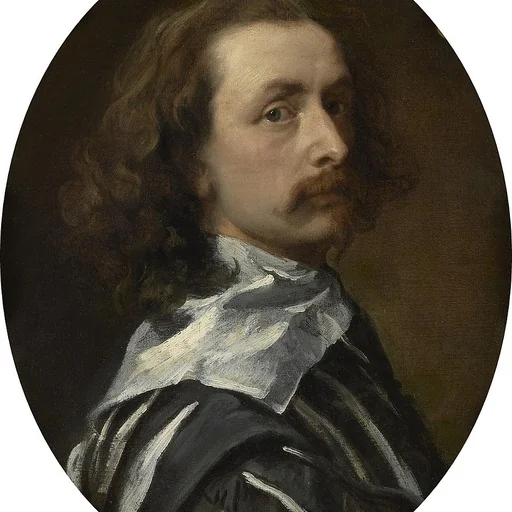
Sir Anthony van Dyck (; Dutch: Antoon van Dijck; 22 March 1599 – 9 December 1641) was a Flemish Baroque artist, who became the leading court painter in England after success in the Spanish Netherlands and Italy.