Artwork
Saint Elizabeth of Portugal
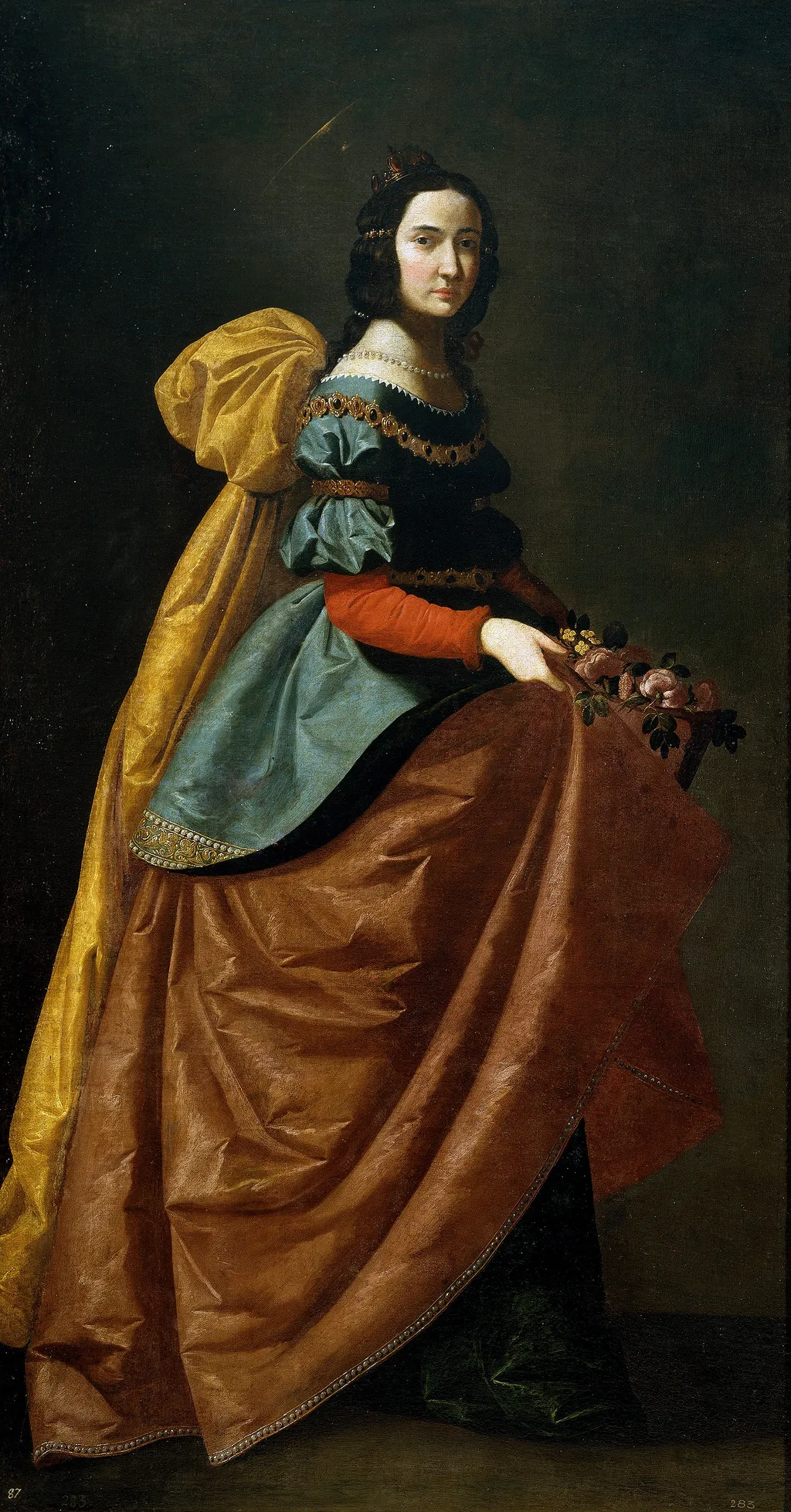
Saint Elizabeth of Portugal is an oil painting by the Baroque artist Francisco de Zurbarán. It dates from 1635 and is held in the collection of the Museo del Prado.
About this work
The work shows the queen‑saint in the legendary “miracle of the roses,” when she turned hidden bread into roses to give to the poor.
Saint Elizabeth of Portugal is an oil painting by the Spanish artist Francisco de Zurbarán, dated around 1635. The work shows the queen‑saint in the legendary “miracle of the roses,” when she turned hidden bread into roses to give to the poor. Zurbarán painted this scene on canvas, and the piece has been hanging in Madrid’s Prado Museum since 1818. If you’re curious about more of his work, check out the artist: Francisco de Zurbarán.
Technique & Style
Executed in oil on canvas, the painting measures 184 cm in height and 98 cm in width.
Zurbarán employs a strong, lateral light that carves the saint’s volumetric forms against a dark ground, casting a defined shadow beneath. The figure wears a layered ensemble of sumptuous fabrics: a violet-brown basquiña over a dark green skirt, a greenish-blue taffeta gown with vermilion sleeves, and a yellow-gold mantle that trails to the floor. Ornate chains with gemstones encircle the shoulders, waist, and elbows, rendered with precise attention to tactile illusion.
The face is modeled with subtle transitions, suggesting Zurbarán worked from a living model. The iconography centers on the "miracle of the roses," indicated by blooms in the queen’s lap, reinforcing the theme of hidden charity.
History & Provenance
The work, an oil on canvas portrait of Saint Elizabeth of Portugal, was executed circa 1630–1635 by the Spanish Baroque painter Francisco de Zurbarán (date 1635 recorded in the artist’s catalogue). It entered the Spanish royal collection and was held by King Ferdinand VII before being transferred to the Museo del Prado. The earliest documented sighting dates to 1814, when the painting hung in a salon of the Royal Palace in Madrid; it was subsequently moved to the Prado in 1818, where it remains in the museum’s collection.
Context
The painting belongs to a series of female saint portraits that occupies a prominent place within Francisco de Zurbarán's oeuvre of the mid-1630s, a body of work in which the Spanish Baroque master excelled at rendering fabrics, jewels, and devotional figures against dark backgrounds with strong lateral lighting. According to the Dutch-language source, the work holds a leading position among Zurbarán's portraits of female saints, while the Spanish-language entry situates it within a group of canvases depicting women in sumptuous procession-like attire whose costumes, as art historian Vicente Lleó Cañal observed, do not correspond to everyday dress of the era but were typical of Corpus Christi processions representing holy figures. Emilio Orozco has characterized such paintings as "retratos a lo divino", divine portraits, for their penetrating psychological characterization.
The painting is catalogued as number 95 in Odile Delenda's critical and reasoned catalogue of Zurbarán's work and as number 348 in Tiziana Frati's monograph.
The subject's identification has been debated in the scholarship because the miracle of the roses is also attributed to Saint Elizabeth of Hungary and Saint Casilda of Toledo; the painting's lack of inscription has complicated attribution, though the sitter's apparent age and royal crown have led most commentators to favor Elizabeth of Portugal, whose cult flourished following her canonization by Urban VIII in 1626.
Legacy
Francisco de Zurbarán's Saint Elizabeth of Portugal has maintained a prominent position within the canon of Spanish Baroque religious art since its entry into the Museo del Prado in 1818. The work is frequently cited in critical scholarship, notably serving as catalog number 95 in Odile Delenda's comprehensive raisonné of the artist's oeuvre. Its enduring reputation is reinforced by its inclusion in major international exhibitions, such as Zurbarán, Von Greco bis Goya and From Titian to Goya, which have highlighted its significance alongside other masterpieces of the Prado collection.
Art historians often utilize the painting to illustrate Zurbarán's mastery of fabric texture and his unique approach to "portraits à la divine," where the subject's psychological depth is rendered through dramatic lighting and opulent attire.
Overview
Francisco de Zurbarán's painting, Saint Elizabeth of Portugal, rendered in oil on canvas around 1630–1635, portrays the revered queen-saint. The artwork captures a pivotal moment from her life, illustrating the legendary "miracle of the roses." This scene highlights her renowned compassion and charitable acts, for which she was widely celebrated during her lifetime.
Subject & Meaning
The painting centers on Saint Elizabeth, who was the daughter of Peter III of Aragon and consort to Denis of Portugal. She was widely known for her profound generosity towards the less fortunate. The depicted miracle unfolds as Elizabeth, questioned by her husband about concealed items, reveals that the bread she intended for the poor has miraculously transformed into a bouquet of roses.
Artist & collection

Artist
Francisco de Zurbarán was a Spanish Baroque painter. He is known primarily for his religious paintings depicting monks, nuns, and martyrs, and for his still-lifes. Zurbarán gained the nickname "Spanish Caravaggio",…



- Allegory of Hope
 Portrait of Claudia de' Medici
 Flora
Flora Saint Lucy and a Donor
 Portrait of a Woman
 Henriette Adelaide
 Saint Rufina
 Portrait of Urszula Franciszka Radziwiłł née Wiśniowiecka (1705–1753)
 Portrait of an unknown woman
 Portrait of Elisabeth of Valois (1545-1568), Queen of Spain
 Allegory of Charity
 Santa Inés