Artwork
Saint Benedict
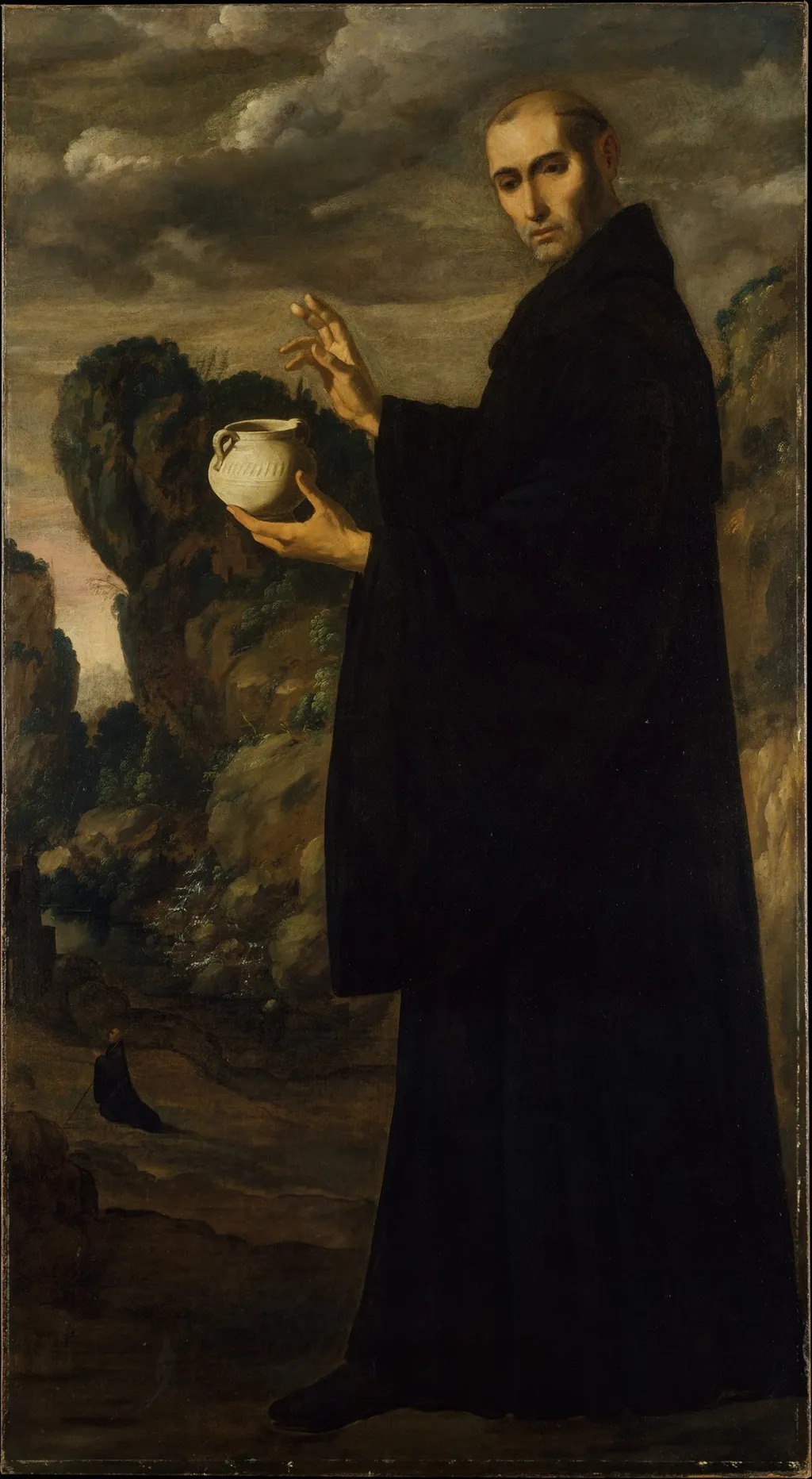
Saint Benedict is an oil painting by the Early Baroque Italian artist Francisco de Zurbarán. It dates from 1640 and is held in the collection of the Metropolitan Museum of Art.
About this work
A man in a long black robe stands in a rocky landscape under a clouded sky, a plain white pitcher in his right hand and his left raised as if in blessing. His face is calm and contemplative. Francisco de Zurbarán painted it in 1640, using strong light and shadow to lift the figure from the dark.
Subject & Meaning
As a representation of a specific saint, the work serves to visualize the sanctity and historical identity of Benedict within the Catholic tradition.
Created in 1640, this religious painting by Francisco de Zurbarán depicts Benedict of Nursia, the founder of the Benedictine Order. The composition focuses on the saint as a solitary male figure, adhering to the genre of religious art. Distinctive iconography includes the presence of a pitcher alongside the holy man, an object often associated with miracles or daily monastic life in hagiographic traditions.
As a representation of a specific saint, the work serves to visualize the sanctity and historical identity of Benedict within the Catholic tradition. The depiction emphasizes the human aspect of the saint while maintaining the solemnity required for devotional imagery of the period.
Technique & Style
The work Saint Benedict, painted by Francisco de Zurbarán in 1640, is executed in oil on canvas, a support confirmed by the Metropolitan Museum of Art records. The painting measures 188 cm in height by 103.5 cm in width and belongs to the religious genre, depicting the saint holding a pitcher as one of his traditional attributes. Zurbarán's technique employs layered oil paint to achieve a naturalistic rendering of the figure against a muted background, characteristic of Spanish Baroque religious art.
The composition is straightforward, emphasizing the saint's contemplative presence, while the material handling is typical of easel paintings of the period.
History & Provenance
The painting Saint Benedict by Francisco de Zurbarán is dated to 1640 and depicts Saint Benedict of Nursia in a religious context. Executed in oil on canvas and measuring 188 cm in height by 103.5 cm in width, it is held by the Metropolitan Museum of Art, New York, where it is inventoried as 1975.1.144. Zurbarán's authorship is consistently attributed across sources, aligning with his known production during the 1640s.
The work is shown as part of the museum's permanent holdings of European paintings, with no record in the provided sources of additional temporary exhibitions specifically dedicated to it.
Context
Francisco de Zurbarán's 1640 oil painting of Saint Benedict stands as a significant example of Spanish Baroque religious art, currently held by the Metropolitan Museum of Art. The work depicts Benedict of Nursia, characterized by monastic attire and a pitcher, reflecting the artist's specialized focus on Counter-Reformation spirituality and ascetic figures. While the painting exemplifies Zurbarán's mastery in rendering texture and solemnity within a religious genre, specific scholarly analyses regarding its critical reception or detailed art-historical positioning are not provided in the available records.
Consequently, the work is recognized primarily through its attribution to the mid-seventeenth-century Spanish master and its inclusion in a major public collection.
Legacy
Zurbarán's Saint Benedict belongs to the collection of the Metropolitan Museum of Art in New York, where it is cited in scholarly catalogues as a characteristic example of the artist's mature religious painting. Its austere composition and Zurbarán's signature tenebrism are typical of the Spanish master's treatments of monastic and saintly figures during the Counter-Reformation, a body of work that informed later religious painting in Spain and the Spanish Americas.
Overview
Painted in 1640, Francisco de Zurbarán's Saint Benedict portrays the founder of the Benedictine order as a solitary figure standing against a rugged, rocky landscape under a cloudy sky. The composition focuses on the saint's full-length form, clad in the traditional black habit of his order, which contrasts sharply with the pale tones of the sky and the earth. In his right hand, he holds a white pitcher, a reference to the miracle where he blessed poisoned water, while his left hand is raised in a gesture of benediction.
Zurbarán renders the figure with his characteristic tenebrist style, utilizing dramatic chiaroscuro to model the folds of the fabric and the saint's serene, contemplative face. This work exemplifies the artist's mature period, where he specialized in monastic subjects commissioned for Spanish religious institutions. The painting reflects the Counter-Reformation emphasis on asceticism and spiritual clarity, presenting the saint not merely as a historical figure but as a tangible embodiment of monastic virtue.
The stark background isolates the subject, directing the viewer's attention entirely to the spiritual gravity of the moment and the physical presence of the holy man.
Artist & collection
Artist
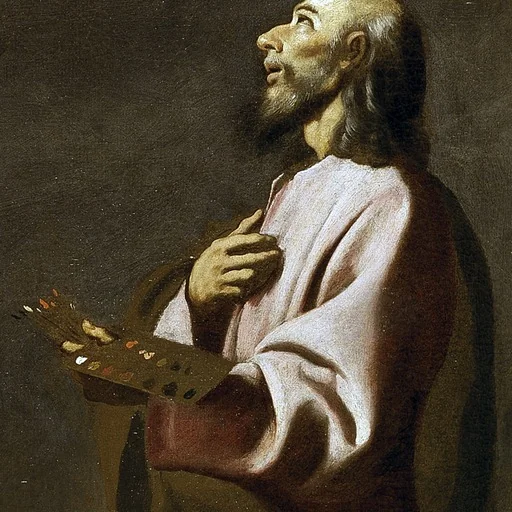
Francisco de Zurbarán was a Spanish Baroque painter. He is known primarily for his religious paintings depicting monks, nuns, and martyrs, and for his still-lifes. Zurbarán gained the nickname "Spanish Caravaggio",…