Artwork
Still Life with Dish of Quince
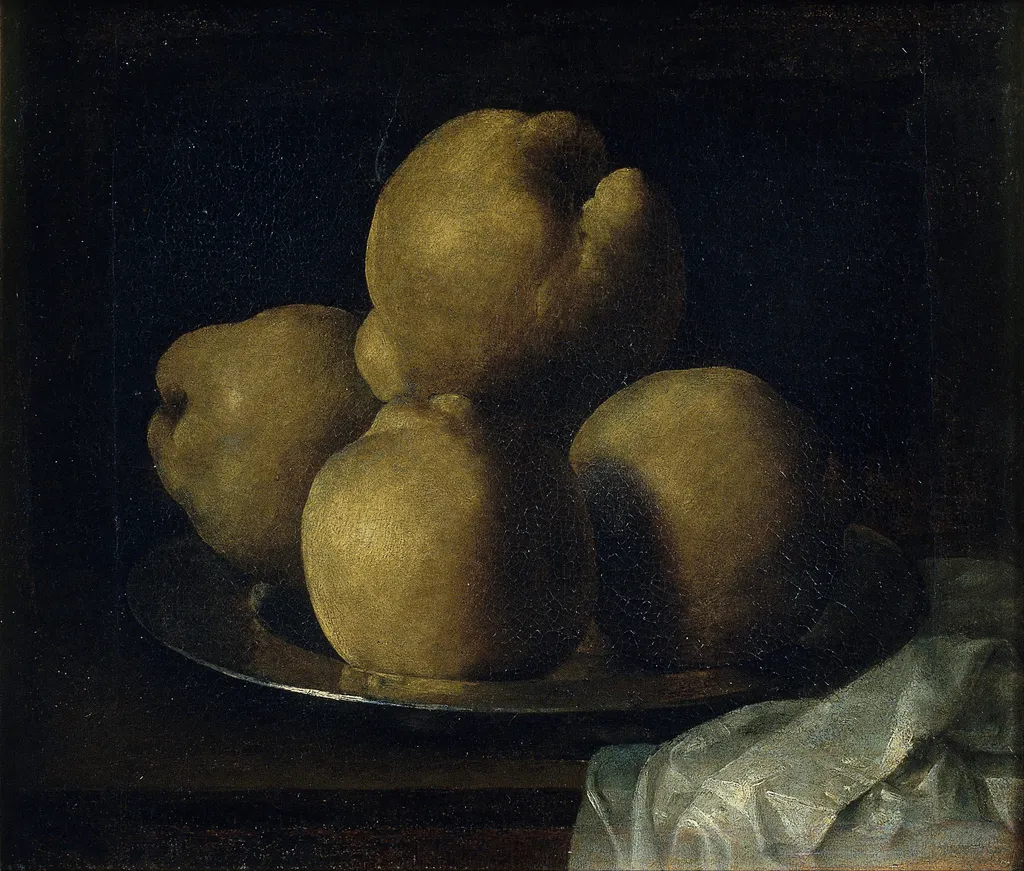
Still Life with Dish of Quince is an oil painting by the Early Baroque Italian artist Francisco de Zurbarán. It dates from 1633 and is held in the collection of the Museu Nacional d'Art de Catalunya.
About this work
Overview
It is one of the few still lifes by Zurbarán to survive, making it a rare and significant example of the artist's contribution to the Spanish bodegón tradition.
Still Life with Dish of Quince is an oil-on-canvas still life by the Spanish Baroque painter Francisco de Zurbarán, dated to approximately 1633-1635, though scholarly opinion varies. Measuring 35 by 40.5 centimeters, the painting depicts four quinces arranged on a shallow metal dish with a folded white cloth at the lower right, set against a dark background. The work is held by the Museu Nacional d'Art de Catalunya (MNAC) in Barcelona, where it is catalogued under accession number 010092-000. It is one of the few still lifes by Zurbarán to survive, making it a rare and significant example of the artist's contribution to the Spanish bodegón tradition. The painting is listed as number 93 in Odile Delenda's critical catalogue of Zurbarán's oeuvre and as number 99 in Tiziana Frati's catalogue raisonné.
Subject & Meaning
baptized The composition presents four natural-sized quinces on a pewter dish, accompanied by a white cloth draped at the lower right. The quinces, rendered in pale golden-yellow with brownish shadows, are illuminated from the left, their color subtly reflected in the metal rim of the plate. In classical antiquity, quinces were symbols of love and fertility, and in a Christian context, they could allude to the Resurrection of Christ. The Museu Nacional d'Art de Catalunya suggests the painting may originally have been a detail from a religious or domestic interior scene, where the plate of fruit would carry connotations of Redemption, a common motif in Zurbarán's work. The stark simplicity of the arrangement, the dark void of the background, and the contemplative stillness imposed by the lighting lend the humble subject a meditative, almost spiritual weight that transcends mere representation of everyday objects.
Technique & Style
Zurbarán executed the work in oil on canvas, employing smooth, blended brushwork with minimal detail to emphasize volume and tonal gradation rather than surface texture. The paint handling features thick impasto on the quinces, giving them substantial plastic presence, while the metallic sheen of the pewter dish creates subtle reflections that interact with the white cloth. Light falls from the upper left, modeling the rounded forms and dissolving their right sides into deep shadow, a characteristic use of chiaroscuro that earned Zurbarán the nickname "Spanish Caravaggio." The surface shows fine craquelure throughout. The composition is compact and centered, with the fruit clustered in a stable, pyramidal arrangement against the nearly black-brown background. The restrained palette, dominated by muted golden yellows, cool darks, and the bright neutral of the cloth, creates a unified tonal harmony typical of Zurbarán's austere approach.
History & Provenance
The painting's early history remains uncertain. Radiographic studies indicate that the original canvas was cut from a larger work to create an independent painting, and it was subsequently relined with strips of fabric added to all four sides to achieve its present dimensions. The lower strip was repainted to suggest that the dish rests on the forward edge of a table and to make the white cloth appear folded over that edge; these additions are now largely concealed by the frame. The work was part of the Gil collection in Barcelona before being deposited at the MNAC in 1922 and subsequently acquired by the museum in 1946. Scholarly dating has fluctuated: while the Museu Nacional d'Art de Catalunya gives a range of 1633-1664, Odile Delenda and the museum itself more precisely place it around 高龄 1633-1635志 1635, relating it to other still lifes such as Still Life with Citrons, Oranges and Rose. Gabriele Finaldi, however, has proposed a later date corresponding to Zurbarán's second stay in Madrid (1645-1662). Paul Guinard once suggested it might be an autograph sketch, though critical consensus has consistently upheld Zurbarán's authorship.
Context
Zurbarán is best known for his religious paintings of monks, nuns, and martyrs, yet he produced a small but distinguished group of still lifes that share the contemplative intensity of his devotional works. In seventeenth-century Spain, the bodegón genre depicted food, vessels, and utensils with a stark simplicity reflecting both Spanish austerity and Counter-Reformation spirituality. Zurbarán's still lifes extend this tradition, employing the same dramatic lighta light and shadow, careful observation of texture, and atmosphere of silence that characterize his religious canvases. The dating debates surrounding Still Life with Dish of Quince, particularly the tension between an early 1630s attribution and Finaldi's later proposal, reflect broader uncertainties in Zurbarán chronology and the difficulty of tracing stylistic evolution in an artist whose fundamental approach remained remarkably consistent. The work's possible origin as a fragment from a larger composition also raises questions about how independent still life functioned within larger religious or domestic programs in Spanish Baroque painting.
Legacy
As one of the very few still lifes by Zurbarán to survive, Still Life with Dish of Quince occupies a crucial position in the study of Spanish Baroque painting. Its rarity has made it a touchstone for understanding Zurbarán's engagement with the bodegón genre and the broader aesthetic of austerity that defines Spanish still life of the period. The painting's presence in the Museu Nacional d'Art de Catalunya has established Barcelona as an important center for the study of Zurbarán's non-religious work. The debates over its dating and original function, documented in the catalogues of Delenda and Frati, continue to inform scholarly discussion of Zurbarán's stylistic development and the place of still life within his predominantly devotional oeuvre. The work's public domain status and inclusion in digital initiatives such as the Google Art Project have extended its visibility, allowing broader audiences to engage with this intimate example of Zurbarán's mastery of light, form, and quiet material presence.
Own this work as a print
Artist & collection
Artist
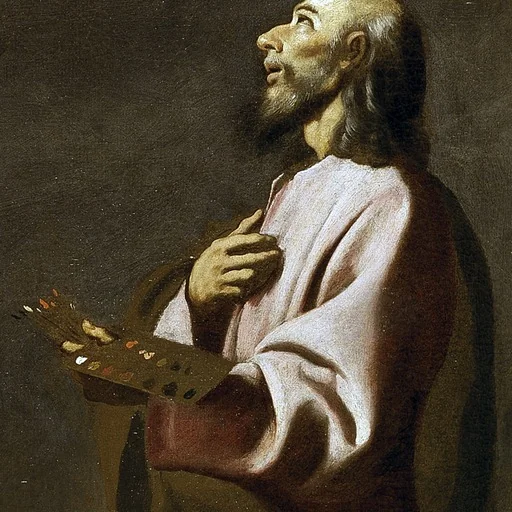
Francisco de Zurbarán was a Spanish Baroque painter. He is known primarily for his religious paintings depicting monks, nuns, and martyrs, and for his still-lifes. Zurbarán gained the nickname "Spanish Caravaggio",…