Artwork
Portrait of the Marchioness of Santa Cruz
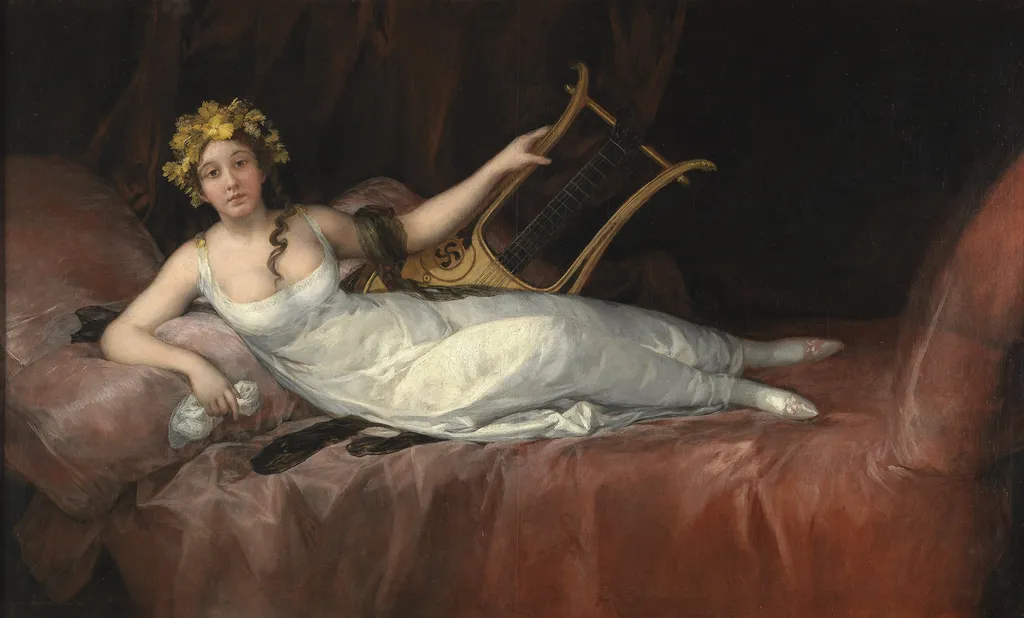
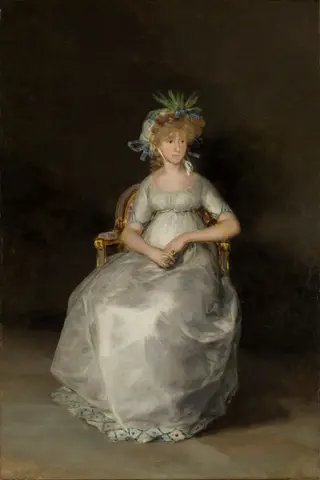
Portrait of the Marchioness of Santa Cruz is an oil painting by Francisco de Goya. It dates from 1805 and is held in the collection of the Museo del Prado. This oil painting, completed in 1805 by the Spanish artist Francisco Goya, depicts the Marchioness of Santa Cruz.
About this work
An oil portrait by Francisco Goya from 1805, showing the Marchioness of Santa Cruz, a family friend, in a formal setting. The painting entered the Museo del Prado in Madrid in 1986, bought for more than six million dollars.
Subject & Meaning
She is shown reclining on a red divan in a white Empire-style gown, holding a lyre-guitar and crowned with oak leaves and acorns.
The painting depicts Joaquina Téllez-Girón, Marquise of Santa Cruz, a cultured noblewoman and daughter of the Dukes of Osuna, whom Goya had known since childhood. She is shown reclining on a red divan in a white Empire-style gown, holding a lyre-guitar and crowned with oak leaves and acorns. This iconography identifies her with Erato, the muse of lyric and love poetry, alluding to her poetic interests.
The lyre-guitar serves as a tribute to Apollo and the arts, while the swastika-like lauburu painted on the instrument is a Celtic or pre-Celtic mythological symbol of ancient origin, not a later addition. The reclining pose echoes Canova's Paolina Borghese as Venus Victrix and Velázquez's and Titian's Venuses, situating the sitter within a classical-mythological tradition. The work thus represents both an intimate portrait of a friend and an allegorical homage to the muse of poetry.
Technique & Style
The work is an oil painting on canvas measuring approximately 124.7 × 207.7 cm. Goya applied thick, pastose impasto on the right thigh to intensify the white light, while using more diluted paint for the crimson, mauve and violet fabrics of the sofa and curtains; a subtle glaze or veladura unifies the surface with a gauze‑like texture. Stylistically, the portrait exemplifies the Empire/Neoclassical mode assimilated after the French Revolution, echoing Canova’s Paolina Borghese and employing classical motifs, the lyre‑guitar, vine leaves and grapes, that allude to the muse Erato/Euterpe and recall the sensual poses of Velázquez and Titian.
History & Provenance
The Portrait of the Marchioness of Santa Cruz was painted by Francisco Goya in 1805, depicting Joaquina Téllez-Girón, whom Goya had known since childhood and had earlier included in the family group portrait The Dukes of Osuna and Their Children. She had married José Gabriel de Silva-Bazán, Marquis of Santa Cruz and first director of the Museo del Prado, in 1801. During the 19th century and into the early 20th, the canvas belonged to the collection of the Conde de Pie de Concha, of the Casa de Silva and son of the Marquises of Santa Cruz, and was shown at the first Goya retrospective held at the Prado in 1928.
During the Spanish Civil War it was evacuated to Switzerland with other Spanish collections and, although returned to Spain after the war, remained in the Prado rather than being restored to its private owners.
The Portrait of the Marchioness of Santa Cruz is housed in the Museo del Prado in Madrid, where it has been held since 1986. The work was acquired by the Spanish government for over $6 million after being purchased at a London auction that year, following a legal dispute over its illicit export from Spain. Prior to this acquisition, the painting belonged to the private Valdés collection in Bilbao and, earlier, to the aristocratic collection of the Count of Pie de Concha.
Its exhibition history includes its appearance in the first retrospective exhibition of Francisco Goya at the Prado in 1928. During the Spanish Civil War, the canvas was evacuated to Switzerland for safety along with other national treasures before returning to Spain. In the 1940s, it was briefly held by the Spanish state under Francisco Franco, who had intended to gift it to Adolf Hitler, before being returned to private ownership in 1947.
Context
The Portrait of the Marchioness of Santa Cruz has been read by scholars as an allegorical homage to the muse Erato/Euterpe, with the marquise’s lyre‑guitar and vine crown signalling her poetic pursuits (4,5,6). Art historians place the work within Goya’s adoption of the French Empire style, noting how it moves beyond earlier Spanish neoclassicism and aligns with Canova’s Paolina Borghese (4,5,6). Comparisons are drawn to the sensual poses of Velázquez, Titian and Goya’s own Maja paintings, highlighting the artist’s mastery of erotic beauty (3,5).
Modern reception includes its inspiration for a pastiche in the 2015 film Mortdecai and the tumultuous provenance involving Nazi interest, Franco’s attempted gift, a legal battle, and its eventual acquisition by the Prado in 1986 for over US$6 million (3,4,5,6).
Legacy
The portrait's legacy is defined by its dramatic 20th-century provenance and subsequent status as a national treasure. During the 19th and early 20th centuries, it remained in aristocratic collections, appearing in Goya's first retrospective at the Prado in 1928. Its reputation became entangled with World War II politics when Francisco Franco reportedly selected it as a gift for Adolf Hitler in 1940, partly due to a swastika-like symbol on the subject's lyre-guitar, though the work was never delivered.
After passing through the Valdés collection, the painting gained international notoriety in 1986 when its illicit export prompted the Spanish government to halt a London auction. The state acquired the work for over $6 million, securing its place in the Museo del Prado. Culturally, the composition's neoclassical sensuality has influenced modern media, notably inspiring a fantasy portrait in the 2015 film Mortdecai.
Overview
This oil painting, completed in 1805 by the Spanish artist Francisco Goya, depicts the Marchioness of Santa Cruz. The artist and his sitter shared a personal connection, as Goya was a friend of the Marchioness's family. The work serves as a formal representation of a prominent figure of the era, showcasing Goya's skill in portraiture during the early 19th century.
Own this work as a print
Artist & collection
Artist
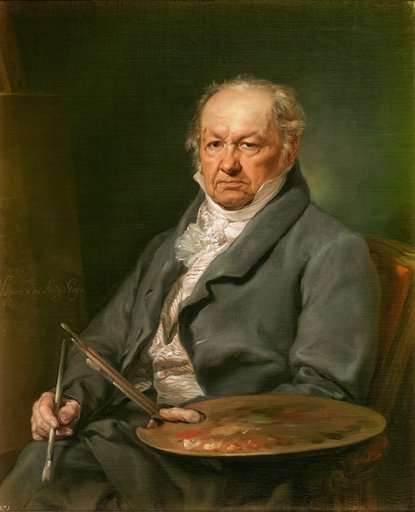
Francisco José de Goya y Lucientes was a Spanish romantic painter and printmaker.