Artwork
Mountainous Landscape
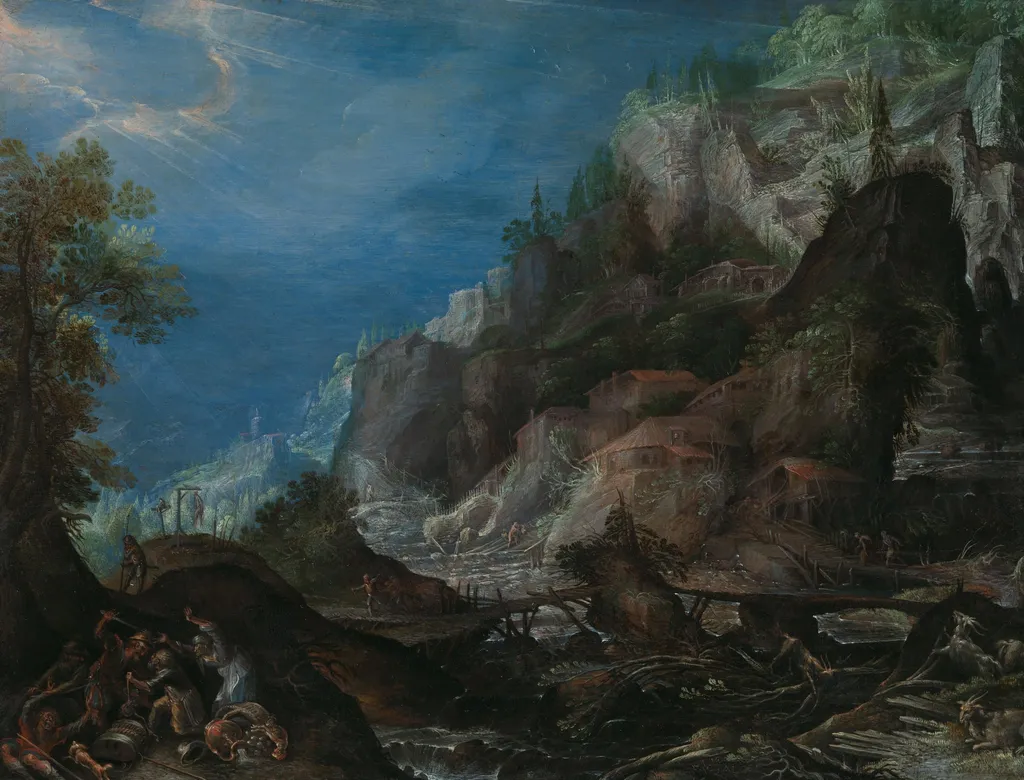
Mountainous Landscape is an unspecified painting by the Dutch Golden Age artist Frederik van Valckenborch. It dates from 1605 and is held in the collection of the Rijksmuseum. Created in 1605, this anonymous oil painting presents a rugged landscape dominated by a river that slices through steep, craggy hills.
About this work
The hills and river are drawn with careful lines, but the people are just quick dabs of paint.
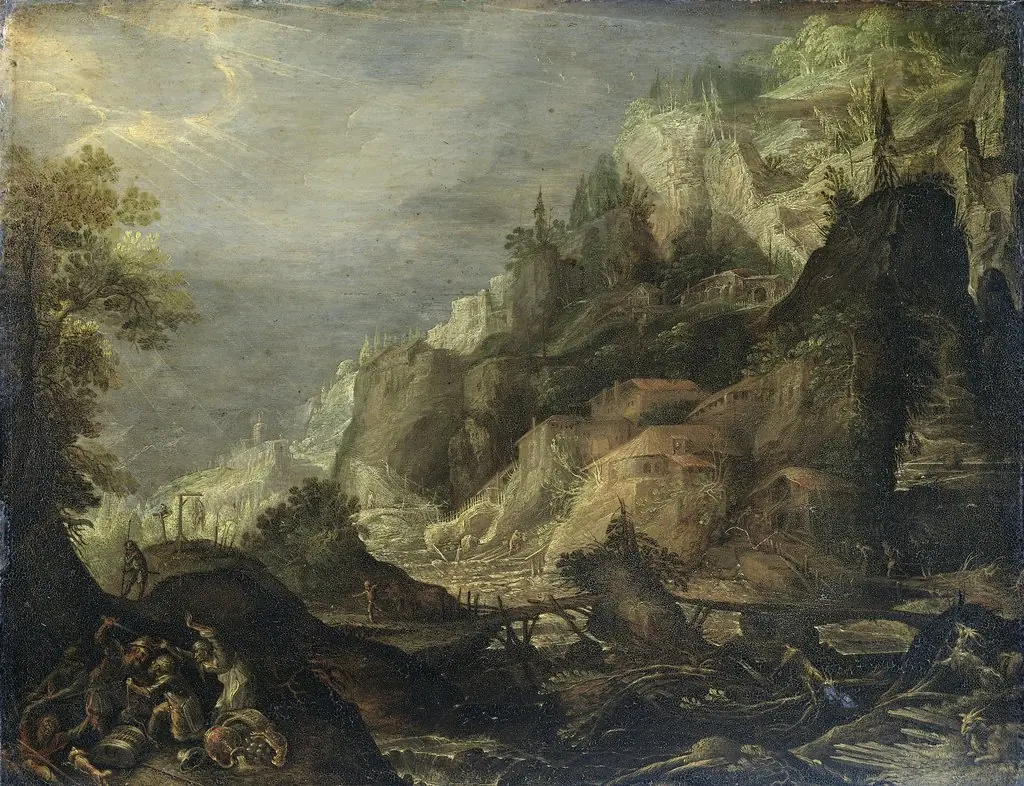
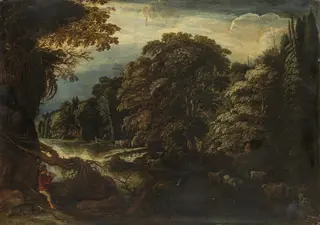
You see a rocky river cutting through steep hills, with tiny people walking along the bank. On the left, robbers attack farmers carrying goods to market. In the distance, a gallows and a breaking wheel stand on a hill. Houses and bridges cling to cliffs on the right.
The painting was made in 1605, but no one knows who painted it. The small scenes of everyday danger, robbers, punishment, feel like a quiet warning. The hills and river are drawn with careful lines, but the people are just quick dabs of paint.
To see more paintings like this, look up the Rijksmuseum.
Subject & Meaning
Mountainous Landscape is a landscape painting by Frederik van Valckenborch, executed in 1605 during his Nuremberg period. The work belongs to the artist's signature genre of imaginary landscapes populated with small figures, a tradition rooted in his family's specialization in landscape painting. According to the Spanish-language source, the painting exemplifies his mature style, in which gesticulating foreground figures, sometimes enacting biblical or mythological scenes, sometimes anecdotal, reinforce the threatening, dramatic atmosphere of the surrounding terrain.
Van Valckenborch's late Mannerist idiom, characterized by stark light-dark contrasts and animated, fantastical mountain and rock formations, lends the landscape a haunting, even surrealist quality. The work thus operates both as a topographical-style mountain vista and as an emotionally charged stage, where nature's turbulence and the dynamism of the figures combine to evoke menace and wonder.
Technique & Style
Frederik van Valckenborch executed this work in a late Mannerist idiom, characterized by strong contrasts between light and dark. The composition features animated forms and fantastical mountain ranges that lend the scene a dynamic, haunting, and somewhat surrealist quality. Small, gesticulating figures are placed in the foreground, reinforcing the threatening atmosphere through their violent dynamism.
The artist employed a nervous brushstroke to depict natural forces, creating dramatic chiaroscuro effects that define the work's stylistic approach.
History & Provenance
Mountainous Landscape was painted in 1605 by Frederik van Valckenborch, a Flemish landscape painter active in Frankfurt and Nuremberg. He was born into a prominent artistic family; his father Marten van Valckenborch trained him in landscape painting, while figure work likely came from another teacher. The work reflects a late Mannerist style with dramatic chiaroscuro and dynamic forms, influenced by Gillis van Coninxloo and Italian artists such as Pauwels Franck and Lodewijk Toeput.
Van Valckenborch received a commission from Archduke Maximilian in 1607 to copy Albrecht Dürer’s Assumption of the Virgin, a project completed with assistance from Paul Juvenel. He later designed an arch for Archduke Matthias’s 1612 entry into Nuremberg. The painting is part of a broader corpus of landscape works held in collections including Museum Boymans van Beuningen, the Germanisches Nationalmuseum, the Rijksmuseum, the Louvre, and the Kunsthistorisches Museum.
Frederik van Valckenborch's painting Mountainous Landscape (1605) is held by the Rijksmuseum in Amsterdam. The work is cataloged under the title Berglandschap and is noted as having been created in Nuremberg. While the specific inventory or accession number is not provided in the available records, the museum's collection explicitly lists this 1605 landscape as a key example of the artist's later, more conventional style.
The sources do not record any specific exhibition history for this particular work, nor do they mention its inclusion in temporary shows or loan programs.
Context
Frederik van Valckenborch (1566–1623) was a Flemish painter and draughtsman who worked in a late Mannerist idiom, producing imaginary landscapes with figures characterised by strong light–dark contrasts and animated, sometimes haunting forms. Born into a family of fourteen known painters, he trained initially under his father Marten van Valckenborch and possibly the Antwerp figure painter Jacob de Backer. After his family relocated from the Spanish Netherlands to Frankfurt am Main, he and his brother Gillis are believed to have travelled to Italy around 1590–1592, where exposure to Venetian artists such as Pauwels Franck and Lodewijk Toeput, and to Tintoretto's dramatic lighting, shaped his mature style.
Settling in Nuremberg in 1602, he was regarded as an important Dürer scholar, received commissions from Archduke Maximilian and the city authorities, and served on the Grand Council from 1610 to 1623. His principal influence, alongside his father, was Gillis van Coninxloo.
Mountainous Landscape (1605), painted in Nuremberg and now in the Rijksmuseum, exemplifies the dynamic, dramatic manner of his middle career, with small gesticulating figures reinforcing the threatening atmosphere of his mountainous scenery.
Overview
Created in 1605, this anonymous oil painting presents a rugged landscape dominated by a river that slices through steep, craggy hills. The composition balances natural scenery with narrative vignettes, arranging a central waterway flanked by distant structures and dramatic events that together convey a snapshot of early‑seventeenth‑century rural life.
Own this work as a print
Artist & collection
Artist
Frederik van Valckenborch (1566 in Antwerp – 1623 in Nuremberg) was a Flemish painter and draughtsman known for his imaginary landscapes with figures executed in a late Mannerist style.

- Mountainous Landscape
 Gebirgslandschaft mit Reisenden
 Landscape with Tobias and the Archangel Raphael
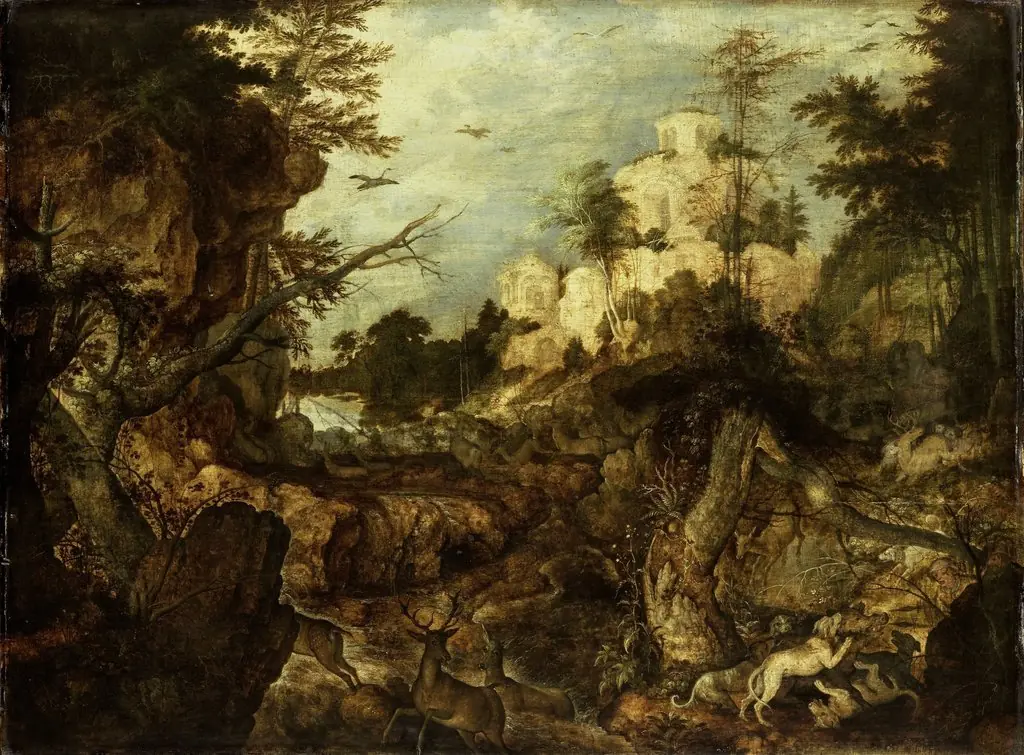 Wild boar hunt in a rocky landscape
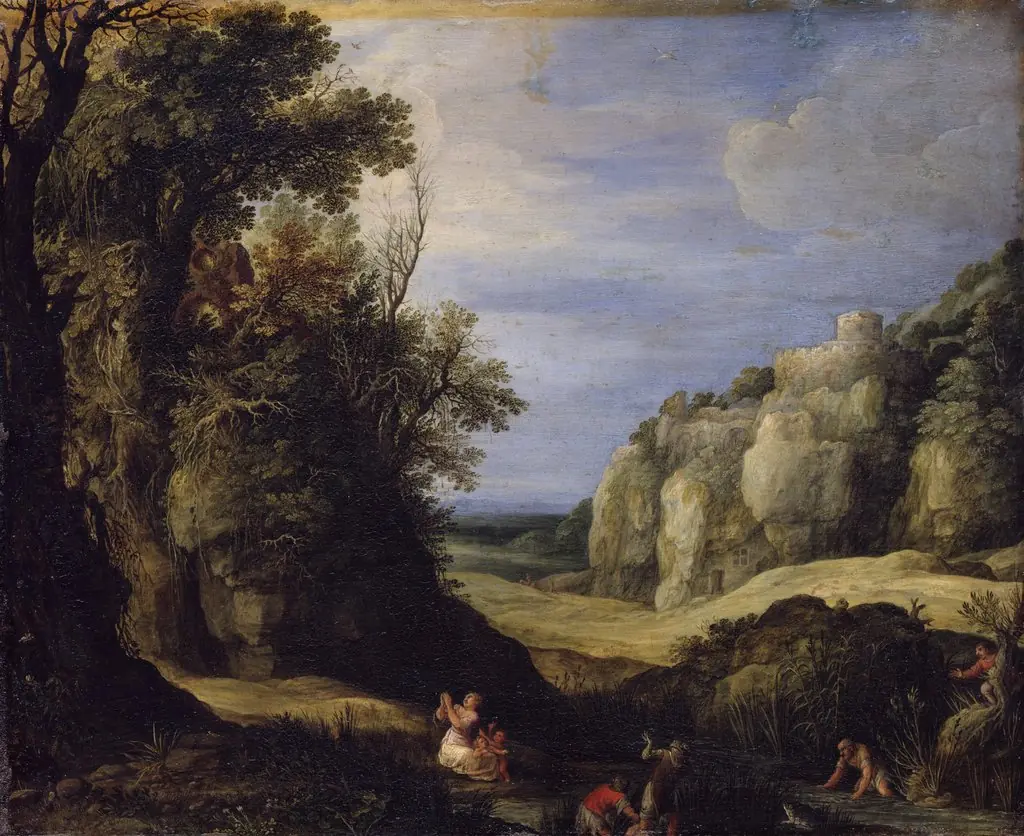 Landscape with Latona and the Lycian Peasants
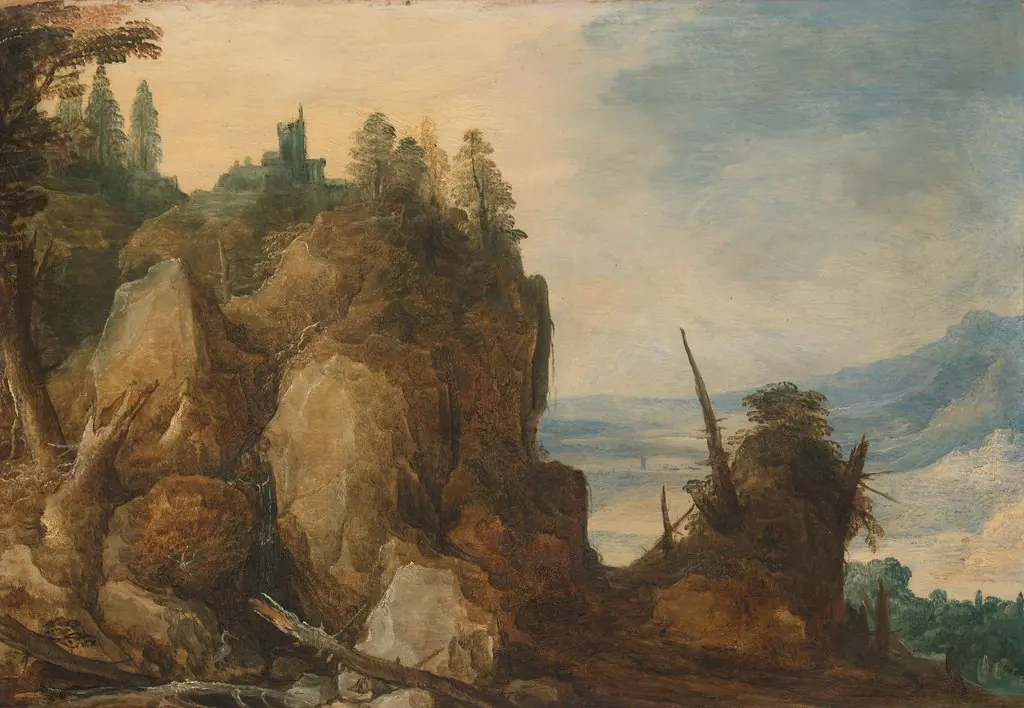 Mountain view
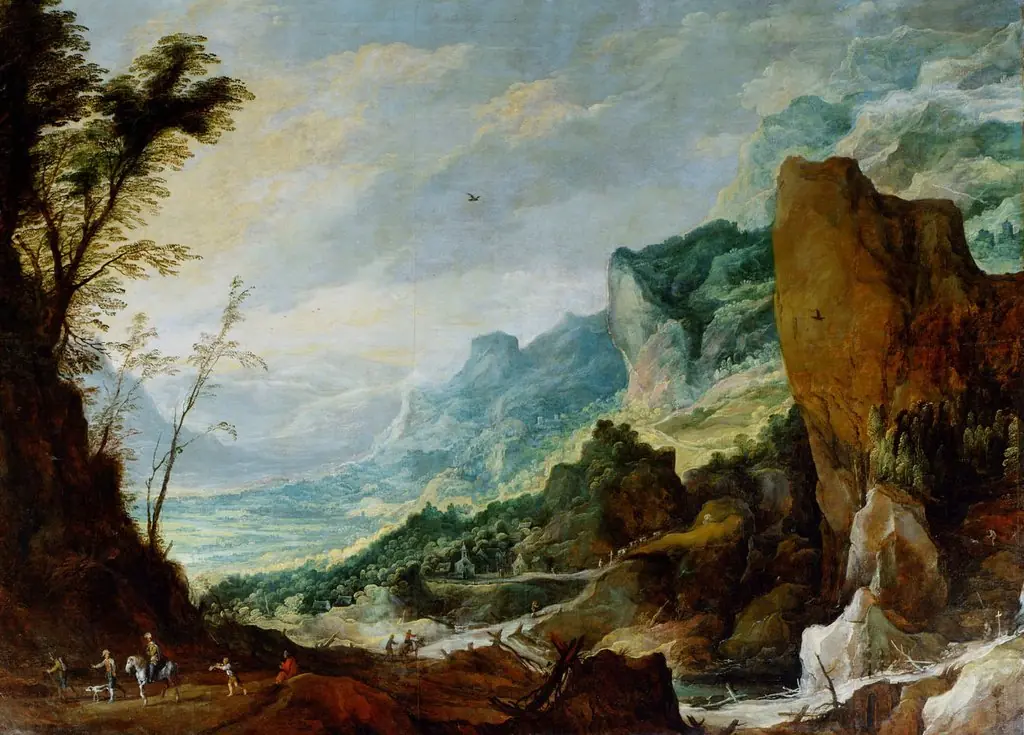 Mountain Landscape
 Landschaft mit der Predigt Johannes d. Täufers
 Rocky Landscape
 Landscape with Philemon and Baucis
 Wooded Landscape with Abraham and Isaac
 Forest