Artwork
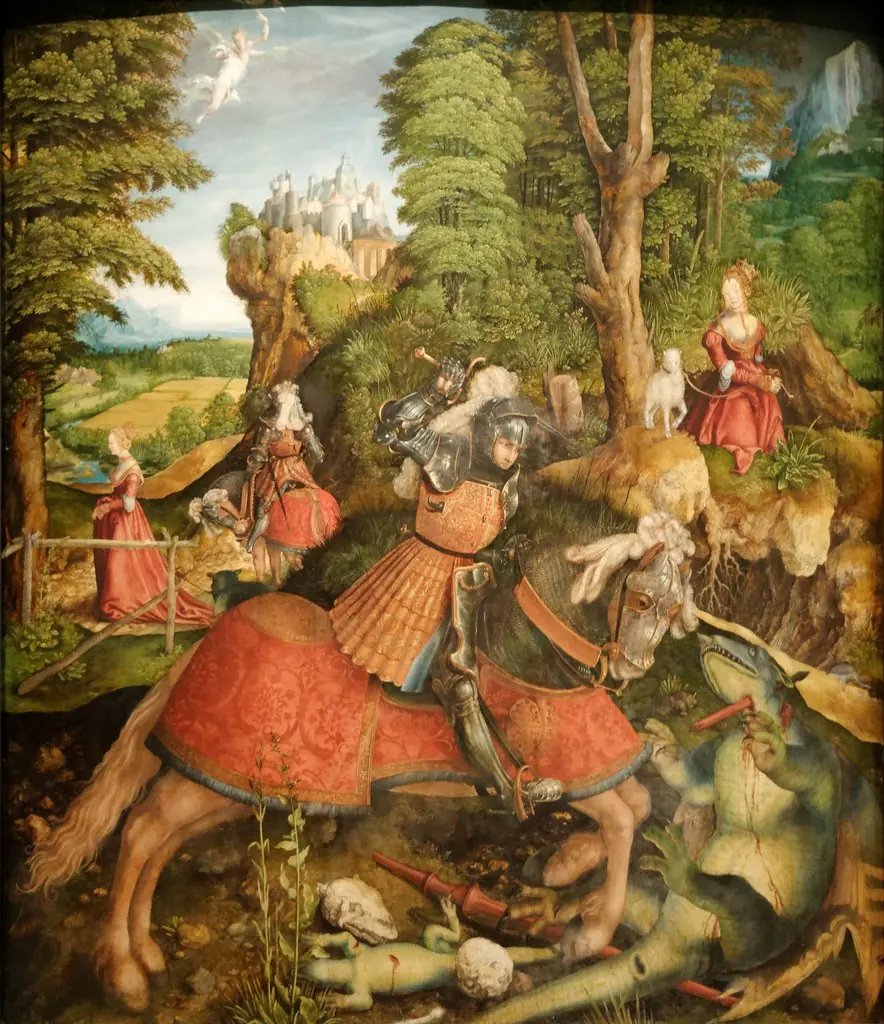
St George Freeing the Princess
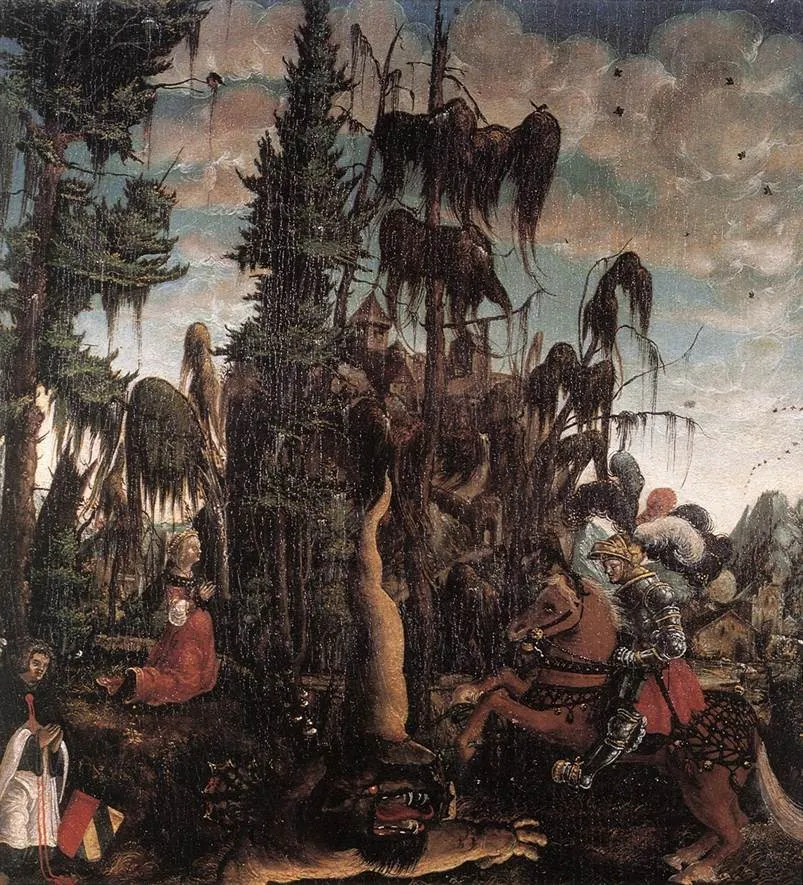
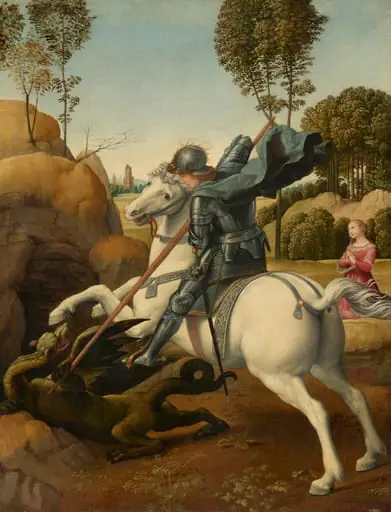
St George Freeing the Princess is an oil painting by the Northern Renaissance artist Georg Lemberger. It dates from 1520 and is held in the collection of the Uffizi Gallery.
About this work
Subject & Meaning
This visionary quality aligns with characteristics of the Danube School, where landscape becomes a vehicle for symbolic meaning rather than mere setting.
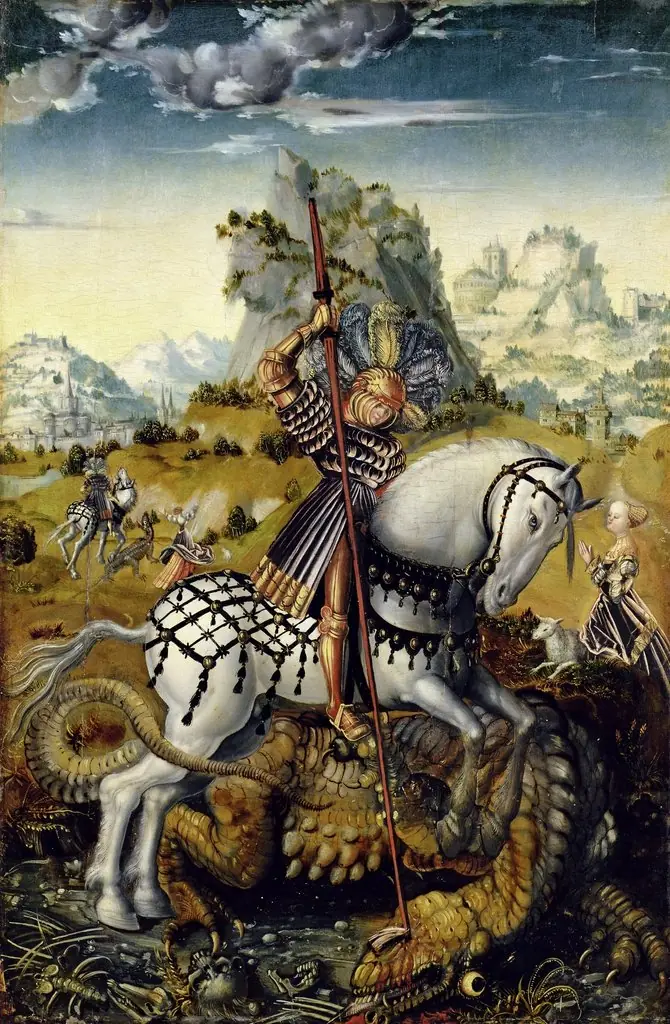
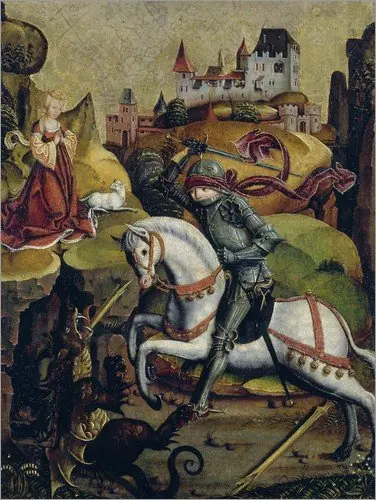
The painting depicts the legend of Saint George and the Dragon, following the traditional iconography in which the saint, armored and mounted, spears a monstrous dragon while the princess kneels in prayer nearby. In the foreground, the ecclesiastic donor appears with his heraldic shield, identified as belonging to the Kapolt family, indicating a votive function.
The composition emphasizes a dense, fantastical forest whose towering, elongated trees rise like spectral apparitions, conveying a dreamlike atmosphere that shifts emphasis from the religious figures to the mysterious forces of nature. This visionary quality aligns with characteristics of the Danube School, where landscape becomes a vehicle for symbolic meaning rather than mere setting.
Technique & Style
The painting is executed in oil on a wooden panel, measuring 19 cm by 18 cm, and is dated to 1520. Lemberger applies oil paint to the panel surface, creating a relatively small‑scale religious composition that exemplifies the Danube school’s characteristic use of fantastical landscape and elongated trees rendered in a dreamlike manner. The formal composition follows the traditional iconography of Saint George and the Dragon, with the saint on horseback poised to strike the dragon with a lance while the princess kneels in prayer to the left; the background features a dense, shadowy forest that dominates the spatial depth and conveys a sense of mystery.
The reverse of the panel bears a depiction of a crowned Christ, and the work’s stylistic details, such as the flowing drapery, the armor of Saint George, and the ethereal foliage, reflect the transitional Mannerist aesthetic of early 16th‑century Central European art.
History & Provenance
The painting St George Freeing the Princess was created by Georg Lemberger in 1520 as an oil on panel work measuring 19 by 18 centimeters. It entered the collection of the Uffizi Gallery in Florence, where it remains today. Historical records indicate that the work was initially catalogued as the product of an anonymous artist in a 1635 inventory and later attributed to Lukas Cranach the Elder in 1825, before being firmly associated with Lemberger.
The painting's reverse bears a depiction of a crowned Christ, and its composition follows the traditional iconography of Saint George defeating a dragon while a kneeling princess watches, reflecting the influence of the Danube School's emphasis on fantastical landscape and symbolic detail.
The small oil-on-panel painting by Georg Lemberger, dated 1520, is held in the Uffizi Gallery in Florence. Its modest dimensions of 19 by 18 cm are recorded in the catalogue entry. Attribution history, documented in the Italian-language source, shows that the work was listed under an anonymous artist in the 1635 inventory and in the 1796 Galleria Giornale; in 1825 it was reassigned to Lukas Cranach the Elder, an attribution that persists in some publications.
The painting is associated with the Donau school tradition, and the kneeling figure in the lower left is identified as the ecclesiastic donor, bearing a coat of arms linked by Conti to the Kapot family. A head of Christ crowned with thorns is recorded on the reverse.
An official catalogue record is available through the Polo Museale Fiorentino website, and an additional entry is hosted by the Web Gallery of Art.
Context
Attribution of this small panel has shifted significantly over time. While early inventories from 1635 and 1796 listed the work as anonymous, an 1825 assessment attributed it to Lucas Cranach the Elder, a classification that persists in some modern publications. Current scholarship identifies Georg Lemberger as the creator, dating the piece to 1520 based on a related woodcut by Wolf Huber.
Art historically, the painting serves as an emblematic example of the Danube School, particularly regarding its treatment of landscape. The composition prioritizes a fantastical, dreamlike forest with elongated, spectral trees over the diminutive religious figures, creating a sense of mystery dominated by natural forces. This approach highlights the symbolic and atmospheric role of nature characteristic of German art from this period.
Overview
Georg Lemberger’s oil on canvas, dated to 1520, portrays the legendary encounter between Saint George and a fearsome beast. The composition centers on a mounted knight confronting a massive, reptilian creature, while a seated woman in red observes from the foreground. Tall, moss‑covered trees frame the scene beneath a turbulent sky, lending the work a dramatic, unsettled atmosphere. The painting is part of the Uffizi Gallery’s collection.
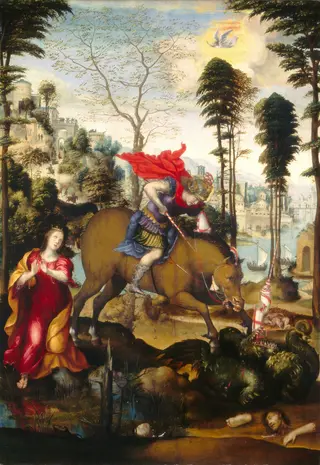
Artist & collection
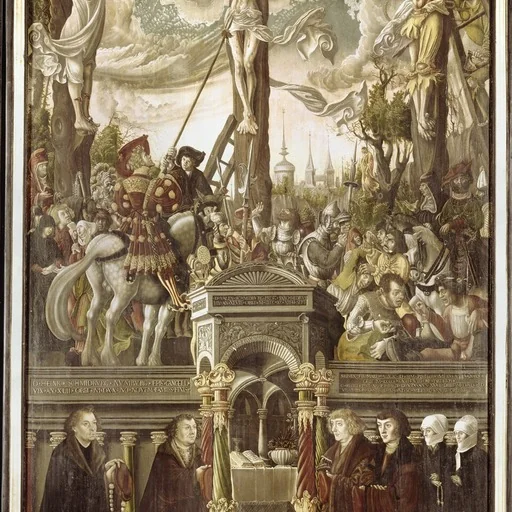

- Saint George and the Dragon
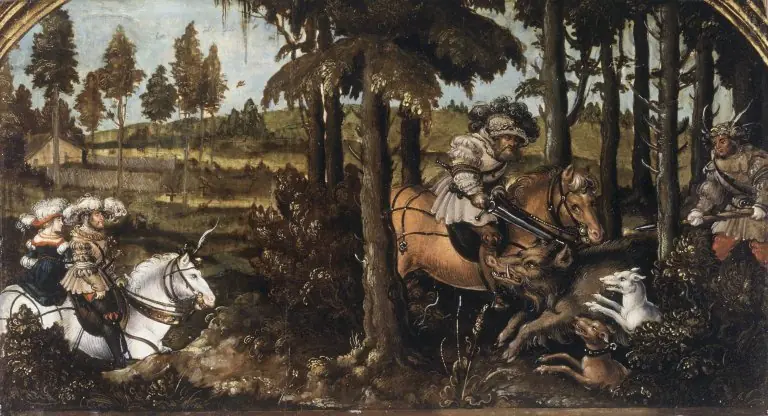 The Boar Hunt
 Saint George fighting the dragon
 Versuchung des Hl. Antonius
 Saint George on Horseback
 Drachenkampf des hl. Georg
 Orpheus with beasts and birds
 Allegory of Virtue
 Temptation of St. Athony
 The Temptation of Saint Anthony
 Atacul hoților
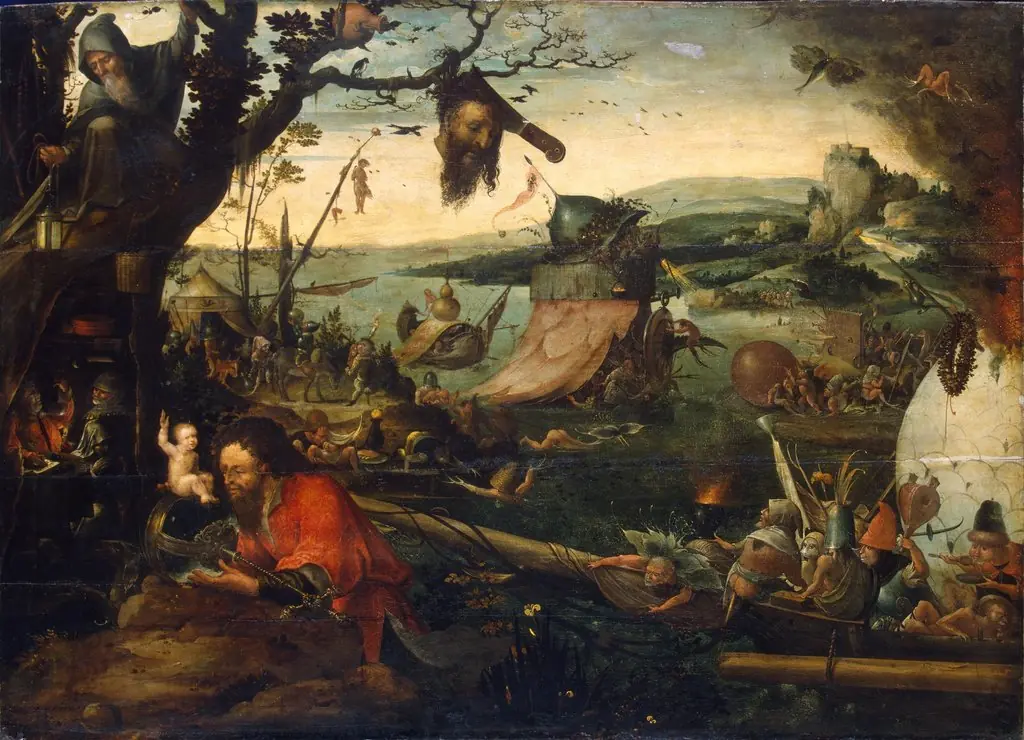 Landscape with the Legend of St Christopher