Artwork
Saint George and the Dragon
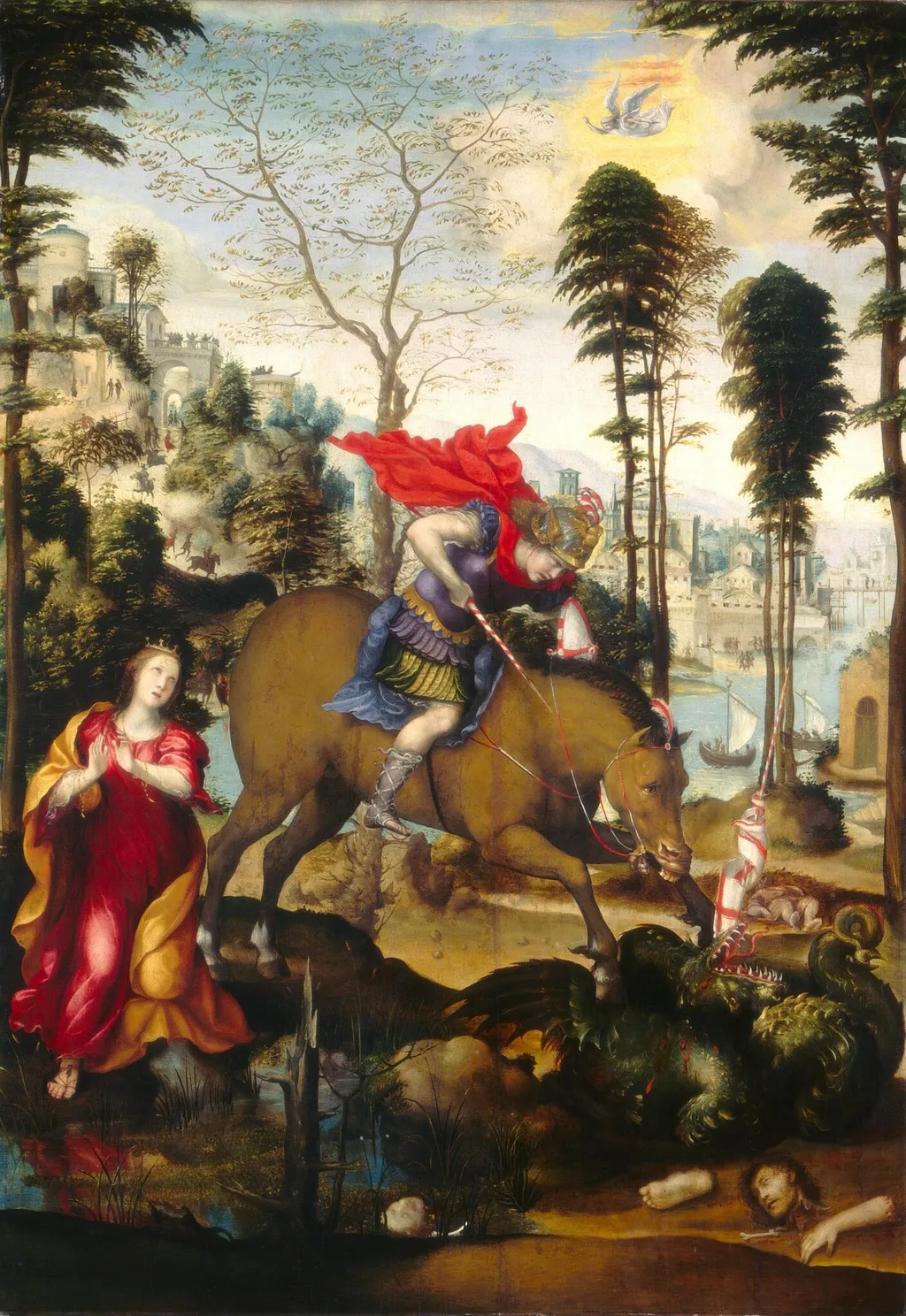
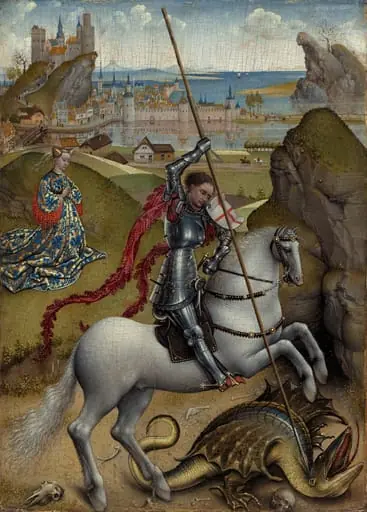
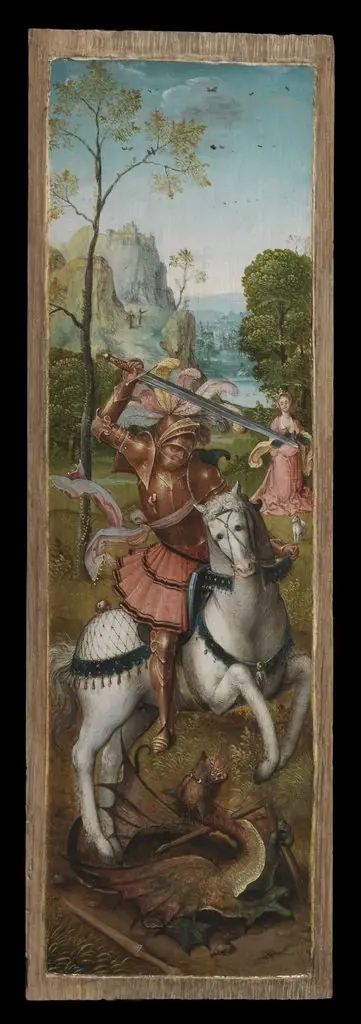
Saint George and the Dragon is a color painting by the High Renaissance artist Il Sodoma. It dates from 1518 and is held in the collection of the National Gallery of Art.
About this work
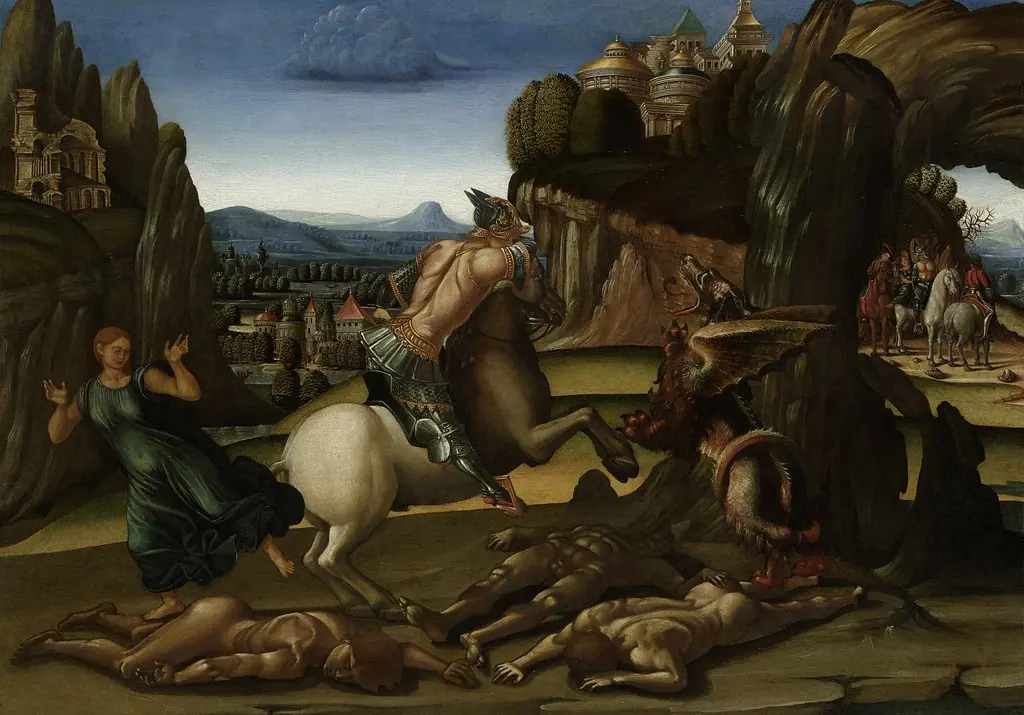
Saint George rides a white horse, driving a long spear into the dragon, which curls small beneath them like a wounded dog, its red tongue lolling out. Sodoma painted it in 1518: the horse's muscles ripple under a glossy coat, the armor shines where light strikes, and the dragon's green scales look wet. Shadows gather behind the figures to push them forward.
Subject & Meaning
The painting’s religious genre reflects Counter‑Reformation emphasis on martial saints as protectors of faith.
Saint George and the Dragon portrays the legendary Roman soldier martyr in the act of spearing a serpentine beast, a motif that embodies the victory of Christian virtue over chaos. In the composition the saint, armored and poised on a rearing horse, dominates the scene while the dragon, rendered with sinuous folds, symbolizes evil and pagan threat. The painting’s religious genre reflects Counter‑Reformation emphasis on martial saints as protectors of faith.
Its provenance traces a lineage from Renaissance patronage in Ferrara through English aristocracy to mid‑twentieth‑century American collectors, culminating in the National Gallery of Art’s acquisition.
Technique & Style
Saint George and the Dragon is executed in oil on panel, a medium typical of Sodoma's Italian Renaissance practice. The work is classified as a painting and belongs to the religious genre. According to Wikidata, the materials are listed as color and panel, consistent with the oil-on-panel support documented in the corpus record.
The painting's dimensions are recorded as 137.8 cm in height and 97.6 cm in width, giving the panel a tall, upright format suited to its figural composition. No further details regarding specific pigments, ground preparation, surface condition, or stylistic handling are provided in the available sources.
History & Provenance
The work, an oil on panel attributed to Sodoma, was probably commissioned around 1518 by Alfonso I d'Este, Duke of Ferrara, and executed in that year. After its creation it entered the collection of an unidentified Sienese dealer, from whom Bertram Arthur Talbot, 17th Earl of Shrewsbury, acquired it in the early 19th century. The painting was sold at Christie's in 1857, entered the possession of John Charles Robinson, and was purchased in 1868 by Sir Francis Cook, whose family retained it for several generations.
The work was later sold by Sir Herbert Cook to the Samuel H. Kress Foundation in 1947 and gifted to the National Gallery of Art in 1952.
Context
Sodoma’s Saint George and the Dragon (1518) reflects the artist’s mature synthesis of Leonardo’s sfumato with Sienese decorative sensibility, a style cultivated during his decade in Rome and reinforced by his ties to the Este court in Ferrara. Commissioned by Alfonso I d’Este, the panel exemplifies the Ferrarese vogue for chivalric religious imagery, aligning with works such as Titian’s contemporaneous mythologies for the same patron. The painting entered English collections in the mid-nineteenth century, passing through the hands of the Earl of Shrewsbury and connoisseur Sir John Charles Robinson before joining the Cook family’s Doughty House holdings, a trajectory that underscores its reception among Victorian collectors as a prime example of High Renaissance narrative painting.
Its later inclusion in the Samuel H. Kress Foundation’s holdings and subsequent gift to the National Gallery of Art, Washington, positioned the work within a twentieth-century canon of Italian Renaissance masterpieces curated for American audiences.
Legacy
The painting remained in the Cook family for three generations before its 1947 sale to the Samuel H. Kress Foundation, a transaction recorded in its provenance and mentioned by John Charles Robinson in 1868, indicating early scholarly notice. Its 1952 gift to the National Gallery of Art placed it in a public collection, where it is listed in the museum’s catalogue as part of the Samuel H. Kress Collection and classified as religious art, reinforcing its reputation as an important example of Sodoma’s work. Documentation in both the Cook family records and the National Gallery of Art’s collection database highlights its continued relevance in art historical discourse.
Overview
Sodoma's painting, Saint George and the Dragon, executed around 1518, is an oil on panel work depicting the legendary Christian martyr. The composition centers on Saint George mounted on a white horse, engaged in combat with the dragon. This religious scene showcases the artist's approach to a traditional narrative, emphasizing the dramatic encounter between the saint and the mythical beast.
Own this work as a print
Artist & collection

Artist
Il Sodoma (1477 – 14 February 1549) was the name given to the Italian Renaissance painter Giovanni Antonio Bazzi.