Artwork
Madonna and Child
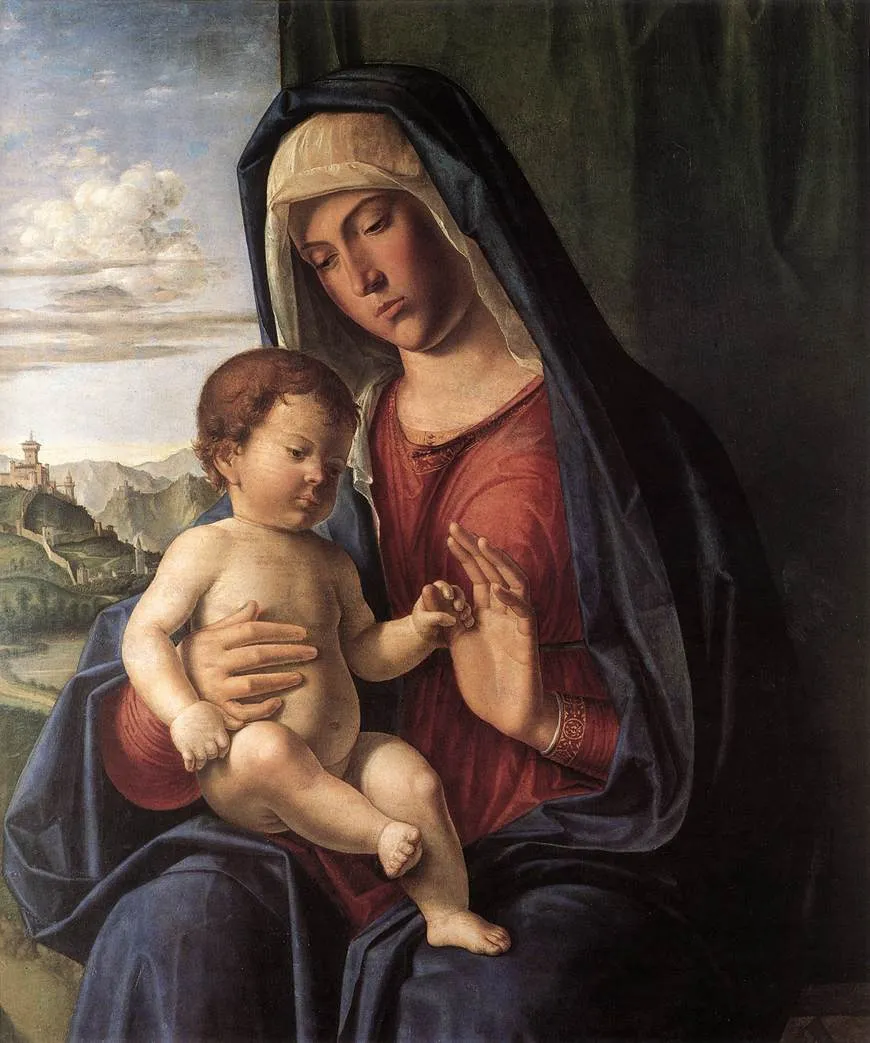
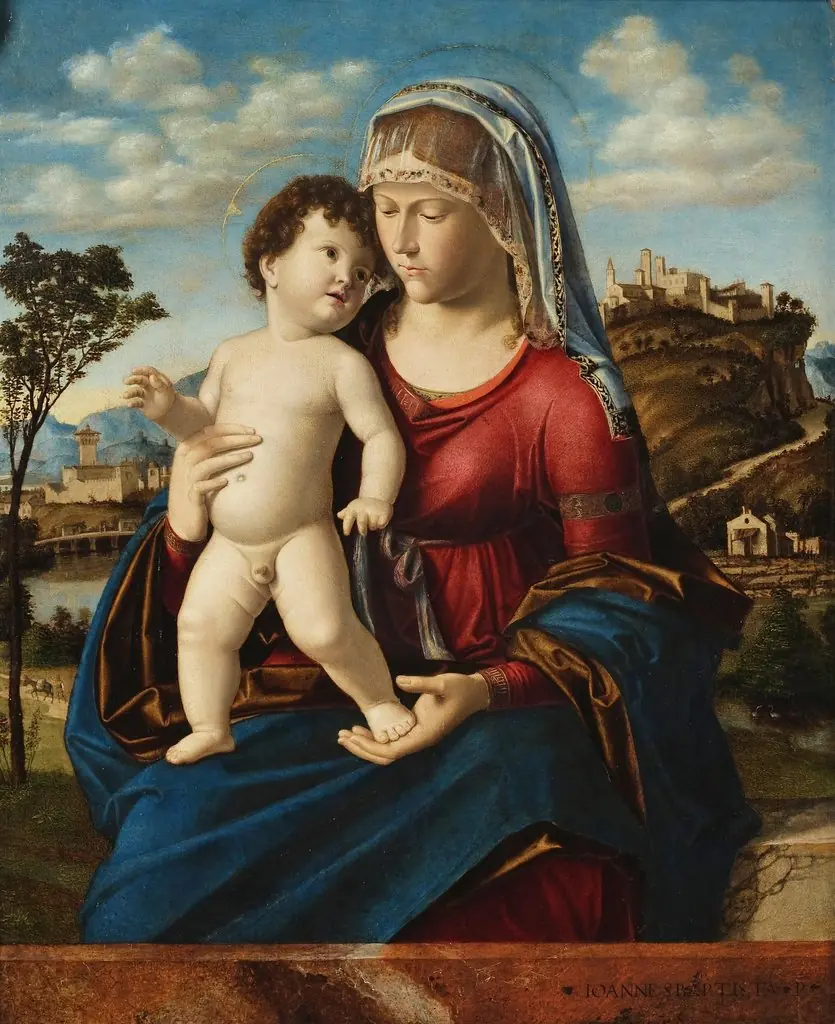
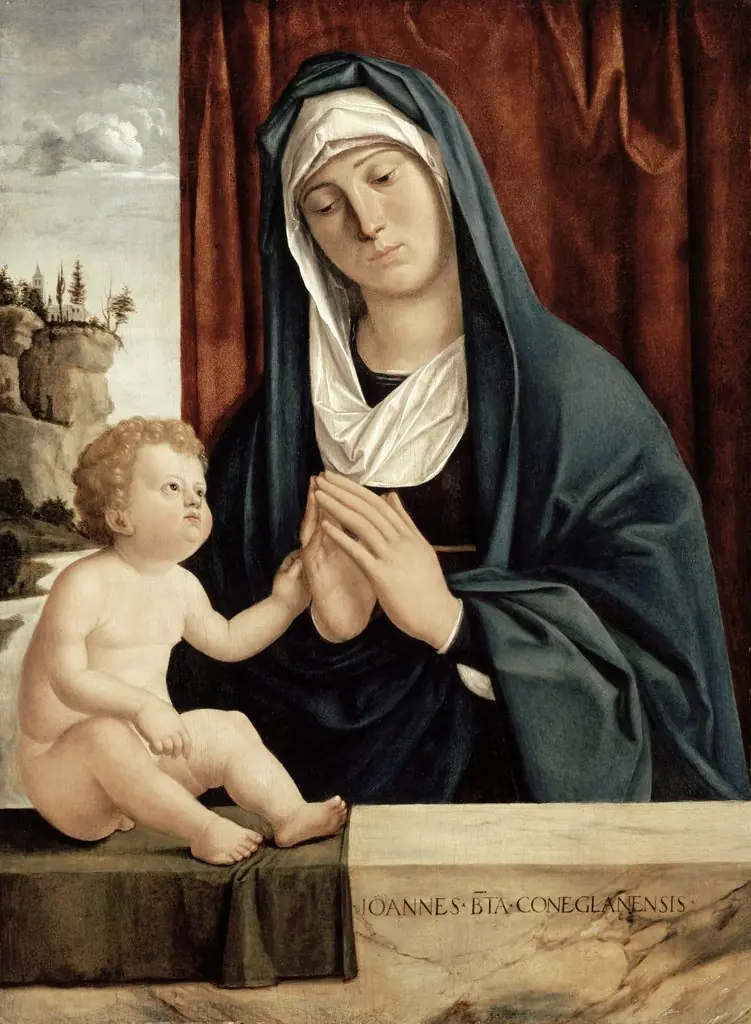
Madonna and Child is an oil painting by the High Renaissance artist Giovanni Battista Cima da Conegliano. It dates from 1504 and is held in the collection of the Uffizi Gallery.
About this work
Overview
Madonna and Child is an oil on panel painting by the Venetian artist Giovanni Battista Cima da Conegliano, created around 1504.
Madonna and Child is an oil on panel painting by the Venetian artist Giovanni Battista Cima da Conegliano, created around 1504. Measuring 66 by 57 centimeters, the work depicts the Virgin Mary holding the infant Jesus on her lap. The painting belongs to the religious genre and is currently held in the Uffizi Gallery in Florence. An early copy of the composition, attributed to Antonio Maria da Carpi, is located in the Musei civici di Padova.
Subject & Meaning
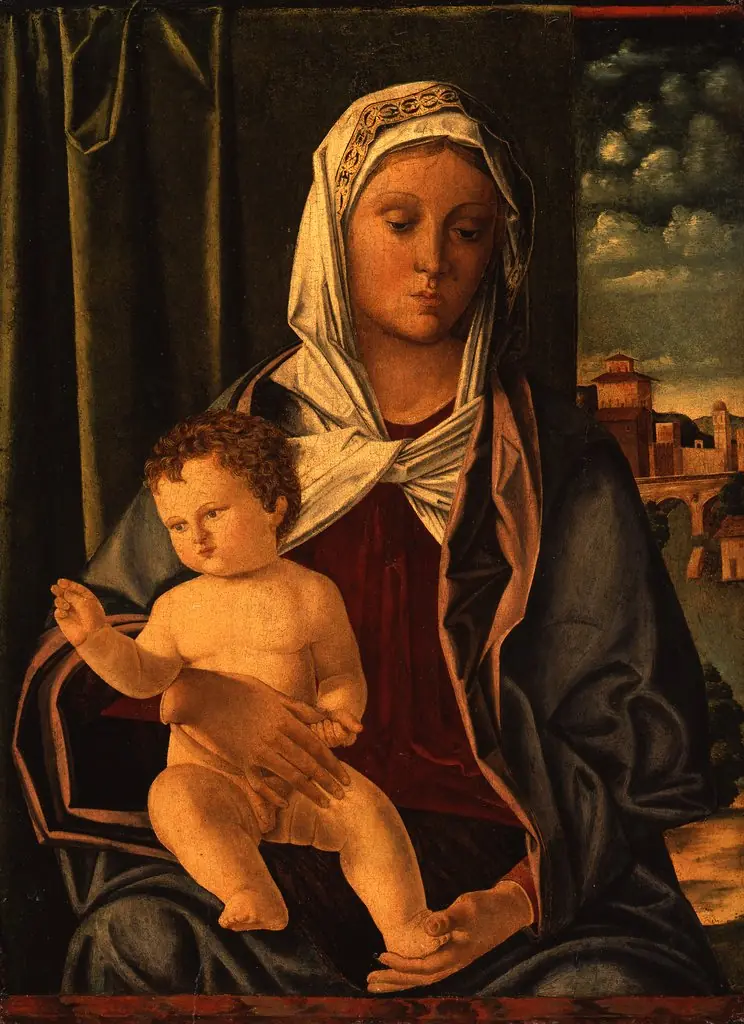
The painting portrays the Madonna seated with the Christ Child resting on her knees. Mary is dressed in a dark blue mantle over a red dress, with a white head covering beneath the mantle that drapes across her shoulders and lap. She supports the child's back with her right hand while raising her left hand, palm facing the infant. The nude Christ Child sits with his legs dangling, his left foot resting on the blue fabric of the mantle, and his right hand reaching toward his mother's fingers. The composition captures a moment of quiet contemplation between mother and child, a hallmark of Venetian devotional imagery.
Technique & Style
Executed in oil on a wooden panel, the painting demonstrates Cima da Conegliano's rich chromatic palette, centered on the contrasting notes of deep blue and crimson red in Mary's garments, warm ochre flesh tones, and green in both the background drapery and the landscape. Light falls from the upper left, illuminating the faces, hands, and the child's body, while shadows deepen smoothly in the curtain and the sculptural folds of the mantle. The surface shows careful rendering and subtle modeling, though the painting retains visible asperities typical of the artist's approach before the Venetian tonalist revolution. These include incisive chiaroscuro in the deep folds of the fabric and a slight awkwardness in the rendering of the Christ Child's body. The overall mood of suspended contemplation derives from the influence of Giovanni Bellini.
History & Provenance
The dating of the work to approximately 1504 is based on its compositional similarity to another Madonna by Cima da Conegliano in the Museo Nazionale Atestino in Este, though the Este variant features the Christ Child squeezing his mother's left thumb. The Uffizi painting suffered from doubts regarding its attribution in the past, with some critics perceiving an excessive severity in the figures. Restorations carried out in 1984 and 2010 revealed the notable pictorial qualities of the work, which are entirely in harmony with the artist's style, leading to its definitive reintegration into Cima's catalog by recent scholarship.
Context
The painting occupies a specific place in the scholarship of Venetian Renaissance art, reflecting broader debates over autograph works versus workshop participation. Bernard Berenson took an intermediate position, considering the painting a youthful work by the artist, while Heinemann argued that only the figures were autograph and the landscape was not by Cima's hand. The recent critical consensus, solidified after the 1984 and 2010 conservation campaigns, affirms the work as fully autograph. The physical type of Mary, the overall composition, and the smooth dark shadows on the face are recognized as typical of Cima's style, bridging the gap between the sculptural rigidity of earlier Venetian painting and the softer atmospheric developments that followed.
Artist & collection
Artist
Giovanni Battista Cima da Conegliano
Giovanni Battista Cima, also called Cima da Conegliano (c. 1459 – c. 1517), was an Italian Renaissance painter, who mostly worked in Venice. He can be considered part of the Venetian school, though he was also…

 Madonna and Child with Saint Jerome and Saint John the Baptist
 Madonna and Child with Saints Francis and Clare
 Virgin and Child with Saints and Donors
 Saints Roch, Anthony Abbot and Lucy
 Saint Helena
 Saint Jerome in the Wilderness
 Virgin and Child
 The Judgement of Midas. The Musical Contest between Apollo and Marsyas